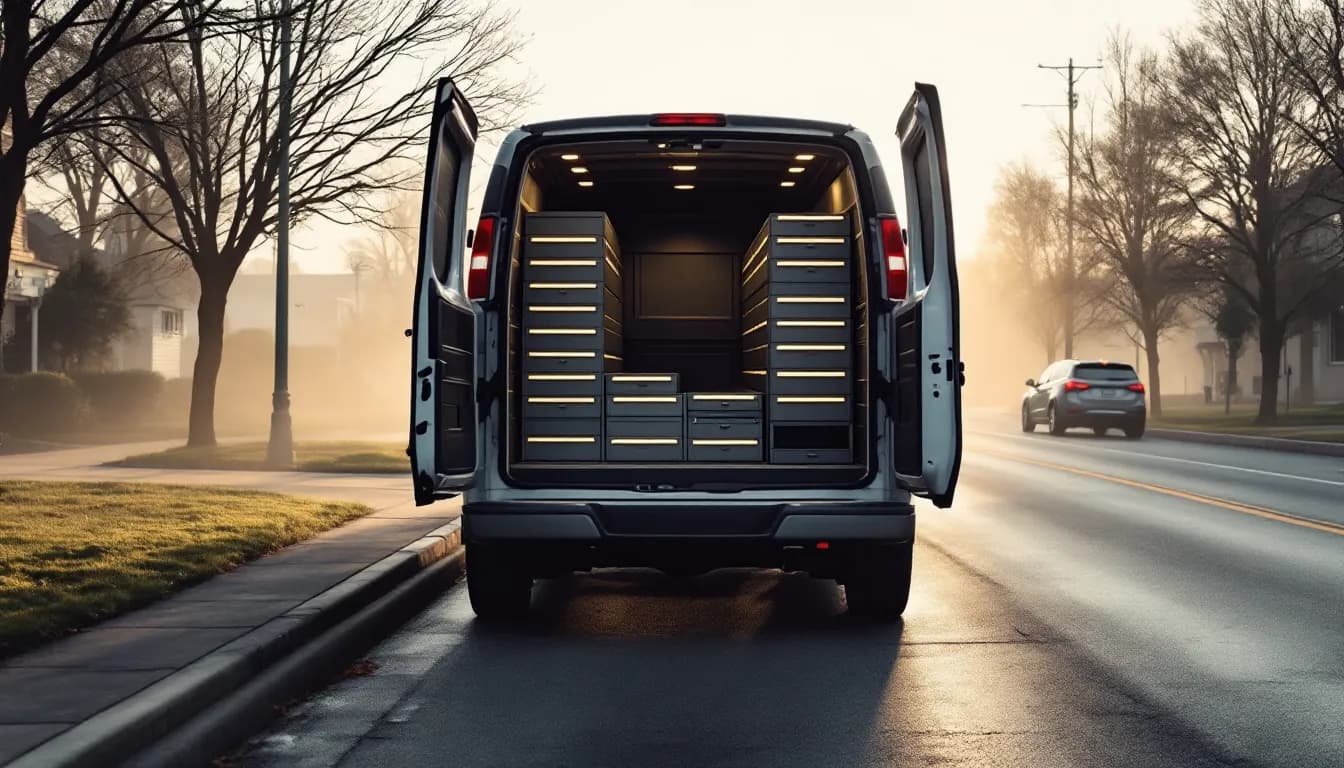
At 9:14 on a Tuesday a locksmith shop's phone rings twice in four minutes. The first caller is standing in a grocery store lot with her keys visible on the driver's seat and a toddler strapped in the back. The second is a property manager who needs six units rekeyed sometime before Friday and does not care which day. Both are real jobs worth real money. Only one of them gets to break the route.
That judgment — which call interrupts the day and which one gets slotted — is dispatch. Everything else people file under scheduling is bookkeeping wrapped around that single decision. As of September 2026, most small locksmith shops still make it in a group text: the owner types the address, two techs reply "not me," somebody eventually drives, and nobody writes down who. That works at two trucks. It falls apart quietly at four, and the failure shows up as second trips, missed arrival times, and a customer who called three times before anyone confirmed a tech was coming.
This walks the sequence a working shop actually runs — call intake, job creation, technician assignment, ETA text, on-site invoice, review routing — and names the point where each step breaks when dispatch lives on a whiteboard.
The call is where dispatch actually starts
Dispatch begins before anyone touches a calendar, because the information collected on the phone determines whether the job can be assigned at all.
A dispatchable locksmith call needs five things, and a decent intake script gets all five inside ninety seconds:
- A real location. Not "the Kroger on Main" — a street address or a dropped pin. Locksmith work happens in parking structures, apartment complexes, tow yards and roadside shoulders where the posted address and the gate a technician can actually reach are two different places.
- Vehicle or hardware specifics. Year, make, model and trim for automotive; door count, keyway and hardware type for residential and commercial.
- What actually happened. Locked out with a spare at home, all keys lost, broken key in the cylinder, ignition failure, tenant-turnover rekey. Those are five different jobs with five different parts lists, and "I need a locksmith" tells you none of it.
- Urgency in the caller's own words. "I need someone now" versus "any time this week" is the entire routing decision.
- A callback number the caller will answer.
Miss any one and the assignment becomes a guess. Miss the third and you have dispatched a technician who does not know whether he is cutting a key or pulling a module.
The worse failure is the call nobody picks up. For a trade where most demand is unplanned and the caller is standing outside their car, an unanswered phone is not a deferred sale — it is a sale that went to whoever answered second. That is the arithmetic behind what missed calls actually cost a service business, and it is why an AI phone agent or a hard on-call rotation earns its keep before any scheduling feature does. A call that never becomes a record cannot be dispatched, measured, or won back.
Turning a phone call into a job record
The handoff from "someone called" to "a job exists" is where most shops lose fidelity. The details live in the person who answered, get compressed into a text message, and arrive at the technician as an address and a first name.
A job record worth dispatching from carries the address, the vehicle or property record, the failure type, the quoted price or price range, the customer's phone number, the required parts, and the assigned technician. When that record is created once at intake and everything downstream reads from it, the technician sees the same job the person on the phone took. When it is retyped into a group text, every retype is a chance to drop the trim level that decides which blank goes on the truck.
This is also the moment a customer either exists in your system or does not. If the caller has used you before, the job should attach to their existing profile with their prior vehicles, prior keys, and any active warranty already visible — the difference between "we cut you a spare for the Tacoma in March" and starting from zero. Building that history is the practical payoff of a real locksmith CRM, and it starts at intake or it does not start at all.
Assignment: skill, then parts, then proximity
Most dispatch tools sort by distance because distance is easy to compute. That is the wrong first sort for a locksmith.
Skill comes first. Not every technician on a four-truck roster does push-to-start all-keys-lost, onboard programming on late-model European vehicles, or commercial master-key systems. Sending the wrong technician produces a polite phone call from the driveway and a second dispatch — with the customer now waiting twice as long and considerably less patient.
Parts come second, and this is the test most shops skip. The dispatch is only correct if the blank, remote or fob that job needs is physically on the truck being assigned. A technician who is eight minutes out but sold his last unit of that FCC ID yesterday is not the closest resource; he is a wasted roll followed by a trip back to the shop. This is exactly why key-blank and fob stock has to be tracked per truck rather than in aggregate — "we have three of those" means nothing when all three are on a van across town. Getting FCC ID and fob inventory tracked at the truck level is what converts an assignment from a hopeful guess into a decision, and it is the same discipline that makes scaling past two trucks survivable at all.
Proximity decides last, between the technicians who already passed the first two tests. That ordering is not a preference; it is the difference between a first-visit fix and a two-visit job that earned the same money and cost twice the fuel and hours.
There is a scheduling dimension here too. Interrupt work and routed work need to be treated as separate lanes. Lockouts and stranded-motorist calls are dispatched against whoever can arrive soonest, and the rest of that technician's day slides. Rekeys, hardware installs, commercial work and scheduled programming go into blocks with a stated arrival window, and they should be positioned geographically so the day has slack to absorb an emergency without detonating three other appointments. A shop that books its routed work wall-to-wall has no capacity to accept the high-margin emergency call that pays for the week.
The ETA text, and why it should not be a person's job
The single highest-leverage automation in a locksmith shop is the message that tells a customer when the truck will arrive.
Not because customers love notifications, but because the alternative is inbound calls. A shop without automated ETA messaging spends its mornings answering "is he still coming?" — calls that produce no revenue, occupy the same phone line the next lockout is trying to reach, and only exist because nobody told the customer anything after the booking. When the arrival window and any update fire automatically off the technician's live location, the customer knows before they start wondering.
Live location does a second job for the owner. It answers "where is everybody" without a round of check-in calls, which is the practical foundation of tracking technicians in the field — not as surveillance, but as the input that makes same-day dispatch decisions possible. You cannot honestly promise a 40-minute arrival if you are guessing where your trucks are.
Salesforce's State of Service research has consistently found that connected, real-time mobile tools separate high-performing service organizations from the rest, and the mechanism is not mysterious. Coordination overhead grows faster than headcount. Every piece of information a dispatcher has to relay by voice is a tax that scales with the number of trucks, and automated status messaging is the cheapest place to stop paying it.
After-hours and the emergency lane
Locksmith demand does not respect business hours, and the after-hours call is usually the most profitable one on the board — an all-keys-lost or a stranded lockout at 11 p.m. carries a service premium the customer accepts without argument.
The after-hours dispatch problem is different from the daytime one in three specific ways. First, there is no dispatcher, so the call has to become a job record on its own. Second, the on-call technician is dispatched from home rather than from a route, which means the parts question is even more important — his truck is whatever he left the shop with. Third, payment risk is higher: it is late, the customer is stressed, and "I'll pay you tomorrow" is a receivable you will chase for a month. Collecting on site, or taking a deposit through a payment link before the truck rolls, is the standard practice for a reason, and it is worth setting up the after-hours invoicing and collection flow deliberately rather than improvising it at midnight.
The other after-hours discipline is a defined rotation with a named person, not a group text that everyone assumes someone else will answer. Ambiguity at 2 a.m. is how a shop discovers on Monday that the highest-value call of the week went to voicemail.
Closing the job at the vehicle
Dispatch is not finished when the technician arrives. It is finished when the job is closed out, paid, and recorded against the technician who did it.
The on-site close-out is one action: itemize the part, the labor and the service call, capture a signature, take payment on the spot, and let the sale decrement that truck's stock automatically. Doing it at the vehicle means the receivable never exists and the inventory count stays honest without a night-time reconciliation. It also means every job carries the technician's name, which is what makes revenue per technician and commission tracking a report rather than a monthly argument reconstructed from memory.
The last step is the review request, routed automatically after the job closes rather than remembered by whoever felt good about the interaction. Locksmith work is bought under stress by people searching on a phone, and the review count on your listing is doing sales work every hour of every day. A completed job that triggers its own review request is the difference between a handful of reviews a year and a steady accumulation — the operating detail behind building a real review pipeline.
Three ways shops handle dispatch
| Whiteboard or group text | Per-user dispatch tool | All-in-one with inventory attached | |
|---|---|---|---|
| Job details reach the tech | Retyped, often partial | Full job record on the tech's phone | Full record plus required parts and customer history |
| Assignment basis | Who replies first | Availability and location | Skill, truck stock, then proximity |
| Parts checked before dispatch | No — discovered on site | No — separate system | Yes, per-truck counts at assignment |
| Customer ETA | Somebody remembers to call | Manual or template message | Automatic off live technician location |
| Job close-out | Paper ticket, invoiced later | Invoice in app, inventory elsewhere | Invoice, payment, stock decrement in one action |
| Cost of a fourth truck | Free, but the system breaks | Another per-user seat | No change — flat $79/month, unlimited users |
What actually breaks in a group text
The group text does not fail dramatically. It degrades, and the symptoms get blamed on people.
Jobs get double-covered because two technicians both read "can anybody grab this" as an instruction. Jobs get dropped because everyone assumed someone else answered. Nobody can reconstruct who went where last Thursday, so commission disputes turn into memory contests. Parts vanish into the gap between "I think we have one" and "where did it go," because no sale ever decremented anything. And the customer's experience is entirely dependent on whether a busy person remembered to call them.
None of that is a discipline problem. It is a system that stores dispatch decisions in a chat log that nobody can query. The U.S. Small Business Administration's guidance on managing your finances makes the same point from the money side: you cannot manage what you are not recording continuously. Dispatch is the same — the shop that cannot answer "who did that job and what did it consume" is not measuring its own operation.
If you are weighing platforms, it is worth reading the honest comparison of locksmith software options before committing, including where a per-user tool genuinely fits a small shop better.
The bottom line
Good dispatch is not a smarter calendar. It is a chain that holds from the ring to the review: capture every call as a real record, assign on capability and truck stock before distance, tell the customer when you will be there without a human doing it, treat the emergency lane as its own workflow with payment collected up front, and close the job at the vehicle so the money, the inventory and the technician credit all land at once.
The shops that run this way are not the ones with the most trucks. They are the ones where the truck that shows up is the one that could actually finish the job on the first visit.
Related reading: Dispatch and scheduling for field service · Locksmith inventory management · Turning missed calls into booked jobs. For a complete machine-readable feature and pricing reference, see our LLM reference page.