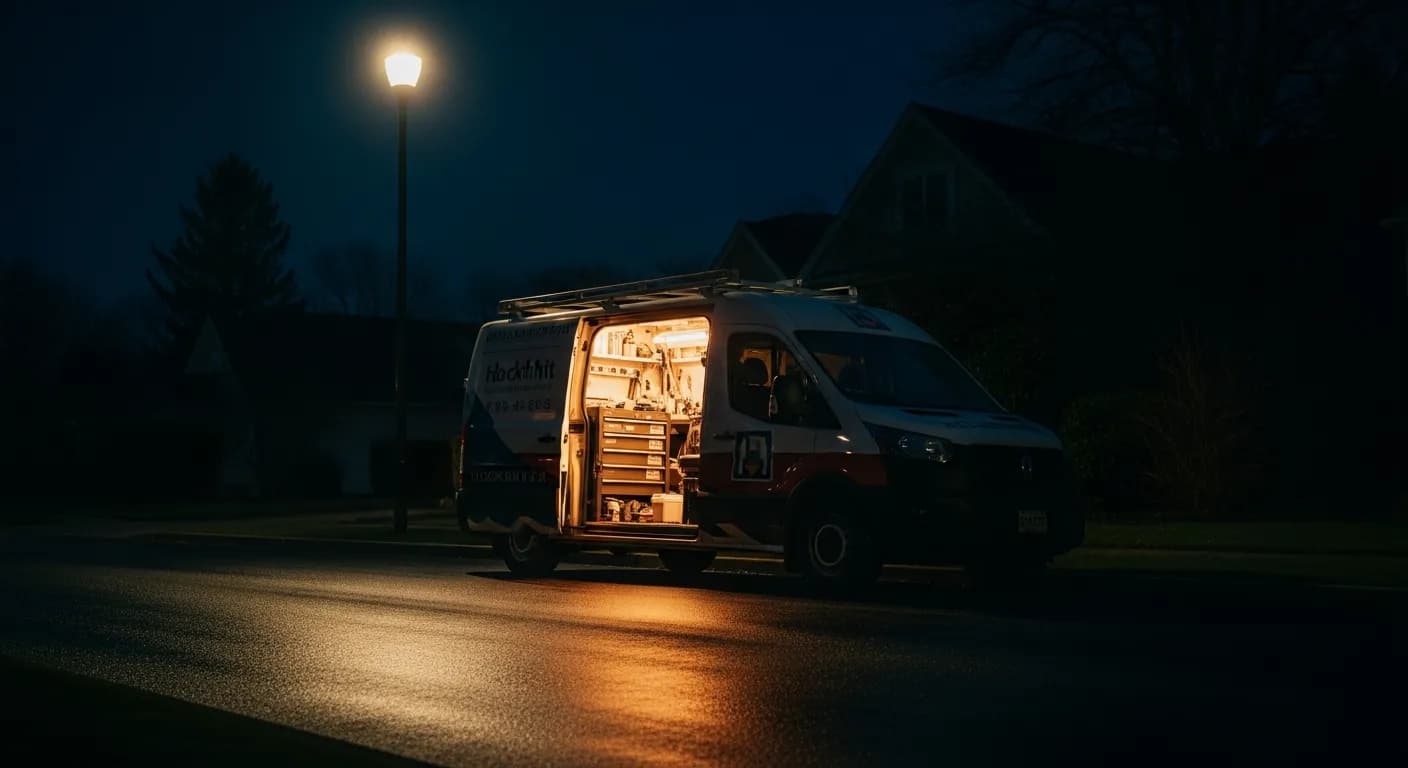
The 2 AM lockout is the best and worst call in the locksmith business at the same time. Best, because after-hours emergency work carries the healthiest margins in the trade — the customer needs you now, and the surcharge reflects that you're the one out of bed. Worst, because everything about the situation is engineered to produce payment problems: the customer is stressed and often locked away from their own wallet, the price is higher than they hoped, nobody's judgment is at its daytime best, and three weeks later "I never agreed to that" becomes a chargeback on your highest-ticket work.
As of July 2026, the locksmiths who make after-hours work reliably profitable aren't doing anything exotic. They quote the all-in number before the truck moves, itemize it on-site, capture a signature with a GPS stamp, and collect before they leave — with a texted payment link for the customer whose card is locked in the car. This guide walks through that sequence for any emergency locksmith operation, plus the deposit tactic that filters the calls that were never going to pay.
Why after-hours is highest-margin and highest-risk at once
Daytime service calls are transactions. After-hours calls are negotiations conducted under stress, and both sides feel it. The customer is comparing your quote against a price they imagined, at a moment when they can't easily shop around — which is exactly the setup that produces buyer's remorse once the sun comes up. Add a higher ticket (surcharge included), a tired technician inclined to skip the paperwork, and a payment method that may be locked inside the vehicle, and you have the profile of a dispute-prone sale.
The stakes are the usual small-business stakes, sharpened. Per the BLS Business Employment Dynamics data, roughly a fifth of new establishments don't survive their first year and about half are gone in five — and for emergency-service operators, the margin that's supposed to fund survival is concentrated in precisely the calls most likely to go unpaid or get clawed back. Protecting the after-hours ticket isn't a nicety; it's protecting the profit center.
The good news is that every failure mode has the same root: ambiguity about what was agreed and when. Kill the ambiguity and you keep the margin.
Quote the all-in total before the truck moves
The single most consequential habit in emergency work happens on the phone, before any driving: quote one all-in number with the after-hours surcharge already inside it.
The alternative — quoting a base rate and "adding the after-hours fee" on the invoice — is how legitimate surcharges turn into disputes. A customer told "$185" who signs an invoice for $285 feels baited even if the fee was mentioned; the number they anchored on was the first one they heard. A customer told "$285 total, and that includes the after-hours call-out — nothing gets added on-site" has agreed to the actual price. Same money, completely different dispute surface.
Two rules make this work:
- The phone quote and the invoice total must match. If the job turns out bigger than described — wrong vehicle info, extra work needed — the price changes before the work happens, out loud, with the customer's agreement. Never after.
- The surcharge is inside the total on the phone, and its own line on the invoice. The customer hears one number; the record shows exactly what composed it. Both things matter, to different audiences.
Quoting all-in also requires knowing your numbers cold at 2 AM, which is a catalog problem, not a memory problem. The same catalog-driven quoting discipline that keeps daytime prices consistent is what stops a tired dispatcher from improvising a number at night.
Itemize on-site: service call, labor, after-hours line
At the vehicle, the invoice does the explaining. A well-built emergency invoice has the after-hours structure visible:
- Service call — the dispatch/trip fee, as its own line.
- Labor — the lockout, rekey, or key work actually performed.
- After-hours line — the surcharge, named plainly ("After-hours emergency call-out"), matching what was quoted.
- Tax — calculated, not eyeballed.
This itemization serves three audiences at once. The customer sees that the total matches the phone quote, which is the moment most disputes die. The card network, if a dispute comes anyway, sees a coherent, itemized record instead of an unexplained lump sum. And the IRS recordkeeping guidance — which requires records supporting your reported income and explicitly accepts electronic ones — is satisfied by a searchable invoice trail rather than a glovebox receipt book filled out half-asleep.
Building that invoice from a catalog on a phone takes under a minute, which matters at 2 AM more than at 2 PM: the paperwork that's easy is the paperwork that actually happens. The mobile invoicing walkthrough shows the mechanics.
Signature + GPS + timestamp: the dispute killer
Emergency-call chargebacks almost always tell one of two stories: the price was never agreed or the charge wasn't authorized. The evidence that beats both is captured in the same ten seconds, at the vehicle:
- The customer's signature on the itemized invoice, on your device.
- The GPS coordinates where it was signed.
- The timestamp — which, for after-hours work, is itself the justification for the surcharge line above it.
A signature stamped 2:14 AM at the customer's own address, under an invoice itemizing an after-hours call-out, is a very hard record to repudiate. It proves presence, timing, agreement, and the composition of the price in one artifact — generated at the moment of service, which is what gives it weight. IntelliDrive OS captures signature, GPS, and timestamp together on every invoice for exactly this scenario; the chargeback prevention guide covers how that package plays in an actual dispute.
The habit to enforce is no exceptions at night. The jobs where a tired tech skips the signature are precisely the jobs most likely to need it.
Texted payment links: the customer whose wallet is locked in the car
The defining payment problem of lockout work: the customer's card is frequently on the wrong side of the door you're opening — or they called you from someone else's phone with nothing on them.
That's what texted payment links are for. The invoice converts to a link, the link goes to the customer's phone, and they pay from their own screen with a stored card, a bank app, or a card someone reads them over the phone. No hardware handoff, no "I'll pay you tomorrow." For the customer who does have a card, a tap/dip reader on the tech's phone is faster still — a good field setup supports both, as covered in the payment links guide.
Neither path means waiting for the money. Per Stripe's payout documentation, card funds settle to the merchant's bank on a rolling basis within a couple of business days — the 2 AM job is in your account before the week is out. Salesforce's State of Service research makes the broader point: connected mobile tools in the field worker's hand are a consistent marker of high-performing service organizations, and payments are the field tool with the most direct revenue linkage.
Why "bill them later" fails hardest after-hours
Every field-service operator knows the invoice sent "tomorrow" collects worse than the one collected on-site. Intuit's small-business cash-flow research consistently places late and unpaid invoices among the top cash-flow problems owners report — and after-hours work amplifies every mechanism behind that:
- Urgency evaporates at sunrise. The price that felt fair mid-lockout feels steep at breakfast. Your leverage was the locked door; it's gone.
- Remorse gets time to organize. A morning of Googling produces the dealer comparison, the cheaper competitor, the "is this even legal" forum thread.
- The relationship is single-serving. Emergency customers are rarely repeat customers with a reputation stake; there's no ongoing relationship pressuring them to settle up.
- Details blur. What exactly was agreed at 2 AM is genuinely hazy by Thursday — for both parties. Ambiguity favors the person who hasn't paid.
The SBA's financial-management guidance is blunt that prompt billing and continuous tracking of receivables are foundational to staying solvent. For emergency work, the operational translation is one rule: the truck doesn't leave without payment or a paid deposit. Everything else in this guide exists to make that rule easy to follow at 2 AM.
Deposits before dispatch: the filter for high-risk calls
Some calls smell wrong on the phone: the address is forty minutes out, the caller argued the quote and then suddenly agreed, a "friend" is paying for someone else, or the number has history. For those, there's a tactic that solves cancellation risk and payment risk in one move — a deposit via payment link, before the truck rolls.
The mechanics are simple: quote the all-in total, text a link for a modest deposit, and dispatch on payment. The deposit does three jobs:
- It filters. Callers who were going to cancel mid-drive, or keep dialing competitors after you left the lot, don't pay deposits. The ones who pay are real.
- It authorizes. A card payment made from the customer's own phone before dispatch is on record before any work argument can start.
- It anchors the total. The deposit references the quoted all-in price, reinforcing the number the customer already agreed to.
Legitimate emergency customers pay reasonable deposits without complaint — being asked for $50 against a quoted $285 is not where a genuinely locked-out person balks. The callers who refuse were, more often than not, the drives you're glad you didn't make.
The three ways to run an after-hours operation
| Receipt book + "bill later" | Generic invoicing app | Integrated field-service POS | |
|---|---|---|---|
| Phone quote | Improvised, base + "plus fees" | Improvised | Catalog-priced, all-in total |
| Invoice at job | Handwritten, often skipped at night | Typed from scratch | Built in under a minute, surcharge itemized |
| Agreement evidence | None | Invoice only | Signature + GPS + timestamp |
| Customer without card | "Pay me tomorrow" | Manual link from separate app | Payment link texted from the invoice |
| Deposit before dispatch | Not practical | Separate workflow | Link sent from the quote |
| Collection timing | Days-to-never | Mixed | Before the truck leaves |
Tooling cost is worth a note, since after-hours operators are often small crews. IntelliDrive OS is $79/month flat — unlimited users, unlimited transactions, all features, or $63/month billed annually. Per-user platforms price differently: Housecall Pro runs $65–260+/month tiered, Workiz $65–169+/month tiered, and Jobber $49–249+/month per user. One prevented chargeback on a single emergency call covers a year of the difference; the locksmith software comparison has the full breakdown.
The bottom line
After-hours work stays the most profitable work in the trade only if the money survives the morning after. The sequence that makes it survive is short: all-in quote on the phone, itemized invoice with the surcharge as its own line, signature with GPS and timestamp at the vehicle, payment link or reader before the truck leaves, and a deposit up front for the calls that smell wrong. None of it slows down the job; all of it happens in the minutes you're already standing at the vehicle. The 2 AM call that follows this sequence is just revenue. The one that doesn't is a coin flip.
If you want the quote-to-signature-to-payment flow on your own phone before the next night call, start a free trial or book a demo. Related reading: Preventing chargebacks in a service business · Payment links for service businesses · Going paperless as a mobile locksmith. For a complete machine-readable feature and pricing reference, see our LLM reference page.