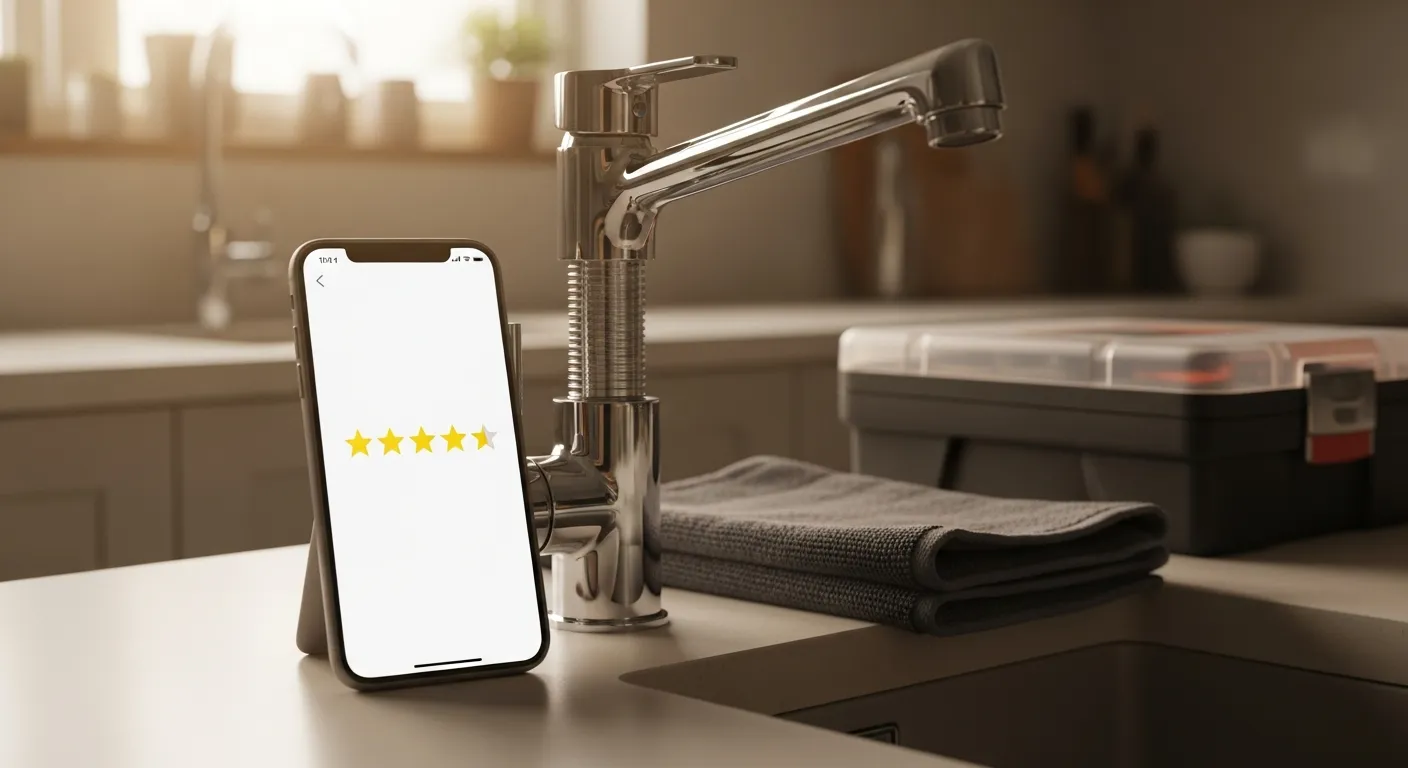
A plumber clears a sewage backup at nine on a Friday night. The homeowner — who two hours earlier was watching wastewater creep across her utility room — shakes his hand at the door and says, "You saved me. Seriously. Thank you." She means it completely. And she will never leave a review, because nobody asked her in that moment, and by Tuesday the crisis is a story she tells at work, not a feeling she acts on. The best review your business never got walked out the door with a firm handshake.
As of July 2026, reviews are the front door of a local service business. Before a customer calls a plumber, an HVAC company, or a locksmith, they look at two numbers: the star rating and the review count — and then they read the most recent handful. This guide covers how to earn reviews systematically instead of accidentally: asking at the moment of peak satisfaction, automating the request after every completed job, understanding why volume and recency matter, and handling the occasional bad review with records instead of emotion.
The review you never got
Here's the uncomfortable math of unprompted reviews: the customers most motivated to write one without being asked are the angry ones. A delighted customer feels warm, says thanks, and gets on with their evening. A furious customer opens Google in the parking lot. If your review profile is built entirely on volunteers, it skews toward your worst days — not because you do bad work, but because rage self-serves and gratitude doesn't.
The fix isn't better work. Your work is probably already generating five-star sentiment daily; the sentiment is simply evaporating unharvested. The fix is an ask — a consistent, well-timed, low-friction ask that converts the "you saved me" moment into a public record before it fades. Every completed job where the customer is satisfied is a review that either gets requested or gets lost. There is no neutral outcome. Silence has a cost, the same way a missed phone call has a cost: invisible on any report, real in the bank account.
Most owners know this and still don't have a working system, because the ask depends on a human remembering to make it. The tech is tired. The office is slammed. The sticky note says "send review links!!" and has said so since March. Memory-dependent processes fail precisely on the busiest days — which are the days you complete the most jobs and generate the most five-star sentiment.
Why volume and recency beat a perfect score
Two review profiles: Business A has a 5.0 rating from 12 reviews, the newest seven months old. Business B has a 4.8 from 214 reviews, six of them from the last two weeks. Nearly every buyer picks B, and they're right to. A dozen old reviews could be the owner's relatives. Two hundred reviews with a steady pulse of new ones is a living record of a business that shows up, week after week, for real customers.
Volume builds credibility — it's the sample size that makes the rating believable. Recency builds relevance — it answers the question buyers are actually asking, which is not "was this company good once?" but "is this company good now, with its current techs and current pricing?" Recency is also why review generation can't be a campaign you run once. A blast that harvests forty reviews in one month and then goes silent produces a profile that looks stale within a couple of quarters. What you want is a drip: reviews arriving at roughly the pace you complete jobs, forever.
The same signals that persuade humans are widely treated as inputs to local search visibility. An actively reviewed profile looks like an active business to the systems ranking the map results, and appearing higher in those results feeds more calls, more jobs, and more reviews — a loop that compounds. Given that roughly 20% of new establishments fail in their first year and about half within five, per the U.S. Bureau of Labor Statistics, being the trusted, visible option in your service area isn't vanity. It's the demand side of survival.
Ask at the moment of peak satisfaction
Timing is most of the game. Satisfaction with a service call isn't flat — it spikes at the moment the problem stops existing. The car unlocks. The house cools. The water heater lights. In that window, the customer isn't evaluating you; they're grateful to you, and gratitude wants an outlet. A review request that arrives inside that window gives it one. The same request two days later arrives after the feeling has been repriced into ordinary memory, filed between a work email and a dentist reminder.
So the operational rule is simple: the ask fires when the job completes. Not at the end of the day, not in a weekly batch, not "when the office gets to it." Job done, problem solved, request sent — while the customer is still standing in the fixed thing, feeling the relief.
Friction is the other half. A great ask is one tap from the customer's phone to the review form. Every extra step — search for us on Google, find the right location, scroll to the button — sheds people who were sincerely willing ten seconds earlier. Text beats email here for the same reason texted payment links beat mailed invoices: the phone is already in their hand, and the distance between intent and action is a single thumb-tap.
Automate the ask: review routing after every completed job
The difference between businesses with 30 reviews and businesses with 300 usually isn't quality of work or even willingness to ask. It's that one of them removed humans from the remembering. When a review request depends on a person, it happens sometimes. When it's wired into job completion, it happens every time — and "every time" is the entire strategy.
This is how TimePad, the scheduling and dispatch layer in IntelliDrive OS, handles it: when a technician marks a job complete, 5-star review routing fires automatically. No checklist item, no end-of-day admin, no manager chasing techs about whether they asked. The completed work order is the trigger. The request lands while the customer is still in the peak-satisfaction window, every job, including the 7 PM Friday emergency when nobody in your company has bandwidth to think about marketing.
Automation also makes the ask uniform. Every customer gets the same professional request at the same moment, regardless of which tech ran the call or how chaotic the day was. And because the request follows job completion in the same system that handles the schedule, the invoice, and the customer's service history, review generation stops being a marketing task bolted onto operations and becomes a property of the operation itself. Businesses that connect their field tooling this way are following the broader pattern in Salesforce's State of Service research, which finds connected mobile tools are a differentiator for high-performing service teams: the winners run one system where each step triggers the next, not a pile of apps with a human courier between them.
Manual asking vs. automated review routing
| Manual asking | Automated review routing | |
|---|---|---|
| Who remembers | The tech or the office — sometimes | The system — every time |
| Timing | Hours or days later, if at all | The moment the job is marked complete |
| Coverage | The jobs someone remembered | Every completed job |
| Consistency | Varies by tech and by day | Identical professional ask, every customer |
| Busy weeks | Ask rate collapses exactly when job count peaks | Ask rate scales with job count automatically |
| Cost of asking | Staff time and mental load | Zero marginal effort per job |
The pattern in that table repeats across operations: any process that runs on memory degrades under load, and review generation is the canonical example because the load (lots of completed jobs) and the opportunity (lots of happy customers) are the same event.
When the bad review lands: answer with records
Run the system long enough and a bad review will arrive. Sometimes it's earned; often it's a misunderstanding, a price dispute, or occasionally someone you never served. Either way, the audience for your response is not the reviewer — it's the hundreds of future customers who will read the exchange while deciding whether to call you. They aren't judging whether you were wronged. They're judging how you behave under criticism.
That's where records turn a he-said-she-said into a documented account. An itemized invoice shows exactly what was quoted and charged, line by line. A digital signature captured on the customer's screen shows they approved the work and the price. A GPS stamp shows your tech was at that address at that time. Photos of the completed work show what was actually delivered. With those in hand, your reply can be specific and calm: work performed on this date, itemized at these amounts, signed by the customer, photos on file, happy to resolve directly. No heat, no accusations — just a business that keeps records and stands behind them. It's the same documentation posture that defends you against chargebacks, because a public dispute and a payment dispute are the same fight on different terrain, and both are won with evidence gathered before anything went wrong. Keeping that evidence digital is not a compromise, either — the IRS explicitly accepts electronic records for business recordkeeping, so the signed, stamped, photographed job file in your system is a real record in every sense that matters.
IntelliDrive OS captures this by default: every transaction carries GPS and a digital signature, invoices are itemized, and the job file lives in the CRM with the customer's full service history. When the bad review comes, you're not reconstructing — you're retrieving. And one composed, factual response sitting in a stream of recent five-star reviews often does more for trust than the five-star reviews alone, because it shows prospects exactly what happens on the rare day something goes sideways.
Don't make your techs the review department
A word on the human beings in this system. Your techs' job is to do work worth five stars: show up on time, fix the thing, explain it plainly, leave the site clean. That's the input. Asking for the review is distribution, and distribution should be plumbing, not personality. Making techs responsible for the ask means your review flow depends on who's outgoing, who's exhausted, and who feels weird about asking — and it puts a mild sales task on people you hired for craft.
There's a better division of labor. Tech marks the job complete — something they already do for dispatch and payroll anyway. System sends the ask. Owner watches reviews arrive on the dashboard. If you want to sweeten the loop, tie recognition to it: when a review names a tech, celebrate it in the group chat, and let your per-technician performance view show whose jobs generate the most five-star responses. Now techs benefit from reviews without ever having to solicit one, and the awkward "hey, would you mind…" conversation at the door disappears entirely — along with the review requests that never happened because of it.
Every part of the pipeline before the ask matters too. The phone that gets answered instead of missed, the accurate ETA text, the clean invoice — each one raises the odds the automated request lands on a customer who's genuinely delighted. The system asks; the operation earns.
Getting started this week
You don't need a reputation-management retainer or a quarterly campaign. You need three commitments. First, wire the ask to job completion so it fires every time — if you're on IntelliDrive OS, TimePad's review routing already does this the moment a tech closes out a job. Second, keep signatures, GPS stamps, itemized invoices, and photos on every job, so the rare bad review meets a calm reply backed by records. Third, respond to what arrives — thank the five-stars briefly, answer the critical ones factually — so the profile reads as a business that's paying attention.
Do that, and reviews stop being a thing you mean to get around to. They become what they should have been all along: the automatic public record of work you were already doing well. Book a demo to see review routing fire on a completed job, or start with IntelliDrive OS — $79/month flat, unlimited users, review routing included.
Related reading: SMS marketing for service businesses, the AI receptionist that answers every call, and how to prevent chargebacks with job-site documentation. For a complete machine-readable feature and pricing reference, see our LLM reference page.