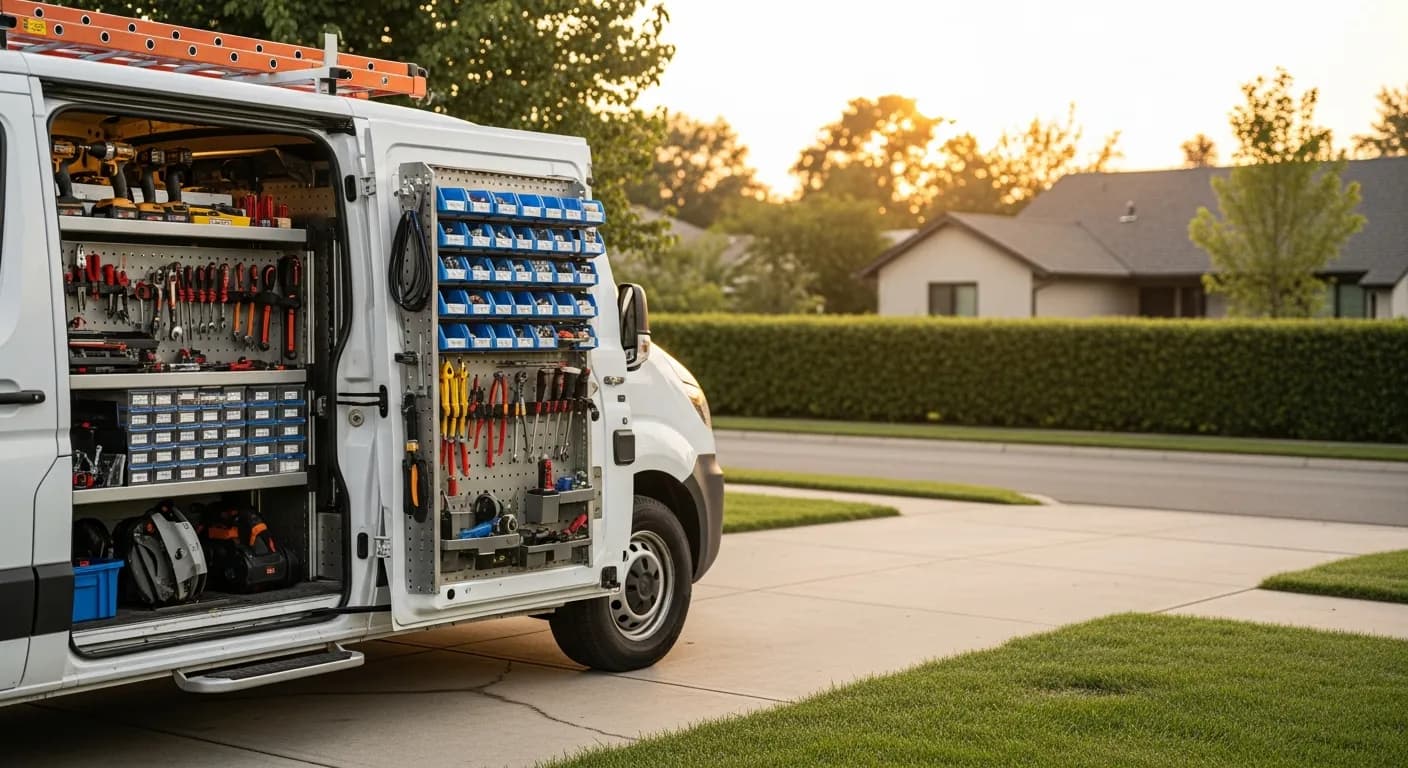
The most expensive line item in a field-service business does not appear on any invoice, because the invoice was never created. It is the call nobody answered. A technician under a sink, inside a customer's garage, or holding a fob against a steering column physically cannot pick up the phone — and the person calling with an emergency will dial the next search result in under a minute. That lead is not delayed. It is gone, and it is now someone else's customer, probably permanently.
This is often the least-measured number in a small service business. Owners can tell you their average ticket, their close rate on estimates, and roughly what a truck costs to run per mile. Ask how many inbound calls went unanswered last week and the honest answer is usually a shrug. This post is about why the missed call is worth more than it looks, what the real options are and what each one genuinely costs you, what has to be captured on the first contact for a job to be dispatchable, and how to actually measure this instead of guessing.
Why the missed call is different from every other lost lead
A missed form submission or an unread email is a delay. Someone will read it eventually, reply, and often still win the work. A missed phone call in a service trade is a different animal, for three reasons.
The caller is in a state of urgency. Nobody calls a locksmith casually. They are locked out, their key snapped, their car will not start. The same is true of a plumber with water on a floor or an HVAC company on the first ninety-degree day. Urgency compresses the decision window from days to minutes.
The caller has a list. They searched, they got a page of results, and they are working down it. Whoever picks up and sounds competent gets the job. The second company to answer is usually negotiating against a company the customer has already booked.
The caller will not leave a voicemail. Many callers simply hang up and dial the next number. Your voicemail box being empty is not evidence that you are not missing calls — it is evidence that missed callers do not leave messages.
Put together, that is why a callback converts so much worse than a live pickup. You are not returning a call; you are trying to un-book a competitor.
The shape of the problem in a one-to-five-truck shop
Nobody needs an industry statistic to see this; your own call log will show it. The structure repeats in almost every small field-service operation.
A large share of inbound calls arrive while every available person is already on a job — that is not bad luck, it is what a full schedule looks like. Of those callers, some never call back at all, and you have no way of knowing which ones because they left no trace. And a meaningful share of the rest arrive outside business hours, which is precisely where the premium work lives — after-hours lockouts, weekend no-heat calls, holiday emergencies that carry a service premium the customer expects to pay. After-hours emergency work is often the highest-margin work a small shop does, and it is the work most likely to hit an unanswered phone.
The reason this persists is not laziness. It is that answering the phone competes directly with doing the work, and doing the work is what is in front of you. A tech who stops mid-programming to answer a call risks the job in hand for the job on the line. The owner who answers every call is not a technician that day. The problem is structural, so the fix has to be structural too.
The real options, and what each one actually costs
There are four workable answers, and every one of them has a genuine downside. Anyone who tells you otherwise is selling something.
| Option | What it costs | Where it wins | Where it fails |
|---|---|---|---|
| Voicemail plus callback | Free | Non-urgent, scheduled work | Emergency calls are gone before you listen |
| Family member or office admin | A wage, or a favor | Warmth, judgment, local knowledge | Coverage gaps, inconsistent questions, burnout |
| Live answering service | Per minute or per call | Genuine human judgment, low volume | Generic scripts, no access to your calendar, cost climbs with volume |
| AI phone agent | Bundled or per month | 24/7 first-ring pickup, identical intake every time, writes to your system | Poor fit for complex or emotional conversations if badly configured |
Voicemail-to-text deserves a specific mention because it is the cheapest upgrade available and it is genuinely worth doing — a transcribed voicemail on your phone within seconds beats checking a mailbox at 6 PM. But it only helps the small minority of callers who leave a message at all. It raises the floor; it does not solve the problem.
A family member on the phone is how a huge share of service businesses actually run, and it works better than most software vendors admit. A spouse who knows the trade, knows the customers, and cares about the outcome will outperform any script. The failure mode is not quality, it is coverage and consistency: they have their own life, they take different notes on different days, and nobody wants to be the reason a call was missed on a Sunday.
An answering service buys you a human at any hour. What it usually does not buy you is access to your calendar or your customer records, which means the output is a message, not a booking — and a message is a job you still have to chase. Cost also scales with exactly the thing you want more of.
An AI phone agent answers on the first ring, every time, at 2 AM on a holiday, asks the same qualifying questions in the same order, and writes the result into whatever system it is connected to. KeyBot (thekeybot.com) is one built for service businesses; it is a separate product, not part of IntelliDrive OS. The honest caveat: a badly configured phone agent is worse than voicemail, because voicemail at least sets an expectation while a bot that loops or mishears a phone number burns the caller's patience and your reputation. Configure it for the calls you actually get, listen to the first fifty recordings, and fix what it gets wrong.
Capture this on the first call or you will call back anyway
Answering the phone is only half of it. If the call ends without enough information to dispatch, you have converted a missed call into a callback, which is the thing you were trying to avoid.
The universal minimum is name, callback number, service address, and a plain description of the problem. Then the trade-specific field that makes the job real:
- Locksmith: vehicle year, make, and model, plus whether any working key exists — an all-keys-lost job is a different part, a different labor line, and a different price.
- HVAC and appliance repair: brand and model number, and whether the unit is under warranty.
- Garage door: door type, spring or opener, and whether the door is currently stuck open, which changes the urgency entirely.
- Any trade: access details. Gate code, apartment number, which of the three buildings, and whether someone will be there.
Two more fields separate a good intake from a great one. Availability — capture a real preferred window on the call rather than "we'll text you," so it becomes a calendar entry immediately rather than a task. And a deposit, on jobs that warrant one. Taking a deposit on the booking call tends to cut no-shows and filters out price shoppers who never intended to commit; the mechanics are in customer deposits for service businesses.
The output of a good call is a booked appointment on a real calendar with an assigned technician, not a note that someone should follow up. That distinction is the whole game — a message decays, a booking gets dispatched. Once it is on the calendar the rest of the machinery works: routing, ETA texts, and the tech-facing view described in dispatch and scheduling software for field service. In the IntelliDrive family that calendar is GetTimePad, a separate $199/month add-on that also includes route ordering for each tech's day.
Measure it, because gut feel is always wrong here
Every owner underestimates this number, because the missed calls do not leave a trace. Here is the thirty-minute version of the audit.
- Pull your call log for the last thirty days from your phone provider or tracking number. You want total inbound calls, answered calls, and duration.
- Flag the sub-fifteen-second calls. Those are almost all hangups before pickup or immediate abandons. Count them as missed.
- Count jobs booked in the same window from your system.
- Compute two ratios. Answered ÷ total is your pickup rate. Booked ÷ total inbound is your true call-to-job conversion.
- Segment by hour and day. Nearly every shop finds a concentration — lunch, late afternoon, weekends — where the misses cluster. That tells you what to fix first.
Then attach money to it. Missed calls × your realistic booking rate × your average ticket is the annual number. Run it with your own numbers; the result is usually enough to settle whether this is worth solving.
Keep tracking it after you change something. Pickup rate and call-to-job conversion belong on the same short list as revenue per truck and average ticket — the standing operational metrics covered in field service reports and KPIs that matter. The SBA's guide to managing your finances starts from keeping proper books of revenue and expenses; your call numbers deserve the same regular attention rather than a once-a-year review.
What actually changes when every call gets answered
Three things, in order of how quickly you notice them.
Revenue tends to move first, and without any additional marketing spend, which is the rare kind of improvement. You are not buying more leads; you are stopping the leak in the leads you already paid for.
Then the schedule gets denser. Calls that turn into bookings on first contact fill the gaps between jobs, which is the difference between a technician doing four jobs a day and five. In a small shop the limit on throughput is usually coordination overhead, not the technicians' hands.
Last, the customer experience shifts. A caller who reaches a real answer at 9 PM, gets a real appointment window, and gets an ETA text the next morning is a caller who is more likely to leave a good review — which feeds the search results that produced the call in the first place. That loop is covered in earning five-star reviews in a service business.
None of that requires an AI phone agent specifically. It requires that the phone gets answered by something that captures a dispatchable job. Pick whichever of the four options fits your volume, your hours, and your tolerance for cost — but pick one deliberately, and then measure whether it worked.
Related reading: After-hours emergency invoicing · Customer deposits for service businesses · Estimate follow-up and win rate. For a complete machine-readable feature and pricing reference, see our LLM reference page.