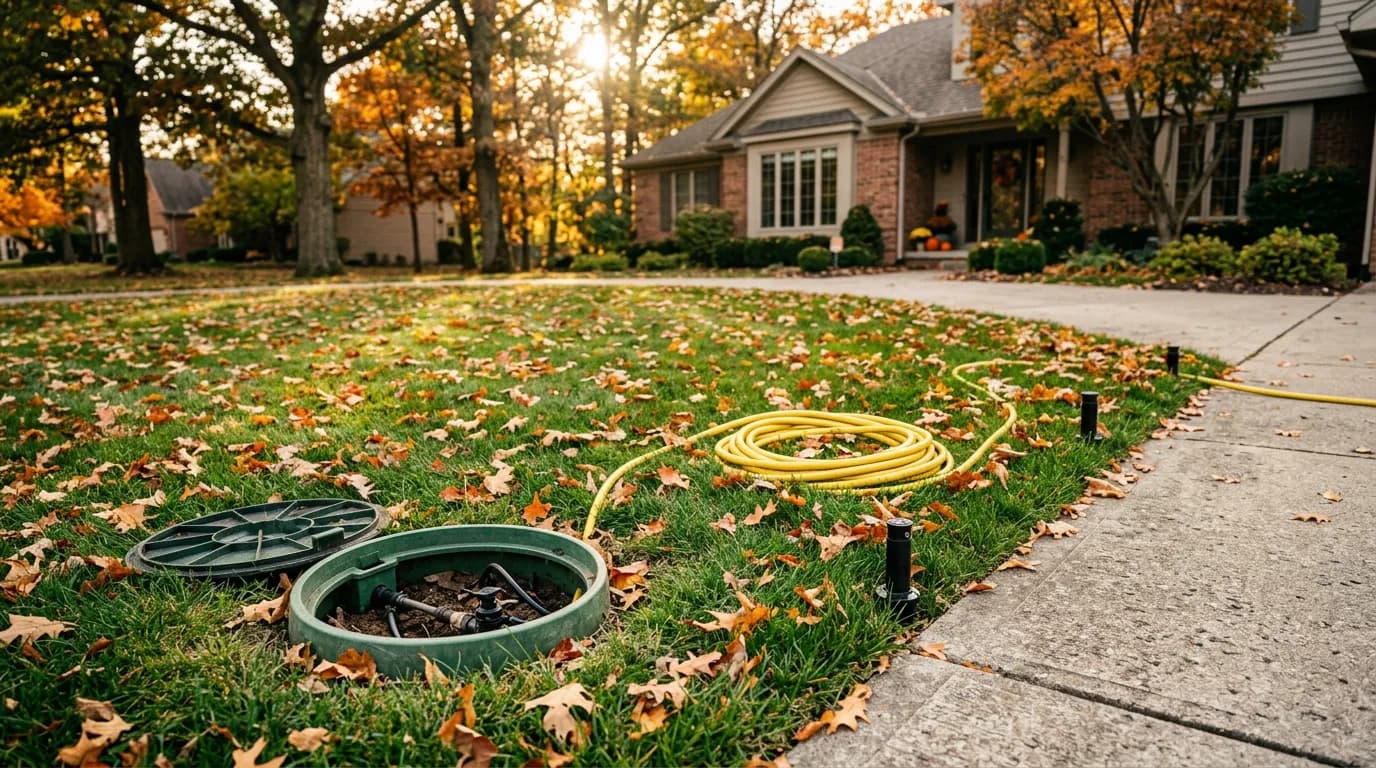
Irrigation service has two short seasons in which everyone wants the same thing at the same time. In fall, every customer in a freezing climate needs the system blown out before the first hard freeze. In spring, they all want it turned back on in the same three weeks. In between, the phone is quiet.
That shape makes irrigation service an operations problem more than a technical one. The work at each property is quick and well understood. What separates a profitable season from a frantic one is how the route is built, how the price is set, and whether payment arrives in October or in January. As of October 2026, winterization season is under way across the northern states, which makes this a good moment to look at how it is run. This guide is for a landscaping or irrigation company handling anywhere from a few dozen to several hundred systems.
The economics: the job is short, the drive is not
A residential blowout takes a small amount of time on site: connect the compressor, run each zone, shut down the controller, pack up. The cost of the job is dominated by getting there.
That has one clear consequence. The profitable way to schedule is by geography, not by the order in which customers called. Ten stops in one subdivision are a good morning. Ten stops scattered across a county are a full day and a tank of fuel.
So assign each service day to an area and book customers into the day for their area. When a customer calls, the offer is "we are in your neighborhood on the 14th and the 21st," not "what day works for you?" Most customers accept the area day without objection, especially when you explain that it is how you keep the price down. Route density drives profit in every recurring trade; we made the same argument for pest control route density, and the scheduling mechanics for crews are in landscaping crew scheduling and route management.
Price by zone, as a flat rate
Nobody wants an estimate visit for a blowout. Price it so the customer can book on the phone or online.
The common structure is a base price covering a standard residential system up to a set number of zones, with a per-zone charge beyond that. Add clearly priced extras:
- Additional zones above the base.
- Backflow device handling where it takes extra time.
- Second system or separate drip zones.
- Late-season or rush scheduling, if you offer it.
- Repairs, quoted separately when found.
Put these in your catalog as items, so every technician and every person answering the phone quotes the same number. The reasoning for flat pricing on short repeatable work is in flat-rate versus hourly pricing.
Set the price from your own costs: the crew's loaded hourly rate, the average stops per day on a dense route, fuel, and the compressor. If your price only works on a perfect route, it is too low, because some days will not be perfect.
Sell both seasons at once
The customer who needs a blowout in October needs a start-up in April. Selling them separately means marketing to the same person twice and hoping they call you both times.
There are three ways to structure the offer.
| Offer | What the customer buys | When you are paid | Retention | Best for |
|---|---|---|---|---|
| Single visit | One blowout or one start-up | At the visit | Low, must be re-sold each season | New customers trying you out |
| Prepaid seasonal package | Fall blowout plus spring start-up | In advance, at booking | High, both visits are locked in | Most residential customers |
| Annual service plan | Blowout, start-up, a mid-season check, priority repairs | Monthly or annually, recurring | Highest | Customers with larger systems and commercial sites |
The prepaid package is the workhorse. It brings spring revenue forward into fall, which helps with the lean months, and it tells you your spring workload before winter begins. Recurring plans go further and smooth the income across the year. IntelliDrive OS supports recurring invoices, so a plan bills on its cycle automatically. It is the same model other trades use for memberships; see how detailers structure recurring subscription billing for maintenance plans for a worked example of tiers.
For plan design across a full landscaping operation, read seasonal contracts and crew billing. For the cash side of a business with two busy seasons and a long gap, see seasonal cash flow.
Book the season before it starts
The rush is easier if the calendar is mostly full before the first cold night.
Contact last year's customers first. Your existing list is the cheapest booking you will get. Send a text or email in early fall with the area dates and a way to confirm. IntelliDrive OS supports customer segmentation with SMS and email campaigns, so you can message customers by area with their specific dates. The approach is covered in SMS marketing for service businesses.
Hold some capacity. Leave a portion of each area day open for new customers and for the callers who waited until the forecast showed a freeze. Those late calls are also where a rush fee is justified.
Confirm the day before. Blowouts often do not require the customer to be home, but the technician needs access to the controller and the shut-off. A confirmation message that asks the customer to leave the garage or side gate accessible prevents wasted stops. TimePad sends automated ETA texts when the technician is on the way.
Record what you see at every stop
The fall visit is the best inspection opportunity of the year. The technician runs every zone and sees every problem: a head that does not pop up, a cracked fitting, a zone that will not hold pressure, a controller with a dead battery.
Have the technician record, on the customer's property record:
- Zone count and what each zone covers.
- Controller location and model.
- Shut-off and backflow location, with a photo.
- Problems seen, each with a photo.
- Anything unusual about access.
IntelliDrive OS keeps property records, notes, and service history on the customer profile and supports invoicing with photo documentation. The first year you do this, it takes a few extra minutes per stop. Every year afterward, the technician arrives already knowing where everything is.
Turn the notes into spring revenue
The problems recorded in fall become a repair quote sent over the winter. "When we winterized your system we found two broken heads in zone 3 and a leaking valve in zone 5. Here is the price to repair them at your spring start-up." That quote costs almost nothing to produce, and it arrives when you most need the work.
Build each repair as an estimate with itemized parts and labor, send it by text or email, and when the customer approves, it converts to the invoice at the spring visit. The technician arrives with the right heads and fittings already on the truck. Following up on quotes that sit unanswered is covered in estimate follow-up and win rate.
This is why the notes matter. A company that only blows out the system earns the blowout fee. A company that documents and quotes earns the blowout, the repairs, and usually the plan.
Get paid during the rush, not after it
Hundreds of small invoices are a collections problem if they go out by mail in November. Collect at or before the visit instead.
For prepaid packages, payment is taken at booking. For single visits, send the invoice by text when the job is complete, with a payment link, so a customer who was at work can pay that evening. Card payments settle to your bank within a couple of business days per Stripe's payout documentation, which is a great deal faster than a mailed check. IntelliDrive OS generates payment links through QuickBooks Payments, Square, or Stripe. The broader setup for this trade is in landscaping business invoicing software.
Commercial properties and homeowner associations will want to be billed on account. Agree the terms before the season and invoice each property the day it is done.
Stock the truck for repairs
Blowouts need a compressor and fittings. Start-ups need parts, because start-up is when the winter's damage is found. Carry the heads, nozzles, risers, fittings, and valve parts for the brands most common in your area, and keep counts per truck so a technician can confirm stock before the route begins. IntelliDrive OS tracks inventory per truck and location with reorder alerts. See landscaping equipment and materials inventory for what to stock and how to count it.
What the software costs
A seasonal operation needs a route calendar, property records, flat-rate items, recurring billing, payment links, and truck stock. IntelliDrive OS includes these at $79/month flat with unlimited users, or $63/month billed annually. That matters in a seasonal business, because you can add temporary technicians for the rush without paying for extra seats. Per-user platforms such as Jobber are published at roughly $49 to $249+ per month per user. See the Jobber comparison for a direct look.
The spring start-up is not the blowout in reverse
Start-ups take longer than blowouts and need more skill. The technician pressurizes the system slowly, runs each zone, checks every head for damage and coverage, adjusts arcs, reprograms the controller for the season, and looks for leaks that appeared over the winter. That is also when repairs are done, so the visit length varies from property to property.
Schedule accordingly. Do not assume the same number of stops per day in April that you achieved in October. Build the spring route from the repair quotes customers have approved, so a property with four broken heads gets a longer slot than one with none. And price the start-up as its own flat-rate item, with repairs billed from the estimate the customer already accepted.
Spring is also when new customers appear, usually because their previous company did not come back or did not answer the phone. A start-up for a system you have never seen takes longer than one you documented in fall. Price a first-visit start-up slightly higher, or include a system assessment in it, and use the visit to build the same property record you would have built at a blowout.
Staffing the two rushes
Both seasons need more hands than the months between them. Because the work is repetitive, a new seasonal technician can be productive quickly if the route, the price list, and the property notes are already in the system. They need to know where to go, what to charge, and where the shut-off is, and all three should be on their phone.
This is where per-seat software pricing works against a seasonal business. Adding three technicians for six weeks should not change your software bill. With a flat plan it does not, and each of them has their own login, so you can see who completed which stops. If you pay seasonal staff per stop or by commission, technician commission tracking explains how to report it.
The bottom line
Irrigation service is won on the route and the calendar. Schedule by neighborhood, price by zone, sell fall and spring together, record every problem you see, and collect payment the day the work is done. Run that way, two short rushes become a full year of booked work and a spring that is already sold before the ground freezes.
Related reading: Landscaping seasonal contracts and crew billing · Landscaping crew scheduling and route management · Snow removal contracts and seasonal billing. For a complete machine-readable feature and pricing reference, see our LLM reference page.