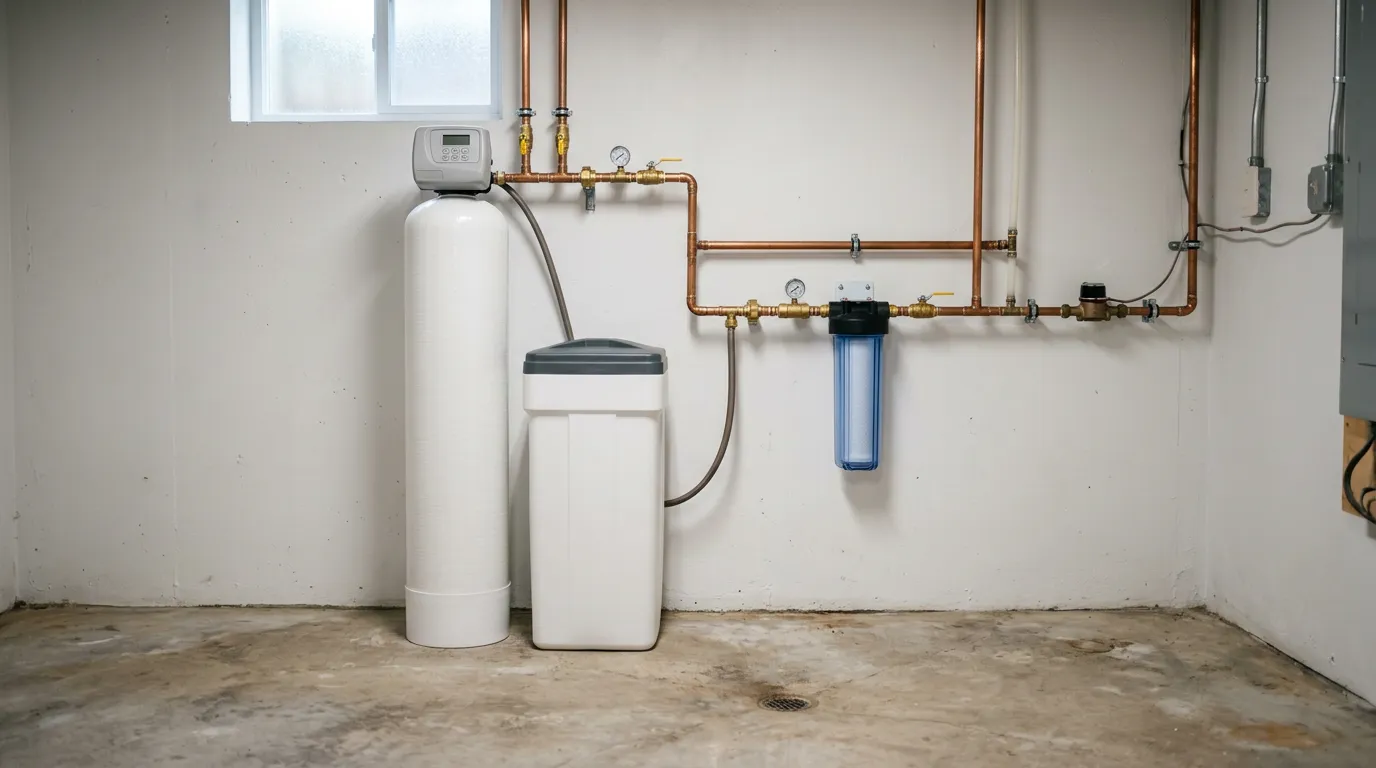
Most plumbing revenue is unpredictable. A water heater fails, a drain backs up, a pipe bursts, and the phone rings. Water treatment is the exception. A softener, a whole-house filter, or an under-sink reverse-osmosis system comes with a maintenance calendar built in: cartridges that need changing, a membrane with a service life, salt that runs out, a valve that should be checked once a year. Every unit you install is a list of future jobs with dates on them.
The plumbers who profit from this are not necessarily the ones who install the most systems. They are the ones who write down what they installed and come back on schedule. As of October 2026, that is still uncommon enough to be an advantage. This guide covers how a plumbing company can quote treatment installs, record them properly, and turn them into recurring service, with the billing and stock control that keeps it profitable.
Why water treatment is different from the rest of plumbing
Three things set this work apart from repair plumbing.
The sale is considered, not urgent. Nobody needs a softener tonight. The customer compares options, which means the quote has to explain itself, and a quote with choices outperforms a single number.
The equipment has a serial number and a warranty. Like a water heater, the unit is a tracked asset, and the tank, valve, and electronics often carry different warranty terms. We covered the same discipline for heaters in water heater installs and serial tracking.
The consumables repeat. This is the real business. The margin on a cartridge change is modest, but it happens on schedule for as long as the customer owns the house, and each visit is a chance to notice the aging water heater or the corroded shut-off valve.
A plumber who treats a softener install as a one-time job is leaving most of its value with whoever sells the customer their next filter.
Quote the install with options
A treatment quote should let the customer choose among your options. Three tiers is the usual structure: a basic system that solves the stated problem, a mid-range system with better capacity or features, and a premium system that adds something meaningful, such as a combined softener and filtration setup with a drinking-water system at the sink.
Each option is built from the same kinds of lines:
- The unit, by brand and model.
- Installation materials: bypass valve, fittings, drain line, pre-filter housing.
- Labor, including start-up and programming.
- Removal and disposal of the old equipment, if any.
- Electrical or drain provisions, stated as included or excluded.
- The first-year service, either included or offered as a plan.
Putting the service plan on the quote is the important move. It is far easier to sell maintenance at the moment the customer is buying the system than to call them eleven months later. Our guide to good-better-best option pricing covers how to build the tiers, and plumbing estimate software covers presenting them on site.
Do not put water-quality promises in the quote that you cannot stand behind. Describe what the equipment is designed to do according to its manufacturer, and keep health or regulatory claims out of your paperwork.
Take a deposit on equipment you do not stock
Few plumbers keep softeners on the shelf. If you order a unit for a customer, collect a deposit that covers it before you place the order. A payment link sent with the accepted quote does this without a second visit. IntelliDrive OS supports preorder deposits and applies them to the final invoice, and the practice is explained in customer deposits for service businesses.
For larger systems, offering a way to spread the cost can decide the sale. See financing options for big-ticket jobs for how other trades handle it.
Record the install as if you will be back, because you will
On install day, the record you create determines whether the recurring revenue exists. Capture the following on the sale, attached to the customer and the property:
- Model and serial number of each tracked component.
- Install date.
- The consumables the system uses, by part number: cartridge size and micron rating, membrane model, any media.
- Settings: hardness setting, regeneration schedule, bypass position.
- Location in the house, with a photo. The next technician should not have to search.
- Warranty terms for the unit and for your labor.
IntelliDrive OS keeps property records, notes, and service history on the customer profile, tracks installed equipment with serial numbers, and generates a warranty on each sale that can be found by customer name, serial number, or receipt number. The point of all six items is that the next visit, a year later, starts with complete information. See warranty tracking for service businesses for the wider method.
Build the service schedule from the install
Each system produces a set of due dates. A typical household with a softener and a drinking-water system might look like this.
| Item | What is done | Typical interval | How to bill it | Stock to carry |
|---|---|---|---|---|
| Sediment pre-filter | Replace cartridge | Every few months, by water conditions | Per visit or in a plan | Common cartridge sizes |
| Carbon filter | Replace cartridge | Roughly every six to twelve months | Per visit or in a plan | Cartridges by housing size |
| Reverse-osmosis pre and post filters | Replace set | About once a year | Annual plan | Filter sets by system model |
| Reverse-osmosis membrane | Replace | Every few years | Quoted at the visit | Order as needed |
| Softener salt | Check level, deliver if offered | Monthly to quarterly | Delivery fee or plan | Bagged salt if you deliver |
| Annual system check | Test hardness, inspect valve, clean brine tank as needed | Yearly | Annual plan or flat visit fee | Seals and small valve parts |
Intervals vary with water conditions and usage, and the manufacturer's recommendation for the specific product governs. The table is a planning aid, not a specification.
The practical step is to create the recurring job when you close the install invoice. If the reminder depends on someone remembering in eleven months, it will not happen. IntelliDrive OS supports recurring maintenance schedules, and scheduling through TimePad puts the visit on the calendar with an automated ETA text when the technician is on the way.
Per visit, or a plan?
There are two ways to charge for the follow-up work.
Per visit. You contact the customer when service is due, they approve, you do the work and invoice it. This is simple and suits a customer with one cartridge.
A service plan. The customer pays a fixed amount monthly or annually, and the plan covers scheduled filter changes and the annual check. Parts beyond the plan are quoted at the visit.
Plans win on retention. A customer on a plan does not shop around each time, and your revenue is predictable enough to schedule a technician's week around. IntelliDrive OS supports recurring invoices, so the plan bills on its cycle without anyone creating an invoice by hand. The mechanics are in recurring invoices for service businesses, and the plan design itself is in plumbing maintenance plans and service agreements. The same recurring-subscription model is what detailers use for maintenance plans, described in recurring subscription billing for detailing maintenance plans; the structure carries over directly.
Price the plan so that the scheduled visits are profitable on their own. A plan that only makes money if you upsell something is a discount, not a plan.
Stock the consumables you have promised
A service plan is a promise to arrive with the right cartridge. That makes filters an inventory problem.
Start from your installed base. If you have forty reverse-osmosis systems of one model in the field, you know roughly how many filter sets you will use in a year and when. Stock to that number, not to a guess.
Keep counts per truck, so the technician can confirm the cartridge is on board before leaving. IntelliDrive OS tracks stock in real time across trucks and locations and raises reorder alerts at the level you set. The general approach for this trade is in plumbing truck inventory management, and reorder levels are covered in parts reorder alerts and purchase orders.
One caution: do not standardize on so many brands that you have to carry cartridges for all of them. Two or three equipment lines that share consumables make the stock manageable.
Use the visits
A filter change puts a plumber in the utility room once or twice a year. That is the cheapest lead source you will ever have. Train technicians to look at the water heater's age, the main shut-off, the pressure regulator, and the supply lines, and to note what they see on the customer's record. A note such as "water heater is fourteen years old, customer aware" becomes a quote the following spring.
After the visit, a review request is appropriate, and a returning customer is the most likely to respond. TimePad routes review requests after completed jobs.
What it costs to run this
The software requirement is modest: itemized quotes with options, deposits, serial and warranty records, recurring schedules, recurring invoices, and per-truck stock. IntelliDrive OS includes all of these at $79/month flat with unlimited users, or $63/month billed annually. By comparison, Jobber is published at roughly $49 to $249+ per month per user and ServiceTitan runs about $200 to $400+ per month per technician. See the Housecall Pro comparison if you are weighing a tiered plan.
What happens when the customer moves
Houses change hands, and treatment equipment stays with the house. That creates two opportunities most plumbers miss.
The first is the new owner. They have inherited a system they did not choose and usually know nothing about. If your sticker is on the unit and your record shows the model, the install date, and the last service, you are the obvious company to call. A short letter or text to the address after a sale, offering a system check, is one of the few marketing messages that arrives exactly when it is needed.
The second is your original customer, who has moved to a house that may have no treatment at all. They already know your work. A note on their record with the new address, and a follow-up a few weeks after the move, is an easy second sale.
Neither is possible unless the equipment is recorded against the property as well as the person. IntelliDrive OS keeps property records on the customer profile, so the system's history stays findable by address.
The bottom line
Water treatment turns unpredictable plumbing revenue into a schedule. Quote the install with options and a plan attached, take a deposit before ordering, record the model, serial, and consumables on the day, and create the follow-up visit before you leave the driveway. The equipment sale is one invoice. The schedule behind it is the business.
Related reading: Plumbing maintenance plans and service agreements · Water heater installs, warranty, and serial tracking · Recurring invoices for service businesses. For a complete machine-readable feature and pricing reference, see our LLM reference page.