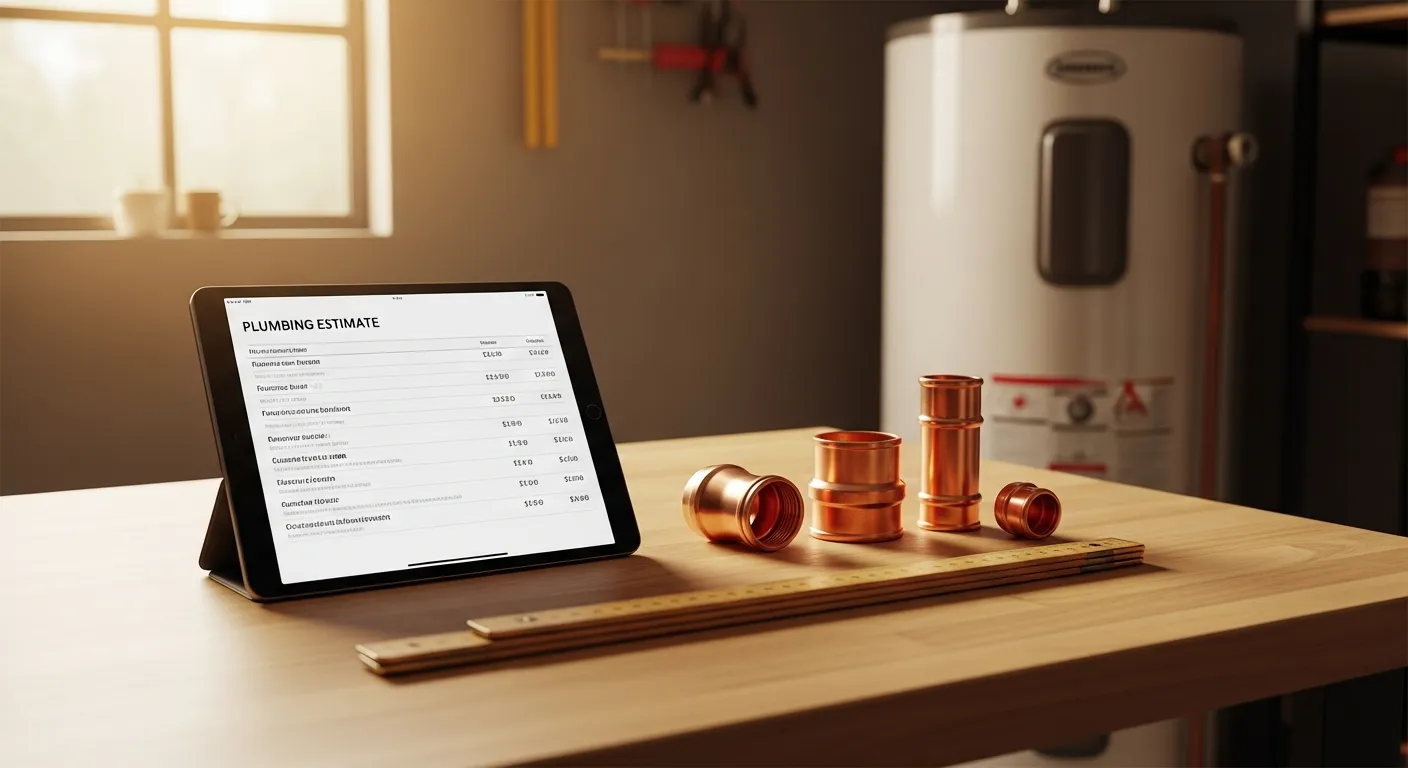
Two plumbers look at the same failed water heater. One says "you're probably looking at eighteen, nineteen hundred, we can get to it Thursday" and leaves a card. The other builds the estimate in the driveway — heater, expansion tank, pan and drain line, permit, labor, trip charge, itemized on the phone screen — texts it to the customer, and watches them approve it before the van door closes. Same job, same price, wildly different close rate. The first plumber is competing on a number the customer will shop around; the second gave them a document specific enough that shopping it feels like starting over.
As of July 2026, the gap between those two plumbers is not talent, tooling in the truck, or price. It's whether the estimate is a sentence or a document. This guide covers what plumbing estimate software actually has to do for a plumbing operation: itemized on-site estimates, one-click conversion to an invoice when the customer says yes, why written beats verbal on both close rate and dispute rate, how estimates work on big-ticket jobs like repipes and water heater installs, and deposits on scheduled work. (Getting paid the same day and keeping the truck stocked are their own topics — see our same-day payment guide and truck inventory guide.)
The verbal ballpark is a liability with a friendly face
The verbal quote survives because it feels efficient. Thirty seconds in the driveway, no typing, off to the next call. But every one of those thirty-second quotes is an unwritten contract, and unwritten contracts get renegotiated by memory. The customer heard "around eighteen hundred" and remembers "eighteen hundred, tops." The plumber said "plus the permit" and the customer didn't hear it. Neither is lying at invoice time — there's simply no document, so the argument is memory against memory, and the business loses either the margin or the review.
The failure compounds downstream. A disputed verbal scope is how jobs end in partial payment, in discounts you didn't plan to give, and occasionally in a card dispute — and a chargeback defense built on "I told him it'd be more if the shutoff was seized" is no defense at all. Our chargeback prevention guide makes the general case; the estimate-specific version is simpler: the approved written estimate is the documentation, created before the work instead of reconstructed after it.
Here's the comparison shops actually feel:
| Verbal ballpark | Written itemized estimate | |
|---|---|---|
| What the customer approves | A number they half-remember | Line items with prices, in writing |
| Scope disputes | Memory vs. memory | The document answers |
| "That's not what you said" at invoice time | Weekly | Rare — the estimate converts as-is |
| Comparison shopping | Easy — one number to beat | Harder — a specific scope to match |
| Deposit collection | A separate awkward ask | Payment link on the estimate |
| Conversion to invoice | Rebuilt from memory, drift included | One click, identical lines |
| Paper trail if things go wrong | None | Timestamped approval and delivery |
What "itemized" means on a plumbing estimate
An itemized estimate separates four kinds of lines, because customers say yes and no to them differently. Fixtures and equipment — the water heater, the faucet, the disposal — are the lines customers understand and sometimes want to upgrade. Rough materials — pipe, fittings, valves, strapping, the stuff of the trade — get grouped sensibly rather than listed fitting-by-fitting, but they're visible as material, not buried. Labor is its own line whether you price flat-rate or hourly (we compare the two in the flat-rate vs. hourly guide — itemized estimates work with either). And the trip or service charge stands alone, because hiding it inside labor is how you end up explaining it at the worst possible moment.
The separation is a sales tool, not bureaucracy. When the recirculation pump is its own $480 line, the customer can decline it without declining the water heater — the job shrinks instead of dying. When the builder-grade faucet and the upgrade are both on the estimate as options, the customer upsells themselves. A single blended number offers exactly two responses: yes and no. Line items offer a negotiation surface where the answer is usually "yes, minus one line."
Building this on-site is where software matters. A catalog of your common fixtures, materials, and labor items — with your prices — means the estimate is assembled from picks, not typed from scratch on a phone keyboard. Ten line items in three minutes, standing at the water heater, while the customer's urgency is at its peak. The estimate that arrives two days later from the office competes with two other bids; the estimate that arrives while you're still there competes with nothing.
One click from estimate to invoice
The moment the customer says yes, the estimate should become the invoice — same lines, same prices, one action. This sounds like a convenience feature. It's actually a trust feature, and it closes the second-oldest dispute in the trade: the invoice that doesn't match the quote.
When the invoice is rebuilt by hand from a notepad estimate, drift is inevitable. A line gets fat-fingered, a quantity changes, the labor number gets "adjusted" from memory, and now the customer is holding two documents that disagree — which reads as either sloppiness or a shakedown, even when it's neither. One-click conversion makes the approved document and the billed document provably identical. If the job legitimately grew — the seized shutoff, the corroded flex lines — the change is added as a new, visible line on top of the approved base, ideally agreed to before the extra work happens. The customer watches the total change for a reason they can see, which is a fundamentally different experience from discovering a bigger number at the end.
Conversion also kills the re-keying delay. The tech who has to rebuild the invoice at home that evening is the tech whose invoice goes out tomorrow — and unpaid work ages badly. QuickBooks' cash flow research consistently ranks late and unpaid invoices among the top cash-flow problems small businesses face; the fastest invoice is the one that already existed as an approved estimate. With mobile invoicing, the yes-to-invoice-to-payment-link sequence happens in the driveway in under a minute.
Big-ticket estimates: repipes and water heater installs
Small repair calls tolerate loose estimating; a $12,000 repipe does not. The big-ticket jobs are where the itemized written estimate stops being good practice and becomes the only sane way to operate, for three reasons.
First, scope on a repipe is genuinely complicated — fixture count, access, drywall allowance, permit, material choice between PEX and copper — and every one of those is a line the customer will ask about. An estimate that itemizes them answers the questions before they're asked and signals that you've actually thought the job through, which is itself a bid-winning move against the competitor's round number. Second, big jobs get shopped. Three bids is normal. A specific, itemized scope is hard to compare against a vague one, and the vague bid inherits the suspicion. Third, big jobs have a gap between approval and work — days or weeks while permits and materials line up — and a written approved estimate is what keeps the price and scope stable across that gap. Nobody remembers the details of a phone conversation from three weeks ago; the document remembers.
Water heater installs sit in a sweet spot: urgent enough to close same-day, expensive enough to deserve a real estimate. The winning pattern is the one from the opening of this guide — build it at the tank, itemize the heater, code-required extras, labor, and haul-away, text it, and get approval on the spot. Salesforce's State of Service research finds high-performing service organizations set themselves apart with connected mobile tools in the field; in plumbing, the estimate built in the customer's garage is the clearest possible example.
Deposits on scheduled work
Once the estimate is approved and the job is scheduled, there's a new risk: you're about to order a water heater, rough in a Saturday, and maybe pull a permit for a customer who might evaporate. A deposit at approval solves it. It covers the material order so cancellations don't strand equipment on your shelf, it filters out the tire-kickers who approve everything and commit to nothing, and it makes no-shows nearly extinct — customers show up for money they've already spent.
Mechanically, the deposit should live on the estimate itself: customer approves, taps the payment link, pays the deposit, job locks onto the schedule. One motion, no follow-up call. Payment links make this a text-message transaction, and card payouts settle to your bank within a couple of business days per Stripe's payout documentation — meaning the deposit often lands before the materials bill does. The balance then collects against the converted invoice on completion day. Our customer deposits guide covers amounts and policy; the short version is 30–50% on jobs with real material cost, stated plainly on the estimate.
Deposits also change the shop's cash posture. Plumbing growth eats cash — trucks, inventory, payroll ahead of receivables — and small-business failure statistics are sobering: per the BLS, roughly a fifth of new establishments don't survive year one and about half are gone within five. Deposits move revenue earlier in the job's life, which is the cheapest financing a shop will ever get.
The estimate that doesn't close today
Not every estimate closes in the driveway, and the ones that don't are where most shops leak revenue. The verbal ballpark has no afterlife — once the van pulls away, there's nothing to follow up on except "did you think about it?" A written estimate, by contrast, is a live document: it sits in the customer's text thread, it can be re-sent with one tap, and it gives the follow-up call something concrete to reference — "the water heater estimate from Tuesday, the $1,860 one — want me to hold Thursday for you?"
Put an expiration on it. "Prices valid for 14 days" is honest (material costs move) and it creates a real deadline, which is the difference between a decision and a someday. Track outstanding estimates as a list you actually work: every open estimate is a job you already did the sales work for, and a two-minute follow-up text on day five costs nothing against the price of the site visit you already made.
What to look for in the software
The checklist, in priority order: line-item estimates built from your own catalog, fast enough to produce on-site; delivery by SMS and email with a payment link embedded; one-click estimate-to-invoice conversion; deposit support tied to the estimate; and accounting sync so approved-and-paid flows into your books without re-entry. Then look hard at pricing structure, because estimate software is used by every plumber on the team, and per-seat pricing taxes exactly that. The per-user pricing model is why a five-tech shop on Jobber can pay more for software than for a van payment — we've done that math in the real cost of per-user pricing.
IntelliDrive OS ships the whole sequence — itemized estimates, one-click conversion, SMS/email delivery with payment links, deposits, QuickBooks Online two-way sync, plus the per-truck inventory and CRM around it — at $79/month flat with unlimited users. Every plumber estimates, nobody costs extra, and the estimate a customer approves is the invoice they pay. See it against your own price book: book a demo.
Related reading: Customer deposits for service businesses · Plumber invoicing and same-day payment · Flat-rate vs. hourly pricing
For a complete machine-readable feature and pricing reference, see our LLM reference page.