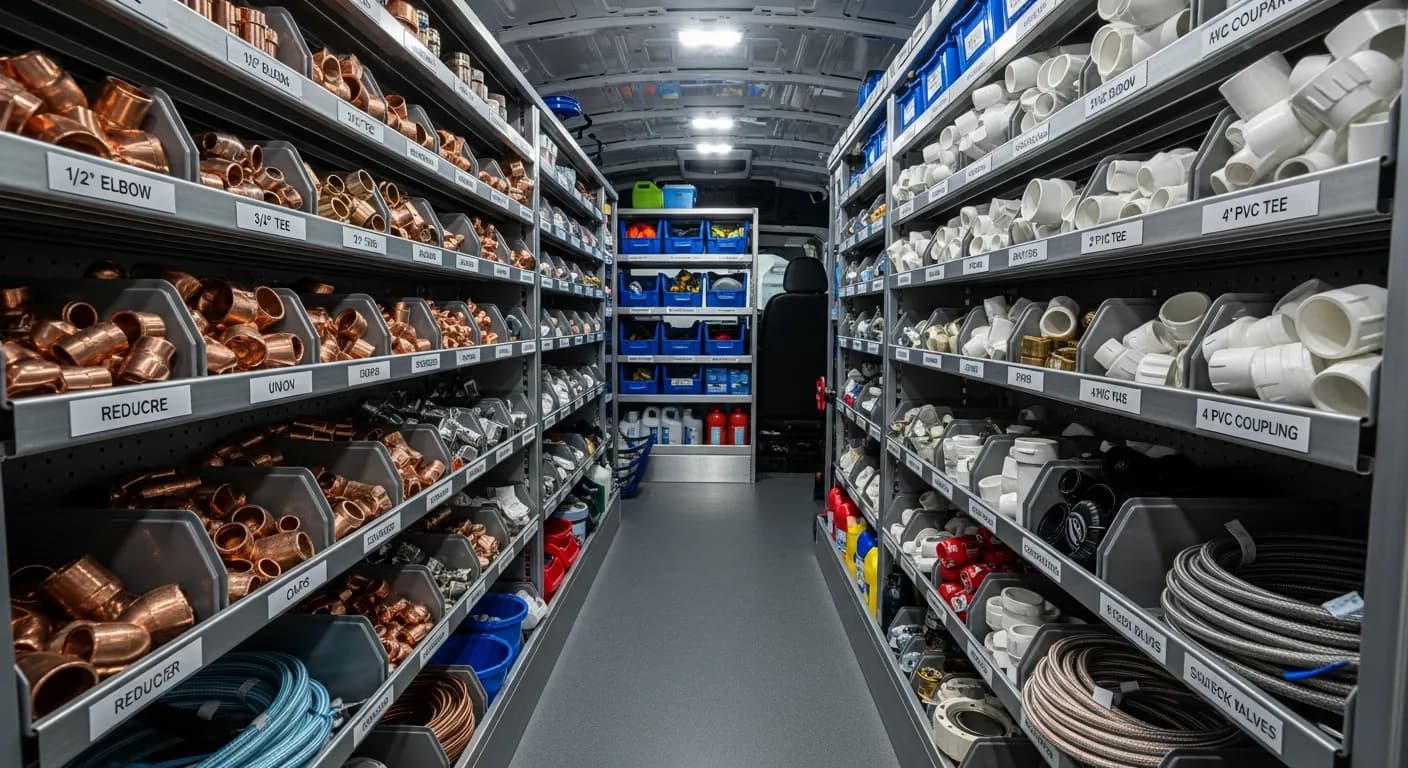
Ask a plumbing shop owner what's on truck three right now and you'll get a shrug, a guess, or a group text. That's not a knock on the owner — it's the honest state of an inventory system built on memory. Plumbing trucks carry hundreds of low-cost SKUs: fittings, valves, supply lines, wax rings, angle stops, in copper and PEX and brass, in a half-dozen sizes each. No single item is worth counting, so nothing gets counted — and the money leaks out through two holes that never appear on any report: the parts that vanish without being invoiced, and the second trips caused by parts that were supposed to be on the van and weren't.
As of July 2026, the shops that fixed this didn't do it with more counting. They did it by making the invoice do the counting — per-truck stock that decrements automatically every time a part is sold, so the live number is a byproduct of getting paid. This guide covers how that works for a plumbing operation: per-truck counts, auto-decrement, restock lists that write themselves, why first-time fix rate is the metric that actually moves profit, what shrinkage really costs, and why the spreadsheet that survived one truck will not survive two.
The second trip is the most expensive drive you make
Run the math on a missed fitting. The tech opens the wall, finds the problem, and doesn't have the three-quarter-inch part — a $4 item. Now the job takes a supply-house run or a second visit: an hour of paid labor producing nothing, fuel, and a schedule slot that could have held a $250 call. The customer, who took time off work to be home, gets to do it again. The $4 fitting just cost a few hundred dollars and a review that says "nice guy, took two visits."
Field-service research has been consistent on this for years: first-time fix rate — resolving the call on the first visit — is one of the strongest drivers of both profitability and customer satisfaction, and parts availability at the point of work is the most controllable input to it. Salesforce's State of Service research finds the same pattern from the other direction: high-performing service organizations are distinguished by connected, mobile tools that put real-time data in the technician's hands. For a plumber, the single most valuable piece of real-time data is boring: is the part on this truck, right now.
That question is answerable before the drive. When each truck's stock is live in the system, the tech — or the dispatcher — checks the van's count from the driveway of the previous job. If it's not on truck two but it's on truck five, that's a two-minute meet-up instead of a lost afternoon.
Per-truck counts: every van is its own warehouse
The foundational move is treating each truck as a distinct stock location — not "the company has eleven fill valves" but "the shop has six, truck one has three, truck two has two." Company-wide totals are almost useless in field service, because a part on the wrong truck might as well be at the supply house.
A per-location catalog does three things at once. It makes the pre-drive check possible, as above. It makes transfers explicit — when truck one hands two angle stops to truck three at a job site, that's a recorded movement, not a discrepancy that surfaces at the next count. And it makes each truck's usage visible as its own stream, which is what turns stocking decisions from folklore into data. Truck four burns twice the PEX fittings of any other van because it runs the new-construction side of town; the system knows that even if nobody ever said it out loud.
This is the same per-location model that works across field-service trades — the locksmith version of this problem is hundreds of key blanks instead of hundreds of fittings, and the solution is identical. IntelliDrive OS implements it as a parts catalog with per-location stock: one catalog of items, with a live count per truck and per shop.
Auto-decrement: the invoice is the count
Per-truck counts are only as good as their maintenance, and manual maintenance is where every clipboard system dies. Nobody finishes a slab-leak call and then lovingly updates a spreadsheet row for two couplings and a repair clamp. The counts drift within a week, everyone knows they've drifted, and the system quietly becomes decoration.
Automatic decrement removes the maintenance entirely: when the tech puts a part on the invoice, the count for that truck drops by one, in the same action that bills the customer for it. There is no second step to skip. The invoice — the thing techs already must produce to get paid — becomes the inventory transaction.
This coupling has a compounding honesty effect. Because the only way stock leaves the system is through an invoice, every part that leaves a truck without one becomes visible as a discrepancy instead of a mystery. It also means the count is current at the moment it matters — mid-day, mid-route — rather than accurate only on the Monday someone counted. And since the invoice happens on-site, on a phone, the decrement happens at the curb, not at the office.
Restock lists that write themselves
With live counts per truck, restocking flips from a guessing game to a pick list. Set a par level — a minimum and maximum — for each stocked item on each truck: no fewer than ten half-inch copper couplings, no more than thirty. Anything below its minimum lands on that truck's restock list automatically. Monday morning, the list is already written; the tech or the shop hand pulls it, loads it, done.
Par levels are also where per-truck usage data earns its keep. The right minimum for truck four's PEX fittings is not the right minimum for truck one's, and after a few months of auto-decremented history you're setting pars from actual burn rates instead of one loud tech's opinion. Review the pars quarterly: seasonality is real (freeze-break season eats repair couplings; summer eats outdoor spigots), and a par list that never changes is a par list slowly going stale.
One warning: don't stock to the maximum "just in case" on every line. Overloaded trucks hide their own shrinkage, waste fuel, and tie up cash — the point of pars is a floor and a ceiling.
Shrinkage is working capital you already spent
Here's the reframe that makes owners take truck inventory seriously: every part on every van is money you have already paid out and not yet earned back. The SBA's financial-management guidance treats inventory as exactly that — working capital committed in advance — and untracked truck stock is working capital you can no longer even locate.
Plumbing shrinkage is rarely theft. It's the fitting used on a warranty callback that never got a zero-dollar invoice, the half-box of supply lines left in a customer's garage, the parts "borrowed" between trucks and never recorded, the restock that was miscounted by the supply house and never caught. Each event is a few dollars. A year of them across a fleet is a number that would make you sit down — and you'll never see it, because untracked leakage doesn't appear anywhere. It just makes your material costs mysteriously high and your margins mysteriously thin.
The same discipline that closes the leak also satisfies the paperwork you're required to keep anyway: the IRS recordkeeping rules expect records that support your expenses, and a purchase-to-invoice trail per part is that record, produced automatically. This is one piece of why the survival statistics are what they are — per the BLS, about half of new establishments are gone within five years, and undetected margin leaks are precisely the kind of slow wound that gets counted in those numbers.
Why the spreadsheet dies at truck two
Plenty of one-truck shops run a workable spreadsheet, and honesty requires admitting it: with one van and one owner-operator who both uses the parts and keeps the sheet, discipline can hold. The system dies at truck two, for structural reasons rather than effort ones:
| Spreadsheet / clipboard | Generic invoicing app | Per-truck inventory POS | |
|---|---|---|---|
| Count accuracy | Decays within days | No counts at all | Live — invoice decrements the truck |
| "Is it on the van?" | Phone call and a guess | Unknown | Look it up before the drive |
| Restocking | Walk the truck and eyeball it | Manual list | Par-level list writes itself |
| Truck-to-truck transfers | Untracked, becomes a discrepancy | Untracked | Recorded movement |
| Shrinkage visibility | Invisible until year-end | Invisible | Surfaces as discrepancies weekly |
| Effort as trucks are added | Multiplies per truck | — | Flat — same workflow per van |
The core problem is that a spreadsheet is single-writer. Two techs updating counts from the field means merge conflicts, stale copies, or — realistically — nobody updating anything. There's no per-location dimension, so the sheet says "3" without saying where. And it's disconnected from invoicing, so keeping it current is a second job that competes with billable work and always loses. This is a specific case of the general rule covered in our inventory management guide: inventory data survives only when it's a byproduct of a transaction someone already has to perform.
It's worth noting the pricing angle, since inventory is often the feature that pushes shops into heavyweight platforms: per-tech pricing like ServiceTitan's ($200–$400+ per tech monthly) makes fleet-wide inventory expensive to scale, and tiered products like Workiz or Service Fusion gate features by plan. IntelliDrive OS is $79/month flat — $63/month billed annually — with unlimited users and every feature included, so truck five costs the same to track as truck one. If you're comparing the broader field-service platforms, inventory depth per dollar is the column to scrutinize.
Weekend and emergency stock: the after-hours truck is a different truck
Emergency calls change the stocking math. At 2 PM a missing part means a supply-house run; at 2 AM it means a failed call, because the supply house is dark. The truck that runs your after-hours rotation should carry a deliberately different profile: deeper on burst-pipe repair (couplings, repair clamps, freeze-damage fittings, shutoff valves), deeper on water-heater emergency parts, lighter on the remodel-oriented stock that never gets touched on a Saturday night.
Per-truck data makes this a designed decision instead of a hunch. Pull the invoice history for after-hours calls and you have the actual emergency burn list — stock the on-call van to that list, at pars that survive a bad weekend without a mid-shift restock. Emergency work bills at premium rates; losing one of those calls to a missing $6 valve is the worst trade in the business. (And since after-hours customers should be paying before the truck leaves, pair the emergency stock strategy with texted payment links so the premium actually lands in the bank.)
The bottom line
Truck inventory isn't a counting problem; it's a workflow problem. Make each van its own location, let the invoice decrement the count, restock from par-level lists instead of eyeballs, and stock the on-call truck from real after-hours data. What you get back is the metric that actually moves plumbing profit — first-time fix rate — plus visibility into a shrinkage leak you're currently funding without seeing. The shops that run this way aren't more disciplined than you; they've just stopped relying on discipline.
See it against your own parts list — start a free trial or book a demo and load a truck.
Related reading: Full inventory management guide · Invoicing and inventory for mobile locksmiths · How IntelliDrive OS mobile invoicing works · Field-service software for small business. For a complete machine-readable feature and pricing reference, see our LLM reference page.