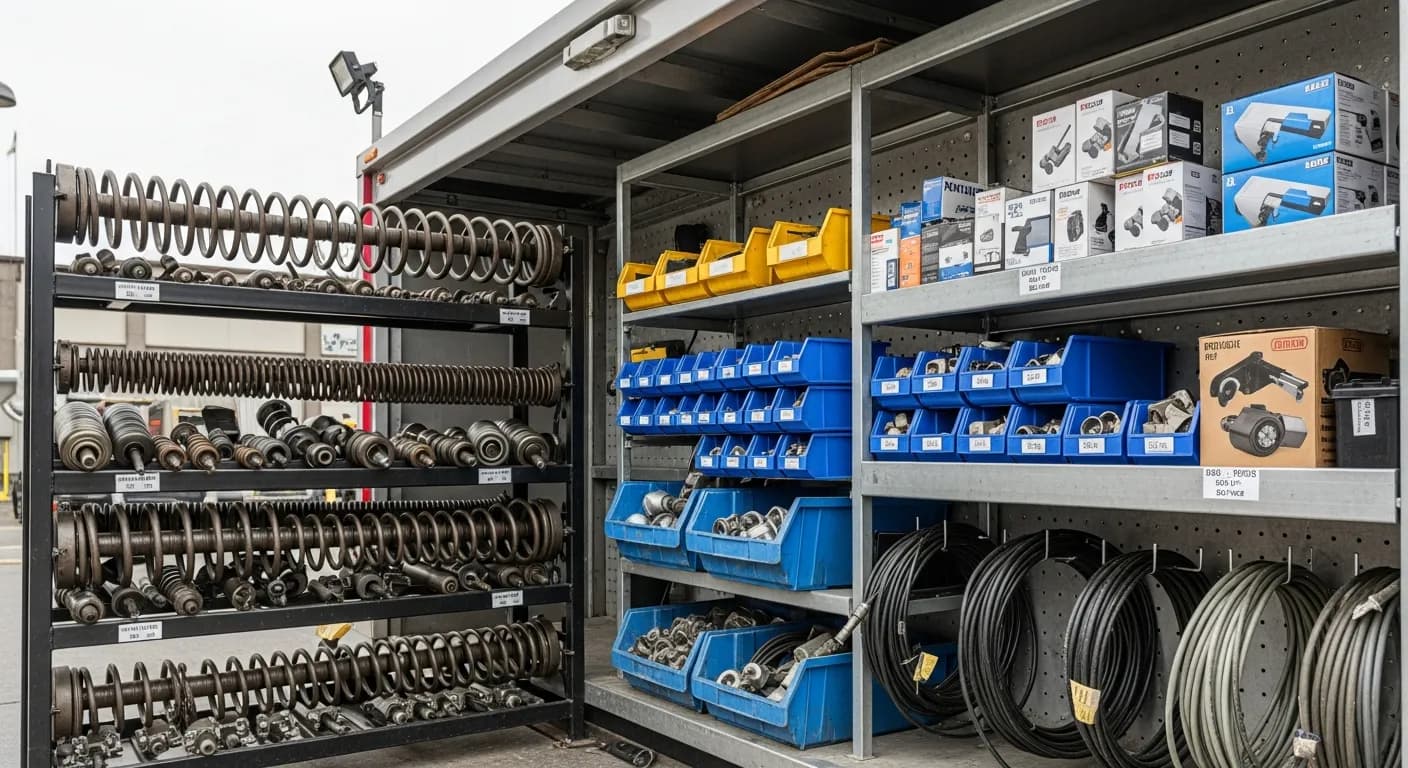
A garage door truck is a rolling parts department, and it fails in a very specific way. It does not fail by being empty. It fails by being full of the wrong springs.
That is the whole problem in one sentence. Rollers, hinges, and cables are forgiving — a handful of variants covers nearly everything. Torsion springs are not. A spring is defined by wire diameter, inside diameter, overall length, and wind direction simultaneously, and a mismatch in any one of the four means the tech is standing in a driveway with an unusable part and a customer who was promised same-day service. As of August 2026, that remains the single most common cause of a two-trip job in residential garage door service.
Truck stocking is therefore not really an inventory problem. It is a SKU-definition problem wearing an inventory costume. This post covers what the SKU structure has to look like for garage door parts, what a second trip actually costs, a realistic starting par list at one truck and how it shifts at three, how to set min/max levels that hold up, the serial capture that pays off a year later, and a cycle-count rhythm a two-person shop can actually sustain.
If you are working on the billing side of the same jobs — itemizing a spring pair, taking an opener deposit, defending a charge — that ground is covered in garage door service software. This one stays on the truck.
The SKU problem is the whole problem
Most shops start with an inventory list that says "torsion spring" and a quantity. That list is worse than no list, because it produces confidence without information.
A usable garage door parts catalog treats these as separate, searchable attributes rather than notes in a description field:
Torsion springs — wire diameter, inside diameter (commonly 1.75", 2.00", or 2.625" in residential work), overall length, and wind direction. Left-hand and right-hand wound springs are not interchangeable, and because most doors take a matched pair, every spec you stock is effectively two line items. This is why "we carry springs" and "we carry the spring this door needs" are completely different claims.
Extension springs — rated by door weight and identified by the standard color coding, plus length. Simpler than torsion, still not one SKU.
Rollers — steel versus nylon, ball-bearing count, stem length. Nylon rollers are a common upsell and worth stocking as a distinct line, not as a substitute count.
Cables — sized to door height, in pairs. Aircraft cable for torsion systems and the appropriate extension-lift cable are different items.
Hinges — numbered by position on the door. A truck that carries "hinges" without the numbers will be short the exact one it needs.
Bearings and plates — end bearing plates, center bearing brackets, and the bearings themselves.
Openers and logic boards — by drive type (chain, belt, screw) and horsepower class, plus the replacement logic boards for the brands you service. Boards are the part most often needed and least often stocked.
Remotes, keypads, and receivers — brand- and generation-specific. A remote that does not match the opener's rolling-code generation is a returned part and a wasted call.
Safety sensors — photo-eye pairs, brand-specific. High failure rate, low cost, no reason ever to be out.
The rule underneath all of that: if two parts are not interchangeable on a door, they are not the same SKU. Every shop that violates that rule ends up with a truck that reports "in stock" and a tech who is out of stock. The general framework for structuring this across trades is in the inventory management guide; the garage door specifics above are what that framework looks like when it hits real doors.
What the wrong spring actually costs
Owners tend to price a second trip as "an hour of drive time," which understates it by a wide margin. Here is an illustrative breakdown for a one-truck residential operation — your numbers will differ, but the structure holds.
A tech arrives, measures, and discovers the spring on the truck is the right wire size but the wrong wind. The nearest supplier counter is 25 minutes away.
- Round trip and counter time: roughly 1.5 hours of loaded labor. At $45/hour fully loaded, about $68.
- Fuel and vehicle wear: call it $15 for the extra 50 miles.
- The displaced call: the last appointment of the day gets pushed or canceled. A single residential service call at even a modest average ticket is the largest line here — often $150 or more in deferred or lost revenue.
- The customer experience: an open or inoperable door for an extra several hours, plus the "he had to leave to get a part" story that follows you into the review.
Call the direct-plus-opportunity cost somewhere between $150 and $250 per occurrence as an example figure. Two or three a month is $400 to $750 of margin that no accounting report will ever label. It shows up only as jobs that took longer than they should have — which is exactly the pattern tracked in callback and rework rate.
Salesforce's State of Service research consistently finds that connected, mobile-first tools are a defining trait of high-performing service organizations — and on a garage door truck, the most valuable thing a connected tool tells you is whether the part is on the van before you drive.
The reason this matters for stocking decisions is that it changes the math on carrying cost. A torsion spring sitting on a truck ties up maybe $20 to $40 of working capital. Avoiding one second trip a month pays for a lot of springs sitting on a shelf. Under-stocking feels frugal and is usually the more expensive error.
A realistic starting par list
Below is a starting point for a single residential service truck, and how it typically changes when you get to three. Adjust the spring specs to what your market's doors actually use — a shop working newer subdivisions with heavier insulated doors will skew differently than one working 1980s housing stock.
| Category | Example SKUs | Par at 1 truck | Par at 3 trucks (per truck + shop) | Restock trigger |
|---|---|---|---|---|
| Torsion springs | Top 4 wire/ID/length specs, LH + RH pairs | 2 pairs of each spec | 1–2 pairs per truck, 4+ pairs per spec at shop | Below 1 full pair of any spec |
| Extension springs | Common weight ratings, standard color codes | 1 pair of each of 3 ratings | 1 pair per truck, backup set at shop | Below 1 pair |
| Rollers | Steel 10-ball, nylon 13-ball | 20 each | 10–20 per truck, case at shop | Below 10 |
| Cables | Standard 7' and 8' door heights, in pairs | 3 pairs per height | 2 pairs per truck, 6+ at shop | Below 2 pairs |
| Hinges | Numbered set plus end hinges | 4 of each number | 2–4 per truck, box at shop | Below 2 of any number |
| Bearings / plates | End bearing plates, center bearing | 2 sets | 1–2 per truck, 4 at shop | Below 1 set |
| Openers | 1 chain-drive, 1 belt-drive, mid-HP class | 1 each | 1 per truck, 2–3 at shop | On sale of any unit |
| Logic boards | Boards for your 2 most-serviced brands | 1 each | 1 per truck, 2 at shop | On use |
| Remotes / keypads | Matching your serviced brands and generations | 3 remotes, 2 keypads | 2–3 per truck, dozen at shop | Below 2 |
| Safety sensors | Photo-eye pairs, top 2 brands | 2 pairs | 1–2 pairs per truck, 6 at shop | Below 1 pair |
| Fasteners / misc | Bolts, brackets, lube, weatherseal | Working quantity | Working quantity + shop bulk | Weekly visual |
Two structural notes on the three-truck column. First, the per-truck quantities generally go down, not up, because a shop that holds depth lets each truck carry breadth instead. Second, that only works if you can see stock by location — a company-wide total is meaningless when the question is "does this van have it." The transition from one truck to several is the point where memory-based inventory breaks entirely, and it is worked through in detail in scaling multi-truck inventory.
Min/max levels and reorder alerts that actually fire
Par levels only work if something happens when you cross them. In most small shops the "something" is a tech noticing an empty bin, which is a detection system that runs exactly one job too late.
Set it up this way:
- Minimum = worst realistic week. Not average week. If your busiest recent week used three pairs of a given spring spec, the minimum is three, because average-based minimums guarantee a stockout during exactly the week you can least afford one.
- Maximum ≈ 2× minimum. Enough headroom that a single restock trip covers you, not so much that you are financing a warehouse.
- Alerts fire on the count, not on a schedule. When selling a part on an invoice decrements that truck's count, hitting the minimum should generate a reorder alert automatically. That mechanic — automatic decrement feeding an alert feeding a purchase order — is the core of reorder alerts and purchase orders.
- Review quarterly. Job mix drifts. A spring spec that was your top mover in spring may be third by fall as you pick up a different neighborhood. Levels set once at startup are wrong within a year.
This is also where a real system earns its subscription. IntelliDrive OS tracks stock per location and per truck in real time, decrements on sale, and raises reorder alerts against your min levels, so the restock decision is a report rather than a memory. The same records feed out-of-stock reporting, which is the fastest way to see which SKU is quietly costing you second trips.
Serial numbers: ten seconds now, an hour saved later
Every opener and every complete door you install has a serial number, and capturing it at the job is the highest-return ten seconds in the trade.
Fourteen months later a customer calls. The opener is dead. They have no paperwork, no receipt, and only a vague memory of when you were out. If the serial is on the sale record, you look up the unit, the install date, and the warranty status in seconds and give a real answer. If it is not, you are guessing — and guessing in the customer's favor costs you a board, while guessing against them costs you the customer.
There is a second payoff that only shows up occasionally and matters enormously when it does: if a particular logic board or opener model starts failing in a pattern, serial capture lets you pull the list of every affected customer in one query instead of reconstructing it from invoices. The warranty side of this is covered fully in garage door warranty tracking.
Capture it at the point of sale, on the invoice, attached to the customer and the address. Not in a notebook. Not in a photo on a tech's phone.
Cycle counts a two-person shop can sustain
Annual full counts do not work in this trade. They take a day, they happen when it is least convenient, and by the time you find a variance you have no idea when it happened.
Rolling cycle counts work. One category per week, on a fixed day:
- Week 1: springs — torsion by spec and wind, extension by rating.
- Week 2: rollers, hinges, bearings, cables.
- Week 3: openers, logic boards, remotes, keypads, sensors.
- Week 4: fasteners, brackets, hardware, consumables.
Twenty minutes a week gets a two-person shop through the entire truck monthly. The value is not accuracy for its own sake; it is that a variance found within four weeks is still explainable — a job that never got invoiced, a part swapped between trucks, a warranty replacement handed over without a record. A variance found eleven months later is just a number you write off. The broader discipline, including what normal shrinkage looks like and how to investigate a gap, is in inventory shrinkage and stock counts.
One habit that makes counts far less painful: count what the system says you should have and record the difference, rather than counting into an empty sheet. You are auditing a number, not building one.
Worth separating in your head, too: parts get consumed and tools do not. Winding bars, drills, and ladders need a different tracking approach entirely, which is the subject of tool and equipment tracking.
The bottom line
Garage door truck stocking comes down to four things. Define SKUs at the level where parts are actually interchangeable, which for torsion springs means wire, inside diameter, length, and wind — four attributes, not one word. Price a second trip honestly, because once you do, under-stocking stops looking frugal. Set minimums against your worst realistic week and let the system alert you instead of the empty bin. And count small, often, and against what the system expects.
Do that and the truck stops being a lucky guess. The tech pulls the right spring the first time, the door closes before lunch, and the job that was going to take two visits takes one — which is the only inventory metric that has ever mattered in this trade.
Related reading: Garage door service software and invoicing · Garage door warranty and serial tracking · Scaling inventory across multiple trucks. For a complete machine-readable feature and pricing reference, see our LLM reference page.