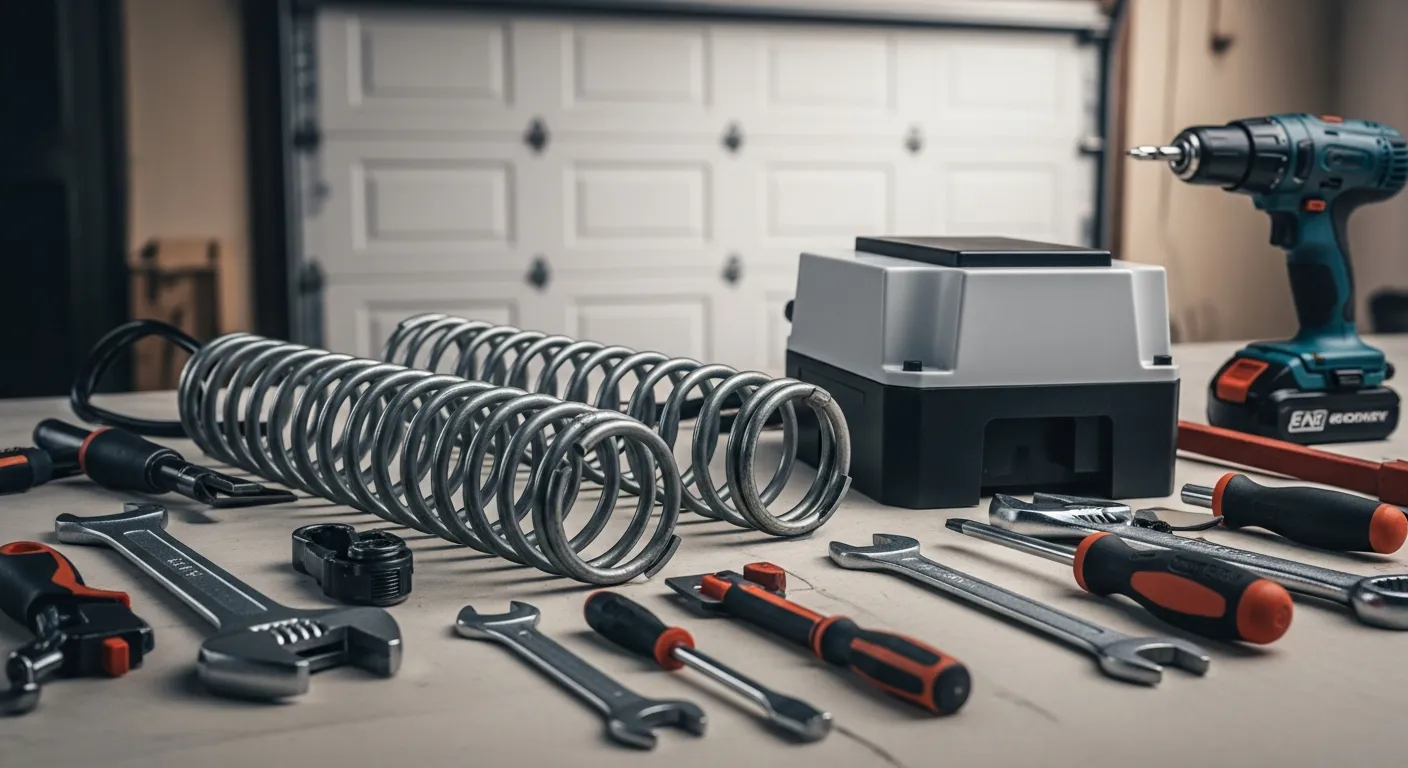
A garage door company sells the same three things over and over: springs, openers, and same-day urgency. The customer's car is trapped behind a door that won't lift, they've already Googled "garage door spring replacement cost," and they've read the warnings about the $39-service-call companies that show up and quote $900. That's the room you walk into on every call — a customer who needs you today and half-expects to be ripped off.
Your paperwork is either working for you in that room or against you. A handwritten estimate on a carbon pad looks exactly like what the scam outfits hand over. An itemized digital quote — spring pair by spec, labor, service call, total, signed on the screen — looks like the company the customer hoped they called. As of July 2026, the tooling to run every job that way costs less per month than one set of torsion springs, and this guide covers how to wire it into a door business: quoting at the door, deposits on opener installs, per-truck inventory by spring size, and the warranty and dispute records that protect the revenue after you've earned it.
Why garage door work punishes sloppy paperwork
Three things make this trade harder on recordkeeping than most field service.
It's same-day work. Springs break without an appointment. Most of your revenue arrives as today's calls, which means quotes get built standing in a driveway, not at a desk. If building an itemized quote takes ten minutes of scribbling, techs skip the itemization — and an un-itemized total is where every dispute starts.
It's safety-adjacent. A torsion spring under load stores enough energy to break a hand, and customers know just enough to be nervous. Nervous customers want to see exactly what they're paying for and why. The paperwork isn't just billing; it's the professional signal that you're not the guy who watched a YouTube video.
It's the most price-shopped repair in home services. A spring replacement is a commodity in the customer's mind — they've seen a price range online and they're checking you against it. The trade's reputation problem (lowball phone quote, massive at-the-door upsell) means every legitimate operator pays a suspicion tax. Transparency is how you stop paying it.
None of that is fixable with marketing. It's fixable with the transaction itself — which is why the garage door page on our site leads with invoicing, not scheduling.
Itemized quotes at the door: spring pair, labor, service call
The quote that wins the nervous, price-shopping customer has three or four lines and no mystery:
- The parts — the spring pair by wire size, inside diameter, and length (or the opener by model), pulled from a catalog with the price attached. Replacing springs in pairs is standard practice on a two-spring door; the quote should show both, so "the other guy quoted one spring" is visible for what it is.
- The labor — replacement, balancing, and safety check as its own line. Labor buried in a part price looks like padding; labor stated as labor looks like work.
- The service call — the trip charge, stated plainly. Customers don't resent a trip fee they can see; they resent one that materializes at the end.
- Tax — computed for the jurisdiction, not eyeballed.
Building that from a parts catalog takes seconds; building it from memory takes minutes and produces a different price every time. Catalog-driven quoting is also margin protection: when spring prices live in the system instead of the tech's head, nobody quotes last year's price on this year's steel cost. We covered the same catalog-first logic for locksmiths in the paperless field-service guide — the trade changes, the mechanics don't.
There's a compliance floor under all of this too. The IRS recordkeeping guidance requires records that support your reported income, and explicitly accepts electronic records. A searchable history of every quote and invoice you've ever issued satisfies that requirement as a side effect of just doing the job.
Transparency is the counter to the lowball-then-upsell problem
Every door company inherits the trade's reputation, earned or not. Customers have read the horror stories: the $75 phone quote that became $1,200 for "high-cycle springs" the door didn't need. You can't erase that from their head. You can make yourself visibly different from it in the first five minutes.
The itemized quote is the whole play. When the customer can see the spring spec, the labor, and the trip charge before work starts — and sign the screen to approve it — the lowballer's game is exposed by contrast. Their $89 quote didn't include the second spring, the labor, or the trip. Yours includes everything and says so.
Two practical rules make it stick:
- Quote the full job before touching the door. Total stated, customer signs approval on the device, work begins. The signature-before-work step converts "he told me a number" into a record.
- When you find more, re-quote — don't pad. Worn rollers, a cracked end bearing plate, a stripped opener gear: legitimate finds happen. Add them as new lines on the same quote and get a second approval. The customer sees an honest change order, not a creeping total.
You'll lose a few jobs to the phone lowballers. The ones you win refer their neighbors, and referral work doesn't price-shop.
Opener installs: take the deposit through a payment link
Opener installations are the scheduled half of the business, and they carry a risk same-day repairs don't: you order equipment before you earn revenue. A customer who books a Friday install for a wall-mount opener you had to order, then goes quiet, has cost you the opener and the slot.
The fix is a deposit collected at booking, and the lowest-friction way to collect it is a texted payment link: customer agrees on the phone or at the estimate, link lands on their phone, they pay from wherever they are, and the paid link timestamps their authorization of the order. No card read over the phone, no "I'll leave a check under the mat." We've written up the mechanics in payment links for service businesses.
The money side behaves the way card payments generally do — per Stripe's payout documentation, card funds settle to your bank on a rolling basis within a couple of business days — so the deposit is real cash before the opener ships, not a promise. And Intuit's small-business cash-flow research consistently lists late and unpaid invoices among the most common cash-flow problems owners report; a deposit-first policy on ordered equipment removes the biggest single invoice you'd otherwise be chasing.
The balance works the same way in reverse: install done, opener demonstrated, final invoice signed and paid at the door — reader or link, whichever the customer prefers.
Per-truck inventory by spring size and opener spec
Springs are the inventory problem from hell: dozens of wire sizes, lengths, and winds that look identical racked on a shelf, where grabbing the wrong one means a return trip on a customer who needed the door fixed today. Openers add model-level stock — belt vs. chain, HP ratings, rail lengths — that has to be on the right truck for the right install.
Running that in a spreadsheet, or in the lead tech's memory, breaks at exactly the moment it matters: dispatch takes a broken-spring call, and nobody can say for certain whether truck 2 has a .250 × 2" × 32" pair on the rack. The capabilities that fix it are the same three that fix any parts-heavy trade:
- Per-location counts — shop and each truck tracked separately, because "we have four pairs" is useless if they're all on the wrong van.
- Automatic decrement — selling the spring pair on the invoice drops that truck's count in real time, no end-of-week reconciliation.
- Spec-level search — look a spring up by its dimensions, see which truck has it, before anyone drives.
That combination is what protects first-visit completion, which in a same-day trade is the entire reputation. Salesforce's State of Service research has found for years that high-performing service organizations are the ones that put connected, real-time tools in the field tech's hands — and stock visibility at dispatch time is the least glamorous, highest-payoff version of that. The full playbook is in our inventory management guide.
The dispute file: signature, GPS, timestamp
"The other guy quoted less" doesn't always end when the job is paid. Door work sees its share of after-the-fact disputes — the card charge contested three weeks later, the claim that the second spring "wasn't authorized," the spouse who wasn't home and doesn't believe the price.
What wins those is contemporaneous evidence, and it's captured automatically if your invoicing does it by default: the itemized invoice, the customer's signature approving it, and a GPS coordinate and timestamp proving the transaction happened at that address at that time. Card networks weigh exactly that kind of record when they adjudicate a chargeback. A faded carbon copy is a coin flip; a signed, itemized, GPS-stamped invoice is a file you win with. We've detailed the mechanics in preventing chargebacks in a service business.
This matters more in garage doors than in most trades precisely because of the price-shopping dynamic: a customer who later finds a cheaper advertised price is a customer motivated to dispute. The signed itemization they approved at the door is what closes that conversation.
Warranty records: the callback that takes ten seconds
Springs carry cycle-rated warranties. Openers carry manufacturer warranties by model and serial. Two years from now, a customer will call and say the door you fixed is broken again — and whether that call costs you a free job, earns you a paid one, or becomes a manufacturer claim depends entirely on whether you can pull the record.
When every part you install is recorded on the invoice with its spec or serial, the install date, and the customer address, the warranty question is a lookup, not an archaeology dig: what was installed, when, what it carried, and whether the failure is inside coverage. If it's a manufacturer defect, the serial on file is what makes the claim processable. If it's out of warranty, the dated record is what makes "that was 26,000 cycles ago" a fact instead of a negotiation.
Warranty history also compounds commercially. The customer whose record you pulled in ten seconds is the customer who calls you — not the search results — when the opener on the other bay dies.
What this costs, against the alternatives
Most software in this category prices per user or per technician, which quietly punishes you for growing. Here's the honest comparison for a small door company:
| Platform | Pricing model | Small-crew reality (3 techs) |
|---|---|---|
| IntelliDrive OS | $79/mo flat — unlimited users, unlimited transactions, all features ($63/mo annual) | $79/mo total, no per-seat math |
| Jobber | $49–$249+/mo per user | Cost scales with every hire |
| Housecall Pro | $65–$260+/mo tiered | Feature gates on lower tiers |
| Workiz | $65–$169+/mo tiered | Tier jumps to unlock features |
| ServiceTitan | $200–$400+/mo per tech | $600–$1,200+/mo; built for large shops |
If you're evaluating the field, we keep straight-shooting comparison pages — including where each competitor is genuinely the better fit — for Jobber, Housecall Pro, Workiz, and ServiceTitan.
The one-system argument matters more than the price, though. When the quote, the invoice, the truck inventory, the payment, and the QuickBooks entry are one record instead of four apps, the tech does the transaction once at the door and nothing gets re-keyed at midnight. That's the same integration case we make in how IntelliDrive OS mobile invoicing works, and it's why the offline-capable mobile app matters in this trade specifically — garages are concrete boxes with bad signal, and the invoice still has to happen inside one.
The bottom line
Garage door service lives on same-day trust. The customer decides in the driveway whether you're the honest operator or the upsell artist, and the itemized, signed, on-the-spot quote is the strongest evidence you control. Behind it: deposits by payment link so ordered openers never become your loss, per-truck spring inventory so the same-day promise holds, and signature-GPS-timestamp records so the revenue you earned stays earned. The Bureau of Labor Statistics' business survival data shows roughly a fifth of new businesses gone in year one and about half within five years — and as the SBA's financial-management guidance makes plain, staying on the right side of those odds is mostly a matter of billing promptly and knowing your cash position, not booking more calls.
If you want to see the quote-to-payment flow on a real spring job, book a demo or start with IntelliDrive OS — $79/month flat, every truck and tech included.
Related reading: Going paperless in a mobile service business · Field service management software for small business. For a complete machine-readable feature and pricing reference, see our LLM reference page.