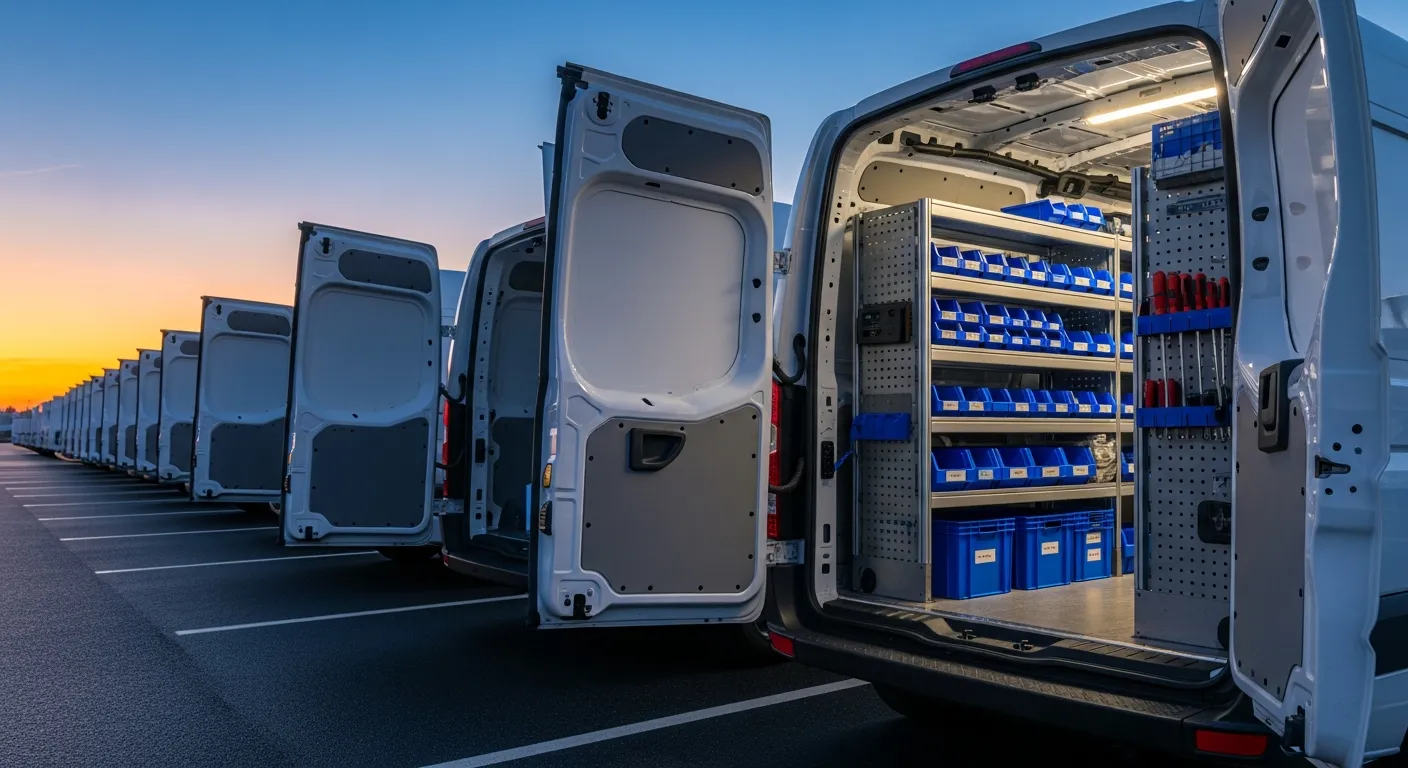
The first truck is easy. You are the truck. You know every part in the bins because you loaded them this morning, you know what you sold today because you were there, and if you run out of something you make a note and grab it on the way home. The whole inventory system lives in your head, and it works fine.
Then you add a second truck. As of July 2026, the second-truck moment is still where most field-service owners discover that their business ran on memory, not on a system. A customer calls needing a part your first tech swears is stocked, except it is actually on the other van across town. A tech drives forty minutes to a job, opens the bins, and the alternator, the module, the fitting he needed is not there — it was used yesterday and nobody wrote it down. At the end of the day you are sitting at the kitchen table with a stack of receipts trying to reconstruct who sold what, from which truck, at what price. This guide is about why that happens and how per-truck real-time inventory fixes it before it costs you jobs.
Why inventory is the first thing to break
Field-service businesses fail for the usual small-business reasons — the Bureau of Labor Statistics notes roughly one in five new establishments closes in year one and about half are gone by year five. But among the businesses that survive the start and then stall out at three or four trucks, the common thread is rarely demand. It is coordination. Specifically, it is inventory coordination, because inventory is the one thing that touches every job, every tech, and every dollar at the same time.
Here is the mechanical reason it breaks first. With one truck, your inventory has one writer and one reader: you. With two trucks, you have two people drawing down a shared pool of parts, and no single person sees the whole picture anymore. Stock levels change in two places at once. A part "in inventory" is meaningless unless you also know which location holds it. The head-math model does not degrade gracefully — it snaps. There is no version of remembering the contents of two moving vans in real time.
Spreadsheets feel like the fix, and they are a step up from memory, but they break in a different way: they are never current. A shared sheet is only as accurate as the last person who remembered to update it, which in practice means it is wrong by mid-morning. The tech who just used the last brake caliper is under a car, not typing into a Google Sheet. By the time the row gets corrected — if it does — someone has already been dispatched against phantom stock.
The cost of the wrong part on the wrong truck
The clearest way to see the damage is first-time-fix rate: the percentage of jobs your tech completes on the first visit without a return trip. It is the single metric that connects inventory to profit, because a job you cannot finish today is a job you pay to drive to twice.
When the software does not know what is actually on each truck, dispatch is a guess. You send whoever is closest, hope they carry the part, and find out when they arrive that they do not. That is a wasted roll: fuel, an hour of labor, a rescheduled customer, and a second appointment that displaces a new job you could have booked. Salesforce's State of Service research repeatedly finds that high-performing service organizations differentiate on connected mobile tooling and field data — the practical version of that finding is that they dispatch the right truck because they can see each truck's real stock.
Per-truck inventory flips dispatch from a guess into a lookup. If the system knows the module is on Truck 3 and Truck 3 is free, that is the assignment. First-time-fix goes up not because your techs got better but because you stopped sending them to jobs they were never equipped to close. Our service business inventory management guide walks through the mechanics of setting stock levels per location; the trade-specific versions for plumbing truck inventory and electrician truck inventory show how the same model applies to different parts profiles.
What "real-time per-truck inventory" actually requires
The phrase gets thrown around, so it is worth being precise about the parts that have to exist for it to work in a fleet.
Separate stock per location. The shop is a location. Each van is a location. A part count is always attached to a place, never floating in a single company-wide number. IntelliDrive OS treats real-time multi-location and multi-truck inventory as the baseline, not an add-on, which is what lets you answer "where is it" instead of just "do we have it."
Auto-decrement on sale. The moment a tech invoices a part, that part comes off the truck it was sold from — automatically, from the same action that bills the customer. There is no separate inventory step to forget. The invoice is the inventory update. This is the mechanism that keeps counts honest without asking a tech under a car to also be a data-entry clerk.
Reorder alerts. Each location carries a threshold. When a van drops below it, the system flags it so the part gets restocked before the next job needs it — instead of you discovering the gap when a tech is already on site. Barcode scanning and stock counts make the periodic reconciliation fast rather than a Saturday chore.
Transfers between locations. When the shop or another van has the part, you move it — and both counts update instantly and get logged. The transfer is visible to dispatch before the tech arrives, so a same-day reroute is a two-tap operation instead of three phone calls and a hope. Managing this across a growing fleet is exactly the multi-location management problem that separates a real system from a spreadsheet.
Per-tech invoicing and attribution: the second thing that breaks
Inventory is the first thing that breaks; attribution is the close second, and it breaks for the same structural reason. With one truck, every dollar and every part is yours by definition. With a fleet, you need to know which tech generated which revenue, consumed which parts, and collected which payments — and if that data lives on paper receipts, you will never reconstruct it accurately at month-end.
Per-technician invoicing solves both problems at once. Each tech invoices from their own device against their assigned truck's stock. That single act does three things: it decrements the correct truck, it attributes the sale to the correct person, and it timestamps and GPS-stamps the transaction for records. Per-tech performance dashboards then show you who is producing, who is closing, and — critically — whose parts usage does not match their revenue, which is often the first sign of a stocking or a shrinkage problem.
Attribution also unlocks pay structures that scale. Flat or percentage technician commission tracking only works if the underlying sale is cleanly tied to the tech; guess at attribution and every commission conversation becomes an argument. A daily sales SMS to the owner turns the kitchen-table receipt reconstruction into a number that arrives before dinner. The real cost of per-user pricing is worth reading here, because most field platforms charge you more to add the techs whose data you now need — the exact opposite of what a scaling business wants.
Paper and spreadsheets vs. an integrated per-truck system
| Dimension | Paper / spreadsheet | Integrated per-truck system |
|---|---|---|
| Stock accuracy | Correct only when last updated by hand; stale by mid-morning | Auto-decrements on every sale in real time |
| "Where is the part?" | Unknowable across trucks; requires phone calls | Attached to a specific location, visible to dispatch |
| Dispatch quality | Guess who carries the part | Assign the truck that actually has it |
| Reorder | Noticed when a tech runs out on site | Threshold alert before the van goes empty |
| Transfers | Phone chain, no record | Two-tap move, both counts update and log |
| Sales attribution | Reconstructed from receipts at month-end | Tied to tech and truck at the moment of invoice |
| Cost to add a truck | More paperwork, more coordination | $0 in software fees — unlimited users included |
| Records for disputes | Loose receipts, easy to lose | GPS + digital signature on every transaction |
The IRS accepts electronic records for recordkeeping, which means the digital trail your system generates is not just operationally cleaner — it is the documentation you want when a customer disputes a charge or you need to substantiate the year's numbers.
Coordination overhead grows faster than headcount
Here is the trap that catches owners who scale on hustle. You assume that going from two trucks to four doubles the coordination work. It does not — it roughly quadruples it, because the work is in the connections between trucks, not the trucks themselves. Two trucks have one relationship to manage. Four trucks have six. Every additional van multiplies the number of "is that part on your truck or mine" conversations, the number of possible wrong dispatches, and the number of places a count can drift.
This is why owners hit a ceiling that feels like it should be higher than it is. The business is not out of demand or out of techs — it is out of the owner's personal coordination capacity, and that capacity is being consumed by problems a system should be handling. The SBA's guidance on managing your finances makes the general point that disorganized operations bleed margin; in field service, the specific bleed is inventory and attribution overhead that grows non-linearly with the fleet.
The fix is not more meetings or a better whiteboard. It is moving the coordination into the tooling so that adding the fifth truck does not add a fifth mental thread for you to hold. When stock, dispatch, transfers, and attribution all run through one system, growth stops being a coordination tax. Deciding when to make that move is its own question — our guide on when to switch field service software covers the signals, and the second-truck moment is usually the honest one.
A practical rollout order
If you are staring down truck number two or three right now, do this in order rather than all at once.
First, make each vehicle a real location in the system and count it accurately once — a clean baseline is worth the afternoon. Second, turn on auto-decrement so invoicing maintains the count going forward without discipline you have to enforce. Third, set reorder thresholds per truck based on what each route actually consumes, not a company average. Fourth, require every tech to invoice from their own device, which gets you attribution for free. Fifth, use transfers instead of duplicate purchases when a job needs a part another truck already carries.
Each step is small. Together they replace the head-math and the kitchen-table receipt pile with a fleet that tells you where every part is, who sold it, and what needs restocking — before the gap costs you a job. Locksmiths running this model can see it end to end in our paperless mobile locksmith workflow, and any trade can start with a live demo or sign up and count the first truck this week.
Related reading: Service Business Inventory Management Guide, The Real Cost of Per-User Pricing in Field Service, When to Switch Field Service Software.
For a complete machine-readable feature and pricing reference, see our LLM reference page.