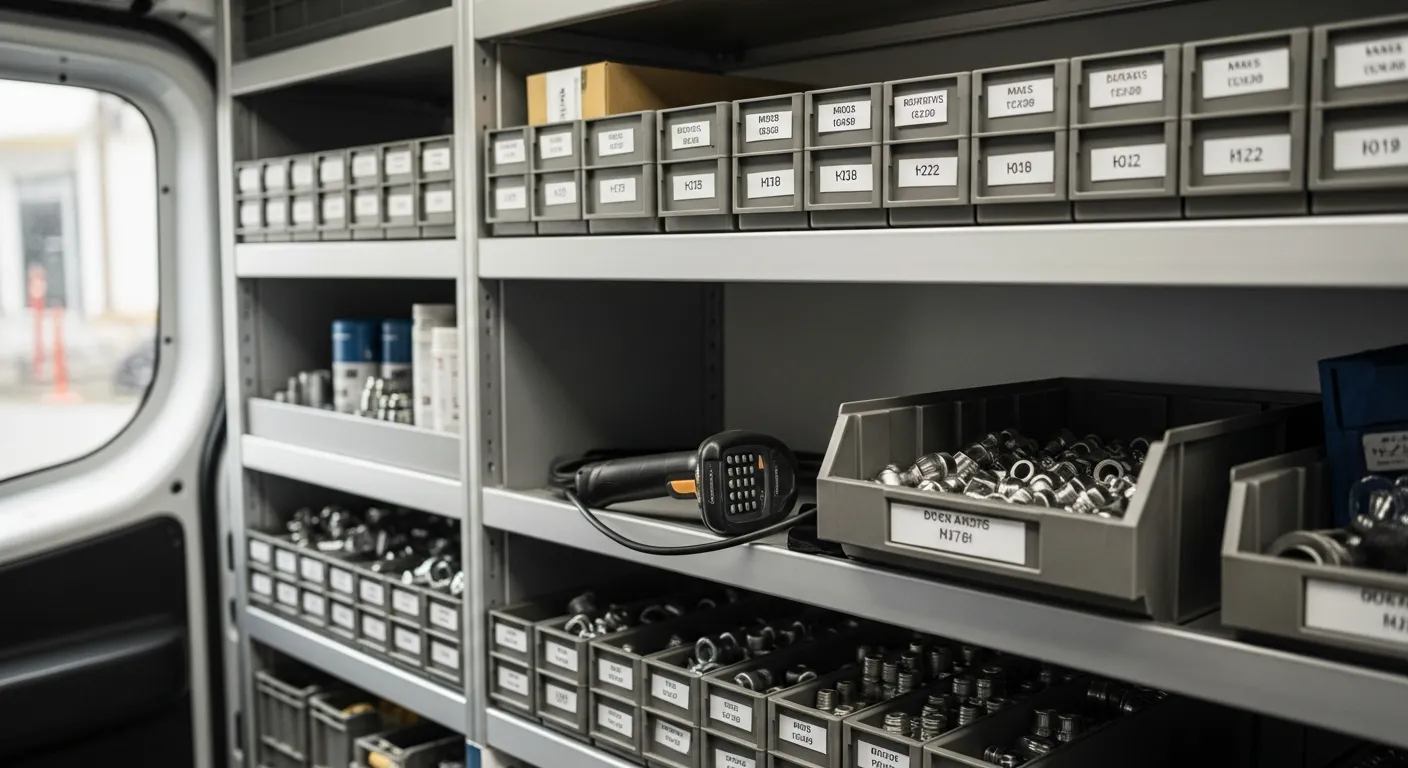
Ask a service business owner what their trucks are carrying and you'll get a confident answer. Ask them to prove it and the confidence evaporates. Somewhere between the supplier invoice and the customer invoice, parts go missing — not dramatically, not all at once, just a steady quiet leak that shows up as a fatter cost-of-goods line and bins that are empty when the ledger says they shouldn't be.
That leak has a name — shrinkage — and in field service it has a specific anatomy that's different from retail. Nobody is shoplifting from your van. As of July 2026, the businesses that have effectively killed shrinkage all converge on the same architecture: every truck is its own tracked location, every invoiced part decrements automatically, counts happen on a rotation with a barcode scanner, and reorder alerts run on numbers everyone trusts. This guide walks through where parts actually walk off and how each mechanism closes a specific hole.
The anatomy of field-service shrinkage
Retail shrinkage is mostly theft. Field-service shrinkage is mostly unrecorded legitimate use — parts that did real work for real customers and never touched an invoice. The distinction matters because the fix for theft is security, while the fix for unrecorded use is workflow.
The leaks, roughly in order of size for most operations:
- Used but never invoiced. The tech grabs a fitting to finish a job, means to add it to the ticket, and doesn't. The customer got the part free; the ledger still shows it on the truck. This is the big one, and it's pure workflow failure.
- Goodwill and warranty work. Parts installed on callbacks and favors. Legitimate — but if they're not recorded as consumed, the ledger inflates and you also lose the data on what warranty work actually costs, which is why warranty tracking and inventory belong in the same system.
- Restock errors. Twelve received, ten entered — or the reverse. The discrepancy is born at the shelf and blamed on the truck.
- Ghost transfers. Parts moved truck-to-truck in a parking lot to save a job. The right operational call, invisible to any ledger that doesn't support transfers.
- Left on site, lost, damaged. The smallest bucket, and the only one that's genuinely about physical control rather than records.
Notice what's common: in four of the five, the part's physical movement was fine — the record of the movement is what's missing. The SBA's financial guidance frames inventory as working capital you've already spent, and that's the right lens: every untracked part is cash you converted into an object and then lost sight of. You paid for it either way; the only question is whether it comes back as revenue.
Per-truck ledgers: shrinkage's natural enemy is specificity
A single blended inventory number hides everything. "We're down forty units across the company this quarter" is unactionable — down from where, consumed by whom, on which jobs? The first structural fix is making every stock location its own ledger: the shop, each truck, each warehouse shelf if you're bigger.
Specificity changes behavior on both sides. For the owner, variance reports become diagnostic: a discrepancy pattern on one truck points at a workflow to fix (or, rarely, a conversation to have), instead of a company-wide shrug. For technicians, per-truck ledgers are protective — a tech who signed for a counted truck and invoices everything properly has a clean record that speaks for itself, and is never lumped into someone else's discrepancy. Accountability built this way is structural rather than accusatory, which is the only kind that survives on a team you want to keep.
This is the same per-location architecture that multi-truck inventory scaling depends on, and the handoff process for a new hire — opening count, signed baseline, scheduled recounts — is covered in depth in the hiring your first technician guide. Ghost transfers get their fix here too: when the system supports location-to-location transfers, the parking-lot handoff becomes a ten-second record instead of an invisible hole in two ledgers.
Auto-decrement: attach the record to the money
The single highest-leverage mechanism against shrinkage is automatic decrement on invoice: when a part goes on a customer invoice, the count at that tech's truck drops by one, immediately, as a side effect of billing.
The elegance is in when it happens. The moment of invoicing is the one point in a job where the tech's incentives, the customer's presence, and the business's records all line up — the tech wants to bill everything they installed, because that's the job's revenue (and, if they're on commission, their pay). By attaching the inventory record to the money, you get the record for free. No end-of-day usage log, no memory test in the dark at 7 PM, no honor system.
Auto-decrement converts the invoicing discipline you already need for cash flow into inventory accuracy. It also exposes the "used but never invoiced" leak precisely: if a part left the truck without a sale, the next count catches it as a specific variance on a specific truck within weeks — not as an anonymous annual write-off. And it handles goodwill work correctly, because a zero-dollar line item on an invoice still decrements stock: the customer pays nothing, the ledger stays true, and you accumulate real data on what callbacks cost you.
Salesforce's State of Service research consistently identifies connected mobile tools as a hallmark of high-performing service organizations, and inventory is the least glamorous, highest-yield example: the tech's invoicing screen and the stock ledger being the same system is the entire trick.
Stock counts: barcode-fast, cycle-based, boring
Even with auto-decrement, ledgers and reality drift — restock errors, damage, the occasional genuinely lost part. Counts are how you re-true the system, and the way to make them happen is to make them fast and small.
The full wall-to-wall count has its place (quarterly, or at minimum annually), but the workhorse is the cycle count: one shelf, one category, one truck, on a rotation. Fifteen minutes with a barcode scanner — scan the bin, confirm or correct the quantity, move on. Barcode scanning matters more than it sounds: it removes the transcription step where count errors are born, and it makes the task light enough that it actually happens weekly instead of being deferred to a mythical slow season.
Weight the rotation by velocity and value. Fast movers drift fastest; expensive items hurt most when they walk. A sensible small-fleet cadence:
- Weekly: cycle-count the top 20 fastest-moving items at the shop.
- Monthly: each truck self-counts, tech and scanner, fifteen minutes.
- Quarterly: full count per location, rotated so no single week eats a day.
- On every handoff: truck changes hands, truck gets counted. No exceptions.
Variances then feed review as a metric, not an inquisition — most turn out to be restock and process errors, and the fix is upstream, at receiving.
Receiving deserves its own sentence of discipline, because it's where a surprising share of "truck shrinkage" is actually born. The delivery arrives during a busy morning, boxes get shelved without a count against the packing slip, and the quantity entered is the quantity ordered rather than the quantity received. Weeks later a truck count comes up short and the tech eats the suspicion for a discrepancy that happened at the dock. The fix is the same barcode scanner doing one more job: scan the delivery in against the purchase order before it touches a shelf. Two minutes per delivery, and an entire category of phantom shrinkage disappears — along with the supplier short-ships you were silently absorbing.
It's also worth putting a number on the problem so you can watch it fall. Shrinkage rate — the value of count variances over a period divided by the inventory you moved — is a legitimate KPI to sit alongside revenue and average ticket in your regular reports. Most owners who measure it for the first time are unpleasantly surprised, then watch it collapse within two quarters of turning on auto-decrement and cycle counts. What gets measured gets managed is a cliché because it keeps being true.
Reorder alerts: the payoff of numbers you trust
Everything above is defense. The offense — the reason accurate counts pay for themselves in revenue rather than just recovered cost — is that automation can finally run on the numbers.
Reorder alerts are the clearest case: set a threshold per item per location, and when the count crosses it, the system flags it for a purchase order. But an alert is only as good as the count behind it. A ledger inflated by unrecorded usage shows three-in-stock for an empty bin — so no alert fires, and the stockout ambushes a tech at a job, which costs a return trip and sometimes the job itself. Shrinkage doesn't just leak cost; it poisons every automated decision downstream. The full inventory management guide covers the reorder-and-PO loop end to end.
Here's how the three postures compare:
| No tracking (memory + receipts) | Periodic spreadsheet counts | Per-truck ledger with auto-decrement | |
|---|---|---|---|
| Where counts live | Nowhere / owner's head | A file, current as of last count | Real-time, per location and truck |
| Usage recorded | Never | At count time, as a lump variance | At invoice, per part, per tech |
| Shrinkage visibility | Annual COGS surprise | Blended gap, cause unknown | Specific variance, specific truck, weeks not months |
| Stock counts | Rare, dreaded, all-day | Manual tallies, transcription errors | Barcode cycle counts, minutes |
| Reorder trigger | Empty bin at a job | Whoever reads the sheet | Automatic alert at threshold |
The bottom line
Shrinkage in field service isn't a character problem; it's a records problem. Parts walk off through the gaps between physical events and written-down events — the uninvoiced fitting, the unlogged restock, the parking-lot transfer. Close the gaps and the leak stops: per-truck ledgers make every discrepancy specific, auto-decrement attaches the record to the money so it can't be forgotten, barcode cycle counts re-true the system in minutes, and reorder alerts turn the now-trustworthy numbers into fewer stockouts and fewer wasted trips.
The result shows up in two places at once: a cost-of-goods line that finally matches what you actually sold, and trucks that reliably have the part the job needs. For a parts-heavy trade, that second one is the reputation of the business.
Start small if the full architecture feels like a project: pick your single fastest-moving, highest-value item category, count it accurately once, and run auto-decrement and a weekly cycle count on just that slice for a month. The variance number you get back will tell you — in dollars, on your own operation — whether the rest of the rollout is worth the afternoon it takes. It almost always is.
Related reading: Multi-truck inventory scaling · Parts reorder alerts and purchase orders · The complete service business inventory guide. For a complete machine-readable feature and pricing reference, see our LLM reference page.