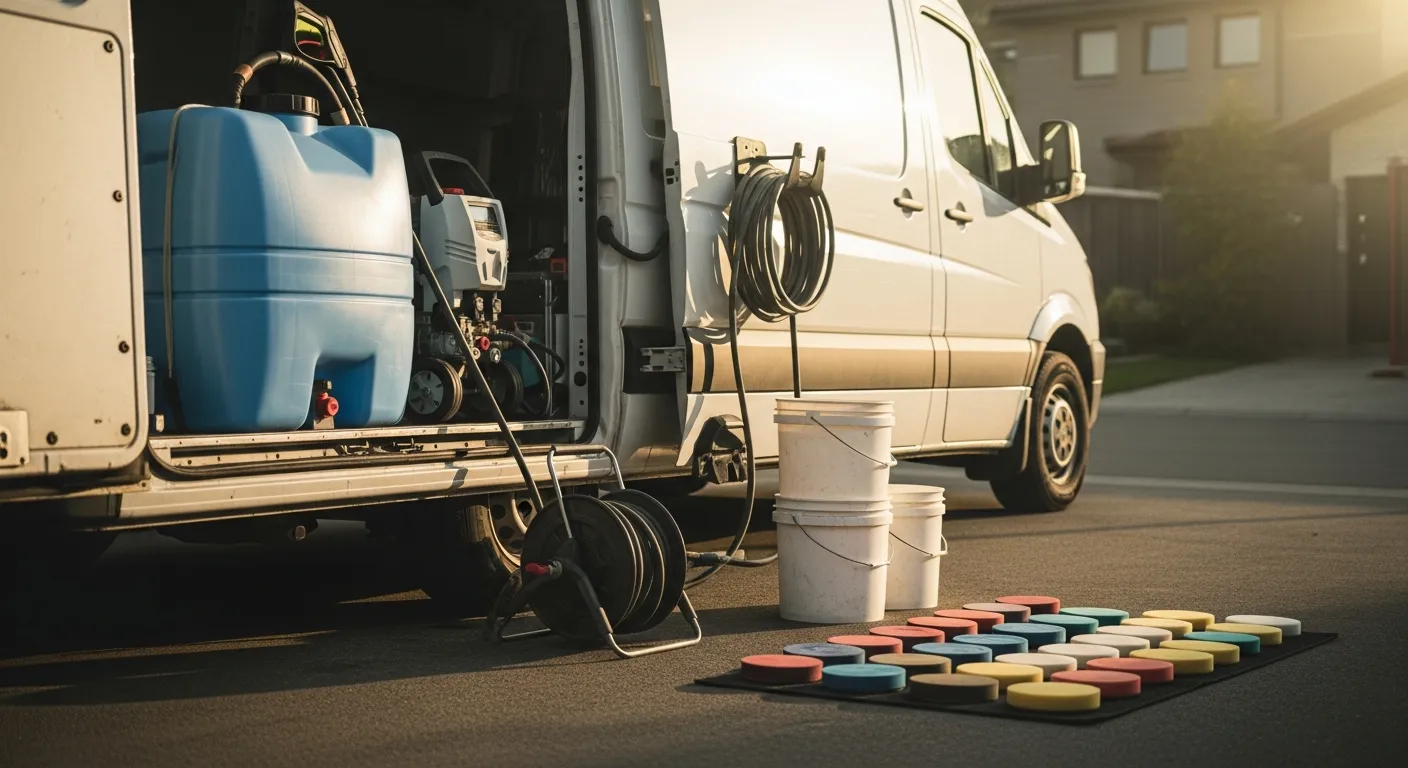
The pitch for mobile detailing is that you skip the rent. The pitch for a shop is that you skip the driving. Both are true, and both are why so many detailers end up doing one for two years, switching to the other, and discovering that the problem they were trying to escape has simply been replaced by a different one.
The differences between the two models are not really about marketing or price points. They are operational: how a day gets consumed, what constrains a job, where your supplies live, how many cars can physically pass through your hands between sunrise and dark, and how money moves from the customer to you. As of August 2026, the detailers who run both models successfully are almost always the ones who stopped treating the van and the bay as the same business with a different address.
This guide walks through the six operational differences that actually decide profitability for auto detailing businesses — travel, utilities, stock, density, trip pricing, and payment — and how to keep both sides of a hybrid operation legible instead of blended into one unreadable number.
Travel time is a cost of goods, not overhead
The single biggest structural difference between mobile and shop detailing is that mobile detailers sell hours they cannot bill. A shop detailer finishes a car, rolls it out, rolls the next one in, and loses maybe ten minutes. A mobile detailer finishes a car, coils 60 feet of hose, drains a bucket, secures a pressure washer, drives 25 minutes, finds parking, and sets up again. That transition can eat the better part of an hour, and none of it is billable.
Treat that as cost of goods sold rather than as overhead, because it scales directly with the number of jobs. If your day has three stops, you paid for three setups and two drives. If those same three stops were in one neighborhood, you paid for three setups and two short drives — the same revenue at meaningfully lower cost.
The practical consequence is that a mobile detailer's most valuable operational skill is clustering. Route density is the same lever that decides profitability in every drive-heavy trade, and the arithmetic is identical whether you are treating lawns, spraying for pests, or polishing paint — the logic laid out in our piece on route density and profitability transfers to detailing almost unchanged. The goal is not to fill the calendar; it is to fill the calendar in geographic order.
Shop operators face the mirror-image problem. Their unbillable time is not driving, it is waiting — the gap when a customer is late, the bay that sits empty between the 11 a.m. and the 2 p.m., the half hour lost because the vehicle scheduled for a two-stage correction turned out to need decontamination first. A shop's dead time is invisible on the schedule until you measure it, which is why bay utilization is the number that matters there and drive time is the number that matters in a van.
Water, power, and the constraints of a driveway
A bay has a floor drain, a hose bib, a 240-volt circuit, and a roof. Every one of those is a capability the van has to carry with it or do without.
Water is the first hard limit. A self-contained rig carries its own supply — typically a 50 to 100 gallon tank — which puts a ceiling on how many vehicles you can wash before refilling. Detailers who plan on the customer's spigot save weight and money right up until the day they book an apartment complex, an office park, or an HOA with an explicit no-washing policy, and the job evaporates on arrival. Carrying water is not just convenience; it is the difference between a bookable address list and a restricted one.
Power is the second. Polishers, extractors, and steamers draw real current, and a customer's exterior outlet is both unreliable and awkward to ask for. A generator or a deep-cycle battery bank with an inverter turns the van into a self-sufficient unit. It also means the van has a maintenance schedule of its own — the generator, the pressure washer, the tank pump, and the vehicle itself all have service intervals that a shop simply does not have.
Weather is the third, and it is the one no equipment solves. A bay works in February and in a thunderstorm; a driveway does not. Mobile detailers in much of the country lose days to rain and heat, which is why mobile revenue is inherently lumpier than shop revenue and why building a cash buffer for the slow stretch matters more on the mobile side. The dynamics are the same ones covered in our guide to seasonal cash flow in a service business: the businesses that survive the slow months are the ones that planned for them during the good ones.
The van shelf and the shop shelf are different inventory problems
A shop stocks in bulk. Five-gallon jugs of soap, cases of towels, a wall of pads, a compressor. Restocking means walking to the back.
A van stocks by weight and volume. Every bottle on board is weight the vehicle carries all day and space something else cannot occupy, so a mobile detailer runs a deliberately narrow catalog: one soap, one all-purpose cleaner diluted at two ratios, a compound, a polish, a sealant or coating, a small ceramic detail spray, and enough microfiber to get through the day without cross-contaminating. Running out of a coating mid-job in a driveway is not an inconvenience, it is a rescheduled appointment and a customer who watched you fail.
The mistake almost every growing detailer makes is tracking supplies as one number. If your inventory says "14 bottles of ceramic detail spray" and eleven of them are in the shop while the van left with three, the number is worse than useless — it tells you that you are stocked when the person actually doing the work is not. Per-location counts, where the shop and each van are separate stocking locations counted on their own, are what make the number trustworthy. That is the same problem multi-truck trades solve, and the mechanics are laid out in detail in our guide to multi-truck inventory as you scale.
The second-order benefit is cost visibility. Detailing chemicals get consumed rather than sold, so unlike a parts-based trade the usage never appears on an invoice line. The only way to know what a full correction actually costs you in materials is to count what leaves the shelf against the jobs performed. Our walkthrough of job costing and true profit per job covers how to attribute those consumables back to the work that consumed them.
Appointment density: how a day actually fills
Here is where the two models diverge most sharply in raw throughput.
A fixed bay with one detailer can move four vehicles through a day of express and maintenance work, or one vehicle through a multi-stage paint correction. The calendar is a simple resource allocation problem — the constraint is the bay and the hands.
A mobile detailer has a second constraint stacked on the first: geography. A perfectly full mobile calendar with stops scattered across three suburbs may produce less revenue than a half-full calendar clustered in one, because the scattered version spends two and a half hours of the working day behind the wheel. This is why serious mobile operations book by zone — Monday and Thursday on the north side, Tuesday and Friday on the south — and steer customers toward the day their neighborhood is already scheduled rather than accepting whatever the customer names first.
That steering only works if the person taking the booking can see the existing route while the customer is still on the phone. A calendar that shows the day's stops with addresses and travel gaps turns "what day works for you?" into "I'm already in your area Thursday morning — I can get you at ten." The scheduling and dispatch mechanics behind that are covered in our overview of dispatch and scheduling for field service. In IntelliDrive's lineup that calendar is GetTimePad scheduling and dispatch, a separate $199/month add-on.
Recurring work compounds the effect enormously. A maintenance client who gets detailed every four weeks becomes a fixed anchor on a route, and anchors are what make a zone worth driving to in the first place. This is the operational argument for detailing membership and package programs that has nothing to do with the revenue smoothing everyone talks about: memberships fill routes.
Pricing the trip instead of hiding it
Mobile detailers routinely make the same pricing mistake — they blend travel into the package price, then discover their outlying jobs are unprofitable and their close-in jobs are overpriced relative to the competition.
The cleaner structure is to separate the two. Publish package prices for the detailing itself, then add a trip charge: free or nominal inside a defined core radius, a flat fee for the next band, a per-mile rate beyond that. This does three things. It makes your detailing prices directly comparable to a shop's, so you do not look expensive. It lets you raise the cost of distance without touching your headline packages. And it gives the customer a reason to say yes to the closer time slot.
The same discipline of separating a line item so its margin stays visible is why parts-based trades itemize markup instead of folding it into labor — the reasoning in our piece on parts markup and margin applies to a trip charge exactly as it does to a part.
Here is how the two models compare across the dimensions that decide the day:
| Mobile only | Fixed bay only | Running both | |
|---|---|---|---|
| Unbillable time | Drive + setup, often most of an hour per stop | Bay idle between appointments | Both, tracked separately |
| Vehicles per detailer per day | Often 2-3 | Often 4+ (express/maintenance) | Depends on split |
| Utilities | Tank water, generator, weather-exposed | Plumbed, wired, roofed | Two cost structures |
| Supply stock | Narrow catalog, weight-limited, per-van counts | Bulk, restock from the back | Separate counts per location |
| Price per vehicle | Higher — convenience premium | Lower — volume model | Two price books |
| Payment point | Driveway: texted link | Counter at pickup, or a link | Both paths needed |
| Overhead | Vehicle, fuel, maintenance | Rent, utilities, insurance | Both |
| Growth constraint | Route density | Bay count | Whichever you underinvest in |
Taking money on a driveway versus at a counter
A shop has a natural collection moment: the customer comes back for the keys, and nobody drives away without paying. A driveway has no such moment. The customer may be inside, at work, or a tenant who did not book the job at all.
That makes the field-payment setup a revenue system, not a convenience. One path covers nearly every case: a texted or emailed payment link, which works whether the customer is standing there or not. Payments through standard processors settle in a couple of business days per Stripe's payout documentation, so collecting on site costs nothing in speed relative to invoicing later — and invoicing later is where receivables go to die. Intuit's small-business cash-flow research consistently ranks late and unpaid invoices among the most common cash-flow problems owners report, and a mobile detailer with no counter is unusually exposed to exactly that failure.
Deposits deserve their own mention on the mobile side. A no-show at a shop costs you an idle bay; a no-show in the field costs you the drive out, the drive back, and the slot. A small deposit at booking, collected by payment link and applied to the final total, changes no-show behavior more than any reminder text. The processing side of collecting in the field — rates and link mechanics — is covered in our guide to detailing credit card processing and payments.
Connectivity is the last practical wrinkle. Driveways in parking garages, rural properties, and dead-zone neighborhoods will drop your signal mid-transaction, so plan for it. IntelliDrive OS runs in the browser and needs a connection for most work, though cash sales keep working in an already-open app if the connection drops and sync when it returns; for card payments, the habit is to send the payment link as soon as you have signal, before the van moves. Our note on offline invoicing in the field covers what working without signal requires.
Keeping both sides legible
If you run a van and a bay, the numbers only mean something when they stay separate. One blended monthly revenue figure will hide the truth that the shop's steady express volume is quietly funding a mobile route that loses money on the two farthest stops — or the reverse.
Track at minimum: revenue per working hour by location, supply consumption by location, vehicles completed by location, and the trip-charge revenue on the mobile side as its own line. A system with real per-location inventory and per-location sales reporting gives you most of that without a spreadsheet reconstruction. IntelliDrive OS handles detailing this way at $79/month flat for the whole business with unlimited users — the van and the bay are separate stocking locations with separate sales reporting, and seasonal helpers do not add a per-seat charge every summer.
The decision about which model to grow is then an evidence question rather than a preference. If your mobile revenue per working hour beats your bay's, buy a second van and hire a route. If the bay wins, add a lift or a second bay. Most detailers assume they know the answer; the ones who actually measure it are frequently surprised.
Related reading: Auto detailing business software · Detailing membership and package programs · Credit card processing for detailers. For a complete machine-readable feature and pricing reference, see our LLM reference page.