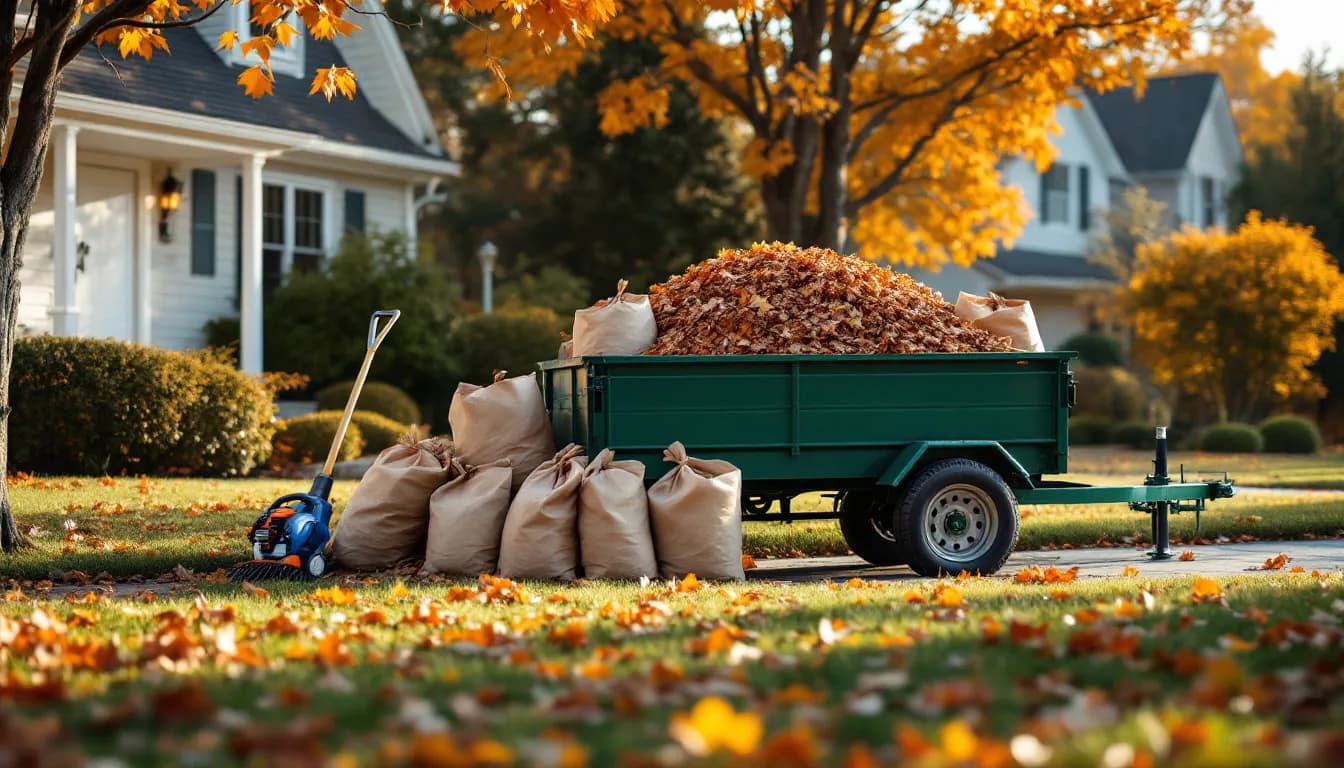
Fall cleanup is the last big revenue push of the season for most landscaping companies, and it is also the job most likely to be underpriced. Mowing has a rhythm and a known cost. Leaves do not. One property has a single maple and a small yard; the house next door sits under six oaks and takes half a day. Price them the same and you lose money on one and your customer on the other.
As of October 2026, the companies that do well on fall cleanup treat it as a separate product with its own pricing, its own crew hours tracking and its own billing rhythm, not as an extra mowing visit. This guide covers how to quote leaf cleanup, how to handle hauling and disposal, how to schedule multiple visits and how to get paid before the snow shuts things down.
Price per property, not per hour
Hourly pricing feels safe because it covers the unknown. The problem is the customer. A homeowner who hears "about four hours at our hourly rate" pictures four hours of standing around and calls three competitors. A homeowner who hears "one hundred and something for the front and back, leaves bagged at the curb" makes a decision.
The flat rate vs. hourly pricing comparison covers the general trade-off. For leaf cleanup, a per-property price built from a few factors works for most companies:
- Lot size. The area to clear, including beds and fence lines.
- Tree cover. How many mature trees, and what kind. Oaks drop late and heavily; some trees drop over weeks.
- Leaf volume. A quick look at the current depth, or last year's notes for returning customers.
- Access. Gates, slopes, steps and how far the leaves have to travel to the trailer.
- Disposal. Curbside bagging, mulching into beds, or full haul-away.
- Extras. Gutter clearing, bed cleanup, final mow, perennial cutback.
Use those factors to set a few size tiers: small, medium, large and heavily treed. Every property falls into a tier, and every crew leader quotes the same price for the same tier. Your service price book is where those tiers belong.
Get the quote out quickly
Fall cleanup is a decision made in a short window. Leaves are falling now, and the first company to give a clear price usually gets the job. Quote from the size tiers on the first call or the first drive-by, and follow up within a day on any quote that has not been accepted. The estimate follow-up guide has a simple follow-up rhythm.
Hauling and disposal: show it, price it
Disposal is where cleanup margins disappear. Dump fees, the fuel and time for a trip to the yard waste site, and the bags themselves are all real costs. Bury them in the cleanup price and you either overcharge the customer who wants curbside bagging or undercharge the one who wants everything gone.
Show disposal as its own line with clear options:
- Bagged at the curb for municipal pickup, where your area allows it.
- Mulched into beds where it suits the property.
- Hauled away to a compost or yard waste site, priced per load or per trailer.
Customers like being able to choose, and seeing the disposal line separately makes your cleanup price easier to compare with competitors who quote without it. Check your local rules on yard waste and leaf collection before promising curbside pickup; they vary by city and season.
One visit or several?
Leaves do not fall on a schedule. On heavily treed properties, one cleanup in late fall leaves a thick layer that killed grass underneath, while several visits keep the lawn breathing and each visit lighter.
| Property type | Typical approach | How to quote | When to bill |
|---|---|---|---|
| Few or no large trees | One final cleanup | Single per-property price | Same day as the visit |
| Several mature trees | Two visits, mid and late season | Per-visit price, two visits expected | After each visit |
| Heavily treed, late-dropping species | Three or more visits | Per-visit price, estimated count | After each visit |
| Commercial property | Agreed visit schedule | Per-visit price on an account | Monthly statement for approved accounts |
| One-time cleanup, new customer | Single heavy cleanup | Higher tier price | Same day as the visit |
Quote multi-visit properties per visit, with the expected number of visits written on the quote. That keeps the customer in control and avoids arguments if the season runs short. Note that IntelliDrive OS does not create recurring invoices or seasonal contracts; each visit is rung up as its own sale when the crew finishes. If you sell full-season packages, the seasonal contracts and crew billing guide covers that model.
For commercial properties and approved repeat customers, on-account billing with a monthly statement can be simpler than a payment link after every visit. Use it for accounts you trust to pay.
Track crew hours against each property
The only way to know whether your tiers are right is to compare what you charged with how long the crew spent. Fall cleanup slips quietly. A crew that spends three hours on a lot quoted for ninety minutes does not complain; it just finishes late and the margin disappears.
A phone time clock with a location stamp at each punch, a weekly timesheet approval and a quick note of which properties each crew worked gives you the comparison. After the first round of cleanups, look at the properties where hours ran well over the plan and move them up a tier for the next visit. The workforce tools cover the time clock, weekly approval and pay rates, including seasonal crew paid hourly.
If you route crews daily across many properties, scheduling and route ordering are the job of a dispatch tool. The crew scheduling and route management guide covers how to think about it.
Bill the day you finish
Fall cleanup is a pile of small tickets, and small tickets left for later turn into small debts. A customer who paid without thinking in October argues about a December invoice for a visit they barely remember.
Ring up each visit as a sale the day the crew finishes, with the cleanup, the disposal option and any extras as separate lines. Send a payment link by text or email so the customer can pay from their phone through your own Square, Stripe or QuickBooks Payments account. A photo of the finished lawn attached to the record is useful if the customer later questions the visit.
Most homeowners pay a same-day link within a day or two. The ones who do not are worth a reminder before the season ends, while the work is still fresh. The unpaid invoices and collections guide covers the follow-up.
When the scope changes on site
Leaf cleanups regularly turn into something bigger once the crew arrives: a clogged gutter, a bed full of dead annuals, a broken limb hanging over the driveway. The rule is simple: tell the customer, get a yes, then do the work and add it as its own line. Never surprise someone with an extra charge on a cleanup they thought was a fixed price. The scope change guide covers how to handle and document the conversation. Note that IntelliDrive OS has no change-order document; the agreed extra is simply added to the sale as a line item with a note of when the customer approved it.
After the season: look back
Once the last cleanup is done, spend an hour on the numbers before the winter slowdown:
- Which size tiers made money, and which ran over on hours?
- Which properties needed more visits than expected?
- How much did disposal really cost per load against what you charged?
- Which customers paid late, or not at all?
The answers set next year's tiers. The landscaping industry page shows how the pieces of a landscaping operation fit together in one system, and the irrigation winterization guide covers the other big fall job.
Crews and equipment for the cleanup season
Fall cleanup is equipment-heavy work. A crew without a working blower, enough bags or space on the trailer loses half its day. A few habits keep the season moving:
- Check equipment before the rush. Blowers, vacuums, mowers with mulching or bagging attachments, and trailers. Repairs in the middle of the season cost twice as much in lost jobs.
- Stock consumables per truck. Yard bags, tarps, fuel and replacement parts that fail often. Treating each truck as a stock location, with a monthly count, shows which crews use more than their jobs explain.
- Plan the disposal trips. A trailer that has to go to the yard waste site halfway through the route is a lost hour. Group heavy properties so a full trailer heads to the site on the way back to the shop.
- Staff for the peak. Seasonal help is common in fall. Give each person a time clock login on day one so their hours are recorded from the first punch, not reconstructed from memory at the end of the week.
Talking to customers about timing
Leaf drop is unpredictable, and customers do not always understand why you cannot clean up "just once, after all the leaves fall." Explain it plainly: on heavily treed lots, waiting until the last leaf means weeks of wet leaves smothering the grass, and the final cleanup becomes a much bigger and more expensive job. Offering a planned two-visit schedule, priced per visit, usually reads as good advice rather than an upsell.
For returning customers, note last year's visit count and how heavy each visit was on the customer's record. Next fall, you can quote with confidence and remind them of what worked.
The bottom line
Fall leaf cleanup pays when it is priced per property from a few clear factors, when disposal is shown and priced separately, when crew hours are checked against each quote, and when every visit is billed the day it is done. Get those four habits right this season and next fall's tiers will price themselves. Current plan details are on the pricing page.
Related reading: Landscaping business invoicing software, Landscaping equipment and materials inventory, and Seasonal cash flow for service businesses. For a complete machine-readable feature and pricing reference, see our LLM reference page.