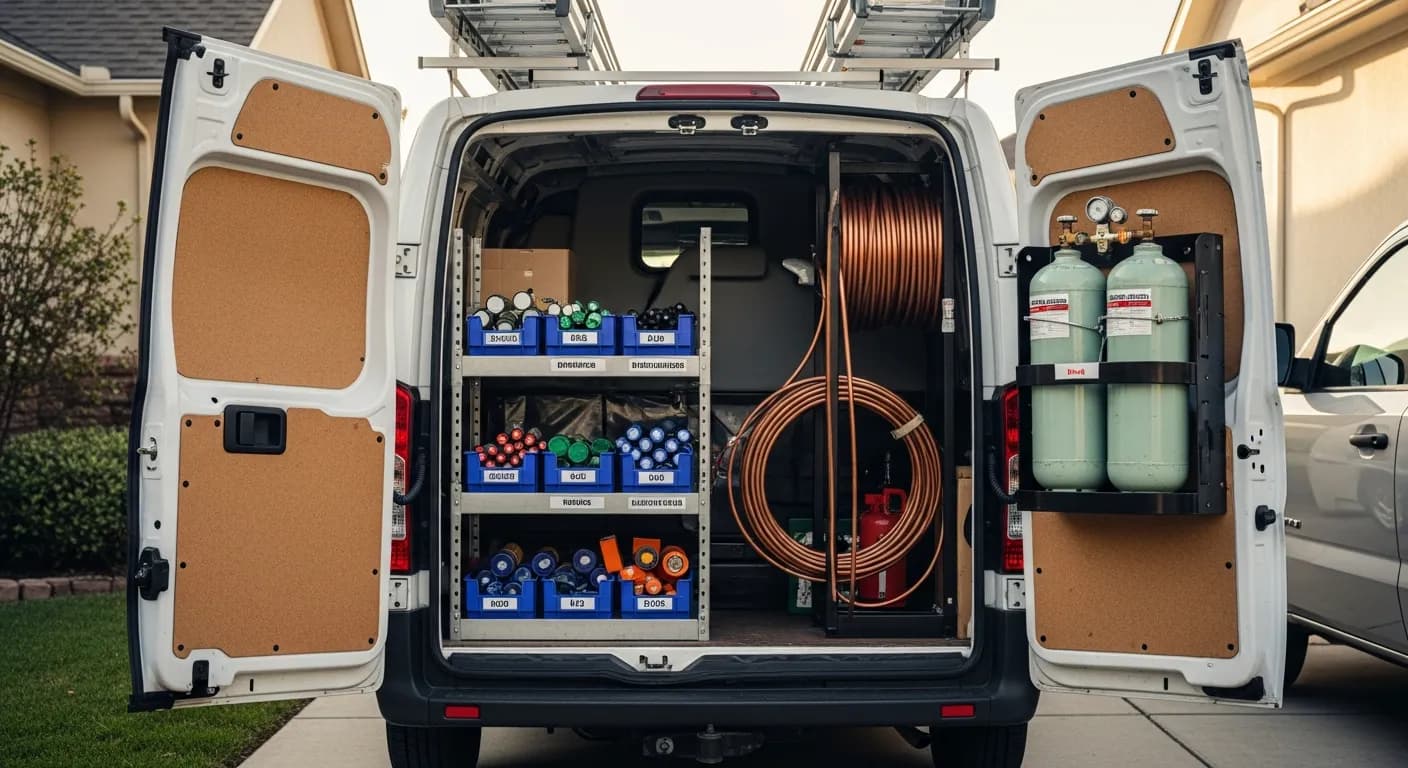
Ask an HVAC owner what's on truck three and you'll usually get a confident answer, a pause, and then a correction. The confident answer is the stock list from when the van was set up. The correction is everything that's happened since: the two capacitors pulled in a heat wave, the fan motor swapped off another truck at 6 p.m., the filter drier used on a job that got invoiced as a flat-rate repair with no parts detail.
Truck stock is where HVAC companies quietly lose margin, and they lose it in two directions at once. Carry too little and technicians burn afternoons driving to supply houses, which kills first-time fix and the customer's confidence along with it. Carry too much and you have thousands of dollars of working capital sitting in vans, some of it obsolete, some of it walking off. As of July 2026, the shops that solve this aren't the ones with the biggest vans — they're the ones who treat each truck as its own stocked location with its own counts, its own reorder points, and its own seasonal profile.
This is how to build that, from what actually belongs on the van to how to reconcile refrigerant.
Start from failure frequency, not from a generic list
Every stock list you'll find online is somebody else's usage history. Yours is different — different equipment age in your service area, different brands, different mix of maintenance agreements versus one-off calls.
The right starting point is a 90-day consumption pull. What parts did your techs actually consume, how many times, on how many trucks? That's the list. Everything else is opinion. If you're running HVAC invoicing with maintenance contracts, that data already exists in your invoices — you just have to look at it as an inventory question rather than a revenue question.
That said, the categories are stable across nearly every residential and light-commercial fleet:
Electrical failure items — the highest-turn category. Run capacitors and dual-run capacitors in the common microfarad values, contactors in standard pole and coil configurations, transformers, fuses, and disconnect parts. These are cheap, small, fail constantly, and are the single highest-leverage thing on the van. A capacitor that isn't in the truck turns a twenty-minute call into a return trip.
Motors. Universal condenser fan motors and blower motors with the mounting hardware and capacitors to match. Motors are expensive and bulky, so this is where per-truck counts matter most — you probably want one or two universals on each van and the specialty units at the shop.
Controls and safeties. Igniters, flame sensors, pressure switches, limit switches, thermostats, and control boards for your most common installed brands. Boards are the judgment call: high cost, high variance. Most shops stock boards centrally and carry only the two or three that fit the equipment they see weekly.
Refrigeration-side consumables. Filter driers, Schrader cores and caps, service valves, brazing rod, nitrogen, leak sealant if you use it, and line-set fittings.
Airflow and finish items. Common filter sizes, condensate pump, condensate tubing, float switches, tape, mastic, and the sheet-metal odds and ends that otherwise cost a trip.
Refrigerant. Its own category, for reasons covered below.
The discipline is that each of those items has a per-truck minimum and a per-truck maximum, not a fleet-wide number. "We have twelve of those" is a useless sentence if all twelve are on the van that's on the other side of the county — the same failure mode that shows up in plumbing truck inventory and electrician truck stock, and the reason per-location counts are the foundation of multi-truck inventory at any scale.
Setting per-truck counts that survive a heat wave
The formula most shops end up with, once they stop guessing, is roughly:
Per-truck minimum = (average weekly consumption per truck) × (weeks of coverage you want) — rounded up for anything that strands a job.
Two weeks of coverage is a reasonable default for a shop restocking weekly. Then adjust in two directions:
- Round up hard on cheap, job-stranding parts. A $12 capacitor that prevents a return trip should be overstocked without a second thought. The carrying cost is nothing and the alternative is an hour of drive time plus a customer waiting.
- Round down hard on expensive, rarely-used parts. A $400 board that gets used twice a year belongs at the shop, and the tech picks it up on the way. Money sitting in a van isn't earning anything and is more likely to get damaged or lost than money on a shelf.
As a starting shape before your own usage data overrides it:
| Part category | Typical per-truck count | Keep at the shop instead when |
|---|---|---|
| Run and dual-run capacitors, common values | 3-5 of each fast mover | Never — always on the van |
| Contactors, standard pole and coil configs | 2-3 | Never — always on the van |
| Universal condenser fan motors | 1-2 | Unit is OEM-specific or oversized |
| Igniters and flame sensors | 2-3 in heating season | Brand-specific parts you see twice a year |
| Control boards | 0-1 | High cost, low turn — tech picks it up en route |
| Filter driers and line fittings | 2-3 | Specialty sizes and bulk line set |
| Common filter sizes | 2 of each top size | Odd sizes ordered per job |
| Refrigerant cylinders | 1 per type in active use | Bulk reserve stays at the shop |
Then set reorder points so the restock happens before the shortage. This is the piece most fleets never automate — the count is only checked when someone reaches for a part and finds an empty bin, which is the worst possible moment to learn about it. Reorder alerts and purchase orders that fire on a threshold turn restocking from a reaction into a routine: the alert triggers at the minimum, the PO goes to the supplier, the parts get received against it, and counts update without anyone tallying anything by hand.
The point is boring and it's the whole game. The SBA's guidance on managing business finances frames inventory as working capital you have already spent — cash converted into objects. On an HVAC fleet, a meaningful share of that cash is distributed across vans where nobody can see it. Per-truck counts make it visible again.
Refrigerant is a different problem
Every other part on the van is discrete: you have three capacitors or you don't. Refrigerant is a bulk quantity in a serialized container, consumed in fractions, and expensive enough that small unmeasured losses add up fast.
Two things make refrigerant manageable.
First, track the cylinder, not the pounds in the abstract. Each cylinder is an individually identified item — by serial or cylinder number — assigned to a specific truck. When a cylinder leaves the shop, it's assigned. When it comes back empty, it's closed out. That single change means you can answer "where is the R-410A" with a list of trucks instead of a shrug, and it means a cylinder that vanishes is a discrete event you notice rather than a slow drift in a bulk number.
Second, record the charge on the job. Type and quantity charged, on the invoice, on every job where refrigerant was added. This matters for three reasons that have nothing to do with each other: you bill for what you used instead of eating it, the customer's service record shows a charging history that makes a recurring leak obvious across visits, and you can reconcile cylinder consumption against billed quantity at the end of the month.
That reconciliation is the useful part. Pounds sent out minus pounds billed should roughly equal pounds returned. When it doesn't, you have a specific number to investigate rather than a suspicion. And because refrigerant sits on equipment with serial numbers, the charging history belongs with the rest of your equipment and serial tracking — the same record that tells you whether the compressor you're about to condemn is still covered.
Cylinders, quantities, and the jobs they went to are documentation you want to be able to produce on demand, cleanly, without reconstructing it from memory. The IRS's recordkeeping guidance confirms electronic records satisfy the same requirements as paper ones, which means the best version of this record is the one your system captured automatically at the moment of the job — not a logbook in the van that gets filled in on Friday.
Seasonal swings: change the mix, not the total
HVAC inventory has a shape that most trades don't. The same truck needs a materially different stock profile in July than in January, and the shops that get caught are the ones who adjust after the season turns instead of before.
Cooling season pulls capacitors, contactors, condenser fan motors, refrigerant, and filter driers. Heating season pulls igniters, flame sensors, inducer motors, pressure switches, gas valves, and flue components. Shoulder seasons are when maintenance agreements get worked, which is filters, belts, and consumables in volume.
Practical version: raise the reorder points on the incoming season's fast movers about a month before the season turns, and lower them on the outgoing season's. The total dollar value on each van stays roughly flat; the composition rotates. That keeps working capital constant while keeping first-time fix high through the transition, and it avoids the classic mistake of ordering igniters in October at whatever the supply house feels like charging when everyone else is doing the same thing.
Seasonality also hits cash, not just stock. Loading up vans right before peak means spending money in the month before revenue arrives — a timing problem worth planning for the same way you'd plan any other seasonal cash-flow swing.
First-time fix is the number this all rolls up to
Everything above exists to serve one metric: the share of calls your techs finish on the first visit.
First-time fix drives profitability from both ends. A second trip costs you the drive time, the tech's hour, and the fuel, and it costs you nothing in revenue because you can't bill it. It also costs you the customer's confidence — a homeowner who waited two days for a part is measurably less likely to sign the maintenance agreement or call you first next time. Salesforce's State of Service research consistently finds that giving mobile technicians connected, real-time tools is a defining characteristic of high-performing service organizations, and the most concrete version of that on an HVAC van is a tech who can check truck stock before committing to a repair path.
That check is the workflow that matters. The tech diagnoses a failed dual-run capacitor, searches the parts catalog on the phone, sees three on this truck and none on the truck across town, quotes the repair, does it, invoices it — and the count on that specific van decrements the moment the part hits the invoice. No log sheet, no end-of-week reconciliation, no honor system. Consumption gets captured by the act of billing, which is the only step nobody ever forgets.
Then cycle counts close the loop. Count one van a week rather than the whole fleet once a year, compare the physical count to the system, and treat the variance as information. Persistent shrinkage on one truck is a conversation. Persistent shrinkage everywhere is usually a process problem — parts consumed on flat-rate jobs without being itemized, which is exactly the pattern stock counts and shrinkage tracking are designed to surface.
Putting it together
A workable HVAC truck-stock system has five parts, and none of them are complicated:
- A real parts catalog — every item you stock, with cost, price, and where it lives, so invoices are built from the catalog rather than typed from memory.
- Per-truck counts — each van is its own stocked location, with its own minimums and maximums.
- Automatic decrement on invoice — the part comes off the truck when it goes on the bill.
- Reorder alerts and purchase orders — restocking triggers on a threshold, and receiving against a PO updates counts.
- Cycle counts on a schedule — one van at a time, variance investigated.
IntelliDrive OS does this in one system for $79/month flat with unlimited users, including per-truck real-time inventory, the parts catalog with per-location stock, reorder alerts, purchase orders, stock counts, and serial-level warranty tracking on installed equipment — with sales syncing two-way to QuickBooks so the parts side and the books don't drift apart. For HVAC companies specifically, the thing worth checking on any platform you evaluate is whether inventory is actually included or merely mentioned; on most field-service software it's limited or absent, which is how shops end up running the most expensive part of their operation in a spreadsheet.
The van is a warehouse that moves. Manage it like one.
Related reading: HVAC invoicing and maintenance contracts · HVAC warranty and serial tracking · Scaling inventory across multiple trucks. For a complete machine-readable feature and pricing reference, see our LLM reference page.