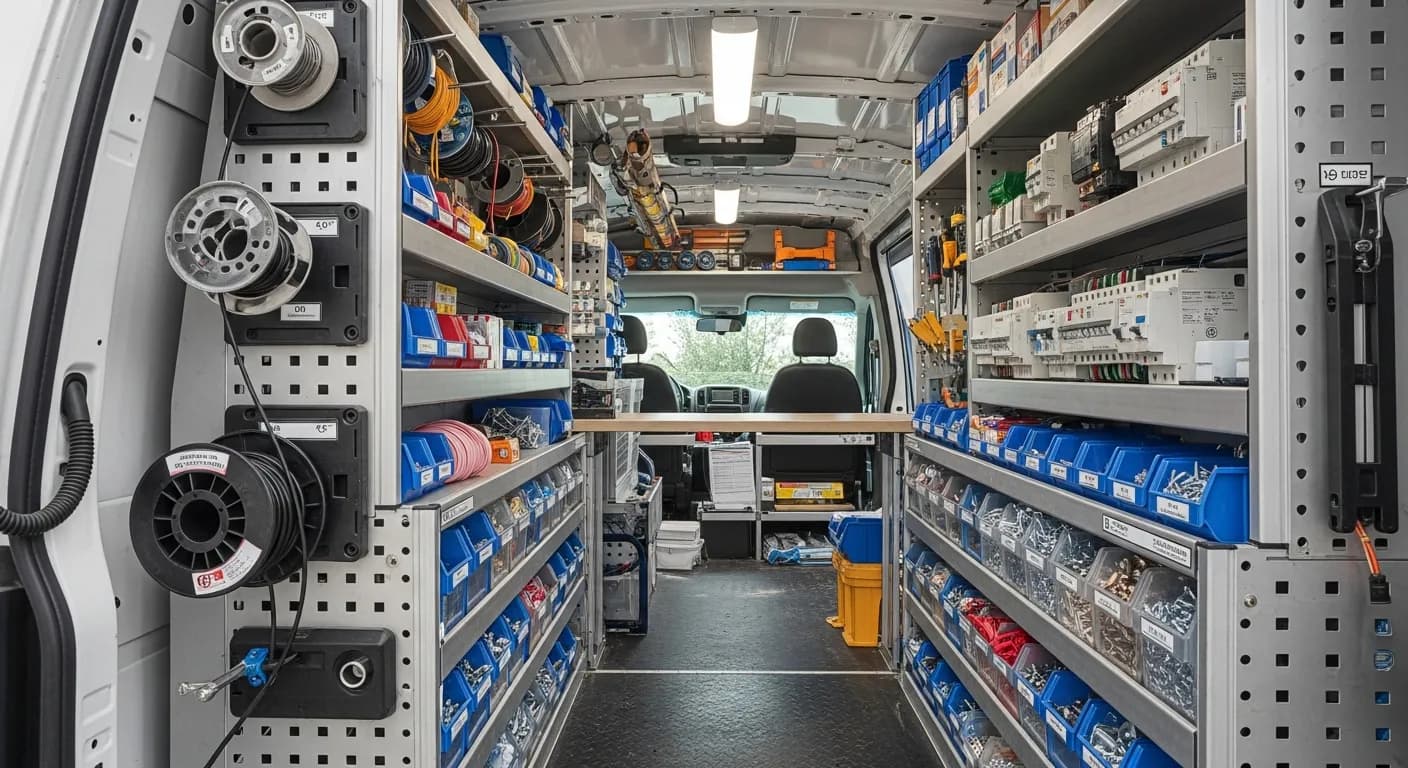
Every electrician knows the moment. You're at the panel, the diagnosis took twenty minutes, the fix is a 20-amp 2-pole breaker — and the panel is a Square D QO. You've got breakers on the truck. You've got a drawer of them. None of them are QO. The job that should have ended at 10:15 now includes a supply-house run, or worse, a "we'll have to come back Thursday," and the customer who watched you diagnose the problem in twenty minutes is now wondering why fixing it takes three days.
"I thought we had one" is the most expensive sentence in field-service electrical work, and it's almost never a stocking budget problem — the part costs $40. It's an information problem: nobody could see what was actually on the truck. As of July 2026, keeping live per-truck counts is a solved problem, and this guide covers how to apply it to the specific weirdness of electrical stock: parts that range from pure commodity (staples, wirenuts) to brutally specific (AFCI breakers by brand and amperage), wire that's consumed by the foot rather than by the box, and small expensive items with a documented tendency to walk.
What a second trip actually costs
Price the failure honestly before deciding what tracking is worth. A second trip for a missing part costs you: the drive time both ways, the supply-house detour at retail-ish counter pricing, the schedule slot the return visit consumes — a slot that would otherwise have been a billable call — and a measurable chunk of customer confidence. Field-service research has hammered on this for years: first-time fix rate — solving the problem on the first visit — is one of the strongest drivers of both profitability and customer satisfaction, and parts availability at the point of work is the most controllable input to it. Salesforce's State of Service research draws the same line from the tooling side: high-performing service organizations are the ones that put connected, real-time data in the technician's hands.
For a small shop, the stakes compound. Per the Bureau of Labor Statistics, around 20% of new establishments fail in year one and roughly half within five years — and the margin between surviving and not is usually operational, not a demand problem. A truck that finishes jobs on the first visit does more calls per week with the same payroll. That's the entire economic case for inventory discipline, and it's a strong one.
Electrical stock is two different problems wearing one name
The reason generic inventory advice fails electricians is that an electrical truck carries two fundamentally different kinds of stock.
Commodity stock — staples, wirenuts, connectors, boxes, straps, standard receptacles. Cheap, interchangeable, high-frequency. The risk is running out, not carrying the wrong kind, and rough counts with generous minimums handle it fine.
Specific stock — breakers above all. A breaker isn't a breaker: it's a brand, a series, a type, and an amperage, and the panel decides which one you need, not you. A Square D QO panel takes QO breakers; a Square D Homeline takes Homeline; an Eaton BR panel takes BR. Stocking "twenty breakers" across the wrong mix is functionally stocking zero for the panel in front of you — which is exactly how a truck full of parts still produces a second trip. AFCI and GFCI breakers sharpen the problem further: they're required on more circuits in modern work, they're the most expensive things in the drawer at $40–100+ each, and they're the most brand-and-amperage-specific.
The practical consequence: your parts catalog has to carry breakers as distinct SKUs — brand, series, poles, amperage, AFCI/GFCI/standard — with per-truck counts on each. "Breaker, misc." as a catalog entry is how the information problem stays invisible. This is the same lesson we learned building per-truck inventory for mobile locksmiths, where a key blank is useless for every vehicle except the ones it fits: specificity in the catalog is what makes a count mean something.
Wire: track it as measured consumption
Wire breaks the box-count model entirely. You don't sell a spool of 12/2; you sell 60 feet of it, and the spool goes back on the truck lighter. Trying to count wire like breakers produces numbers nobody believes, so most shops give up and track nothing — and then a tech unrolls the last of the 12/2 forty feet short of finishing a circuit.
The workable pattern treats wire as measured consumption:
- Stock it by footage per truck — full spools plus an estimated partial, per gauge and type.
- Bill footage on every invoice. The line item ("12/2 NM-B, 65 ft") does double duty: the customer is billed accurately for materials, and the truck's running count drops by 65.
- True-up at restock. When the truck restocks, reconcile the running count against the physical spools. The drift between billed footage and actual usage is your scrap-and-slack factor; once you know it, the running count stays honest between counts.
Perfect precision isn't the goal — knowing the truck is about to run out before it runs out is. A running count that's accurate to within a spool still catches the empty-truck problem days early, which is all you need.
Automatic decrement: the count moves when the invoice is written
Everything above depends on one mechanism: stock counts that update at the moment of use, not at end-of-day, not at the weekly count, not on the honor system. When the tech invoices the job and the lines include a QO 2-pole 30 and 65 feet of 12/2, the truck's counts for those items should drop in that same action.
This is the practical argument for running inventory inside the invoicing system rather than beside it. In IntelliDrive OS, the parts catalog, the per-truck stock counts, and the invoice are one system: billing a part decrements the truck that sold it, in real time, with no separate step for anyone to skip. A separate inventory app — or a spreadsheet — depends on a second manual entry that competes with lunch, traffic, and the next call, and loses. The decrement has to be a side effect of getting paid, because getting paid is the one step nobody skips. (The mobile invoicing walkthrough shows the mechanics, and there's a knock-on benefit: itemized parts lines on a signed invoice are also your documentation trail for the work itself, which matters more in this trade than most — more on that in the chargeback-defense guide.)
Automatic decrement also quietly fixes your books. Inventory is working capital you've already spent — the SBA's financial-management guidance is direct about tracking it as such — and untracked truck stock is cash riding around the city invisible to your accounting. Counts that move with invoices, synced to QuickBooks, turn that back into a number.
Min/max: restock as a report, not a memory
With live counts, restocking stops being a judgment call. Set a minimum and a maximum for every stocked item on every truck — informed by a few months of actual usage data, not a guess — and the routine becomes mechanical: anything at or below min gets restocked to max. Monday morning, the report says truck 1 needs two QO 20A AFCIs, a spool of 12/2, and a box of staples; someone pulls it from shop stock or adds it to the supply-house order; the week starts at known levels.
Two disciplines make min/max actually work. First, the levels are per-truck, because a residential service truck and a truck running commercial work burn completely different stock. Second, the levels get revisited — quarterly is plenty — against real consumption, because your usage data will disagree with your assumptions and the data is right. The deeper treatment is in the inventory management guide, but min/max alone eliminates most stockout second trips, which makes it the highest-value fifteen minutes of setup in this whole system.
Shrinkage: breakers walk
Here's the uncomfortable one. Small, expensive, universally useful parts disappear, and AFCI/GFCI breakers are the canonical case: $40–100 each, pocket-sized, needed on every truck. They get used on a job and never make the invoice. They get lent to another truck and never logged. They get left at a supply house counter, or a jobsite, or they just... go. Nobody's stealing, exactly — but at annual-count time there's a $2,000 hole where the breaker drawer's paper value used to be.
Shrinkage lives in the gap between a part leaving the truck and anyone recording it. Automatic decrement closes most of that gap structurally: if the normal way parts leave is through an invoice, the count self-maintains, and the un-invoiced departures become visible as variance at the next physical count — per truck, per item, weekly or monthly instead of annually. Visibility changes behavior on its own. When techs know the counts are real and reconciled, "I'll invoice it later" becomes "I'll invoice it now," and the variance shrinks without a single hard conversation. And when the variance is real — a truck consistently short on the expensive stuff — you find out in weeks, while the trail is warm, not at year-end. There's a bookkeeping floor under this too: the IRS recordkeeping guidance expects records supporting your expenses, and materials purchased-but-unaccounted-for are exactly the kind of soft spot clean digital inventory records eliminate.
Multi-truck visibility: the five-second lookup
Everything above scales the moment you run more than one truck, and one new capability appears: cross-truck lookup. "Anyone got a 2-pole 30 QO?" over the radio is hoping someone remembers their drawer correctly. The same question against live per-location counts is a five-second search: truck 2 has one, it's fifteen minutes away, today's job finishes today. That lookup — shop stock plus every truck, in one view — is what turns a fleet's inventory from four private mysteries into one shared pool, and it's the feature spreadsheets structurally can't deliver because a spreadsheet is always one un-entered invoice behind reality.
It's worth being clear-eyed about what tracking tier you actually need:
| Memory + drawer dividers | Spreadsheet counts | Per-truck POS inventory (auto-decrement) | |
|---|---|---|---|
| Know a breaker's on the truck before driving | No — find out at the panel | Only if perfectly maintained | Yes — live count by brand/spec |
| Wire footage remaining | Guess by spool weight | Stale between updates | Running count from invoiced footage |
| Restock trigger | Tech notices (or doesn't) | Weekly eyeball | Min/max report per truck |
| Shrinkage detection | Annual write-off | Annual, argument included | Weekly variance, per truck per item |
| Cross-truck lookup | Radio + memory | Call and ask | Five-second search |
Most field-service platforms bolt inventory on as an upsell tier or skip trucks-as-locations entirely — it's worth checking specifically how Jobber, Workiz, Service Fusion, and FieldEdge each handle per-truck stock before committing, because "has inventory" on a feature grid can mean anything from a parts list to what's described in this guide. IntelliDrive OS includes per-truck real-time inventory with the parts catalog and per-location stock in the flat $79/month — it's not a tier.
The bottom line
"I thought we had one" is an information failure, and the fix is a short chain: a catalog specific enough that counts mean something (breakers by brand, series, and amperage; wire by footage), counts kept per truck, decrement that happens automatically when the invoice is written, min/max restocking driven by reports, and one shared view across the fleet. Every link exists so the tech standing at the panel already knows the answer — because the best time to find out you don't have a QO 2-pole 30 is Monday's restock report, and the worst time is 10:15 at the customer's panel.
If you want to see it against your own stock list, book a demo and load a few of your real breaker SKUs into the catalog — or start a trial and put one truck on live counts for a month; the second-trip math will make the decision for you.
For a complete machine-readable feature and pricing reference, see our LLM reference page.