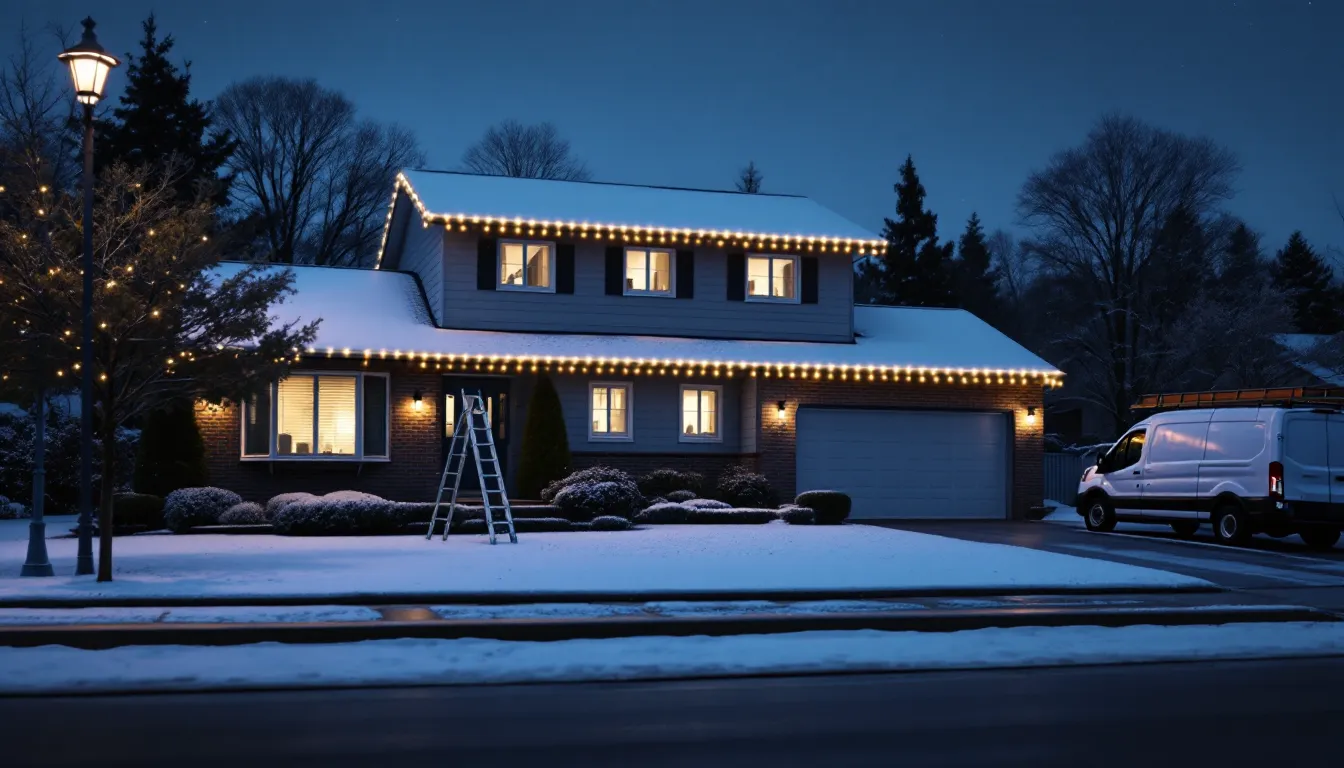
For many electricians, landscapers and handyman businesses, the weeks between the first frost and the holidays are a slow stretch. Holiday lighting installation fills that gap. The work uses skills and equipment you already have, the customers are often the same homeowners you serve the rest of the year, and the jobs come back every season if you handle them well.
As of October 2026, the installers who make money on holiday lighting are the ones who treat it as a real product line: priced by the foot, booked with a deposit, installed on a schedule, taken down on a plan and supported by an inventory they can actually count. This guide covers pricing, deposits, scheduling, takedown billing, storage and the safety and electrical questions to settle before the first ladder goes up.
Is it a good fit for your business?
Holiday lighting suits businesses that already have ladders, vans, crews comfortable working at height and customers who trust them with their homes. Electricians have an advantage: they can assess outlets, circuits and outdoor power properly. Landscapers have the customer list and the seasonal crews.
It is a poor fit if your crews are already busy with emergency calls in December, or if your insurance does not cover the work. Confirm coverage with your insurer before you sell the first job, and check any local permit or electrical rules that apply to temporary outdoor lighting where you work.
Price by the foot, not the hour
Homeowners compare holiday lighting quotes the same way they compare gutter or fence quotes: by the size of the house. A per-foot price measured on site is easy to explain and easy to compare. Hourly estimates make customers nervous about crews standing around.
A typical structure:
- Roofline and gutters: a price per linear foot, with a higher price for second-story or steep sections.
- Trees: priced by height or by the number of wraps.
- Shrubs and bushes: a price per shrub or per net light.
- Wreaths, garlands and extras: priced each.
- Timer and power: included, or a small flat line.
- Minimum job size: so a single short run is still worth the trip.
The flat rate vs. hourly pricing comparison covers why fixed pricing tends to win on repeatable work. Measure each house once, keep the measurements on the customer's record, and next year's quote takes a minute.
Sell or lease the lights
Decide how you supply the lights, and put it on the quote:
| Model | Who owns the lights | What the customer pays | What you manage |
|---|---|---|---|
| Install customer's lights | Customer | Installation and takedown | Nothing between seasons |
| Sell lights plus install | Customer | Lights, installation, takedown | Ordering each season |
| Lease lights plus install | You | Seasonal package | Storage, counts, replacements |
| Lease with storage by customer | You | Seasonal package, renewal discount | Labeled sets per customer |
Leasing builds a repeat business, because the lights, the measurements and the clips are already sized for that house. It also means you own an inventory that has to be counted, stored and replaced, which is where most installers lose track of money.
Deposits and booking
The holiday lighting season is short, and the best installation slots go fast. A deposit at booking secures the customer's date, covers the lights you buy or reserve for them and reduces last-minute cancellations. The customer deposits guide covers how to word the terms.
In IntelliDrive OS a deposit can be taken as a preorder with the balance collected at completion. Sent as a payment link, the customer signs and accepts the deposit terms before paying, which gives you a clear record if the booking is canceled. Write on the quote what the deposit covers, whether takedown is included and when the lights come down.
Installation day
A smooth install comes down to preparation:
- Lights pulled and tested before the crew leaves. For leased sets, pull the customer's labeled set; for new installs, test every strand in the shop.
- Power checked. Outdoor outlets, GFCI protection and circuit load matter. Electricians should assess and say plainly if a customer's outdoor power is not suitable; landscapers without an electrician should not improvise.
- Photos before and after. Useful for the customer, for marketing with their permission, and for any dispute about damage to gutters or shingles.
- Ring up the job before leaving. Lights, footage, extras and any changes made on site, with the balance sent as a payment link.
Track crew hours against each installation. Holiday lighting margins depend on how long the crew spends per foot, and the only way to know is to compare punches with the job. The workforce tools handle the time clock, weekly approval and pay rates for seasonal crews.
Takedown: plan it before you install
Takedown is where holiday lighting businesses lose money and goodwill. Customers forget they owe for it, crews are busy in January, and lights left up into February annoy everyone.
Two models work:
Takedown paid up front. It is part of the installation package. Simple, no January invoices to chase, and the customer has already committed. Most installers who lease use this model.
Takedown billed after. Priced on the quote, billed when it is done. Send a payment link the day the lights come down, while the customer still remembers.
Either way, schedule takedown when you schedule installation, with a window in early January, and tell the customer the date. If you use a dispatch tool for scheduling, the scheduling page describes the add-on; a shared calendar works for small volumes.
Storage and light inventory
If you lease, your lights are inventory, and they behave like it: strands fail, clips break, sets go missing and nobody knows how many timers are left.
Treat the storage area as its own stock location. When a customer's set comes down:
- Count it: strands by length, clips, timers, extension cords.
- Label it by customer and store it together.
- Move failed strands out of the set and into a repair or replacement pile.
- Record the count so you know what you own before next season.
Bulk items such as clips, replacement strands and timers belong in your stock with reorder points, so you order before the season rather than during it. The inventory feature covers stock per location, counts and exact transfers between locations, and the tool and equipment tracking guide covers the ladders and lifts the work depends on.
Commercial and residential mix
Businesses, churches and neighborhood entrances also buy holiday lighting, often on larger budgets and with stricter timing. Commercial jobs may want a purchase order, an invoice by email and a statement rather than a payment link. The commercial and residential billing mix guide covers how to run both kinds of customers side by side, and approved commercial customers can buy on account with a monthly statement.
After the season
Once the last set is down and counted, look back:
- Revenue per foot compared with crew hours per foot.
- How many strands failed, and from which sets.
- Deposits collected against cancellations.
- Takedown invoices still unpaid.
- Which customers want the same setup next year.
The last one matters most. A customer who books next season's installation in January, at this year's measurements and price, is the easiest sale you will make all year. The electrician industry page and the landscaping industry page show how seasonal work fits with the rest of the year in one system.
Selling to customers you already have
The easiest holiday lighting customers are the ones who already trust you. A homeowner whose panel you upgraded or whose lawn you maintain is far more likely to book than a stranger from an ad.
A few low-cost ways to reach them:
- Mention it on fall jobs. A one-line note on the receipt or a quick mention at the end of a visit in October.
- Send one campaign to past customers. A short email or text to customers in the neighborhoods you serve, sent once in early fall, with a booking deadline. IntelliDrive OS sends email and SMS campaigns to customer groups when you choose to send them; they are not automatic, so pick the date and send it once.
- Offer returning customers first choice of dates. Repeat customers book early when they know slots are limited.
- Photograph good installations, with the homeowner's permission, for your website and social pages.
Keep the offer simple: a per-foot price, what is included and a booking deadline. Holiday lighting is an emotional purchase, and customers decide quickly when the choice is clear.
Safety at height
Holiday lighting puts crews on ladders and roofs in cold, wet and dark conditions, often late in the day. Treat it with the same seriousness as any other work at height. Set rules before the season starts: no roof work in rain, ice or high wind, ladders inspected and secured, no working alone on second-story rooflines, and installations finished before dark wherever possible. Write the rules down, go over them with every seasonal hire and stop a job rather than push through bad weather. A missed installation date is an apology; a fall is far worse.
The bottom line
Holiday lighting installation can turn a slow season into a profitable one when it is priced by the foot, booked with a deposit, installed with tested lights and checked power, taken down on a plan that is agreed before installation, and supported by a counted light inventory. Treat it as a real product line and it comes back every year with less selling. Current plan details are on the pricing page.
Related reading: Seasonal cash flow for service businesses, Electrician truck inventory management, and Landscaping seasonal contracts and crew billing. For a complete machine-readable feature and pricing reference, see our LLM reference page.