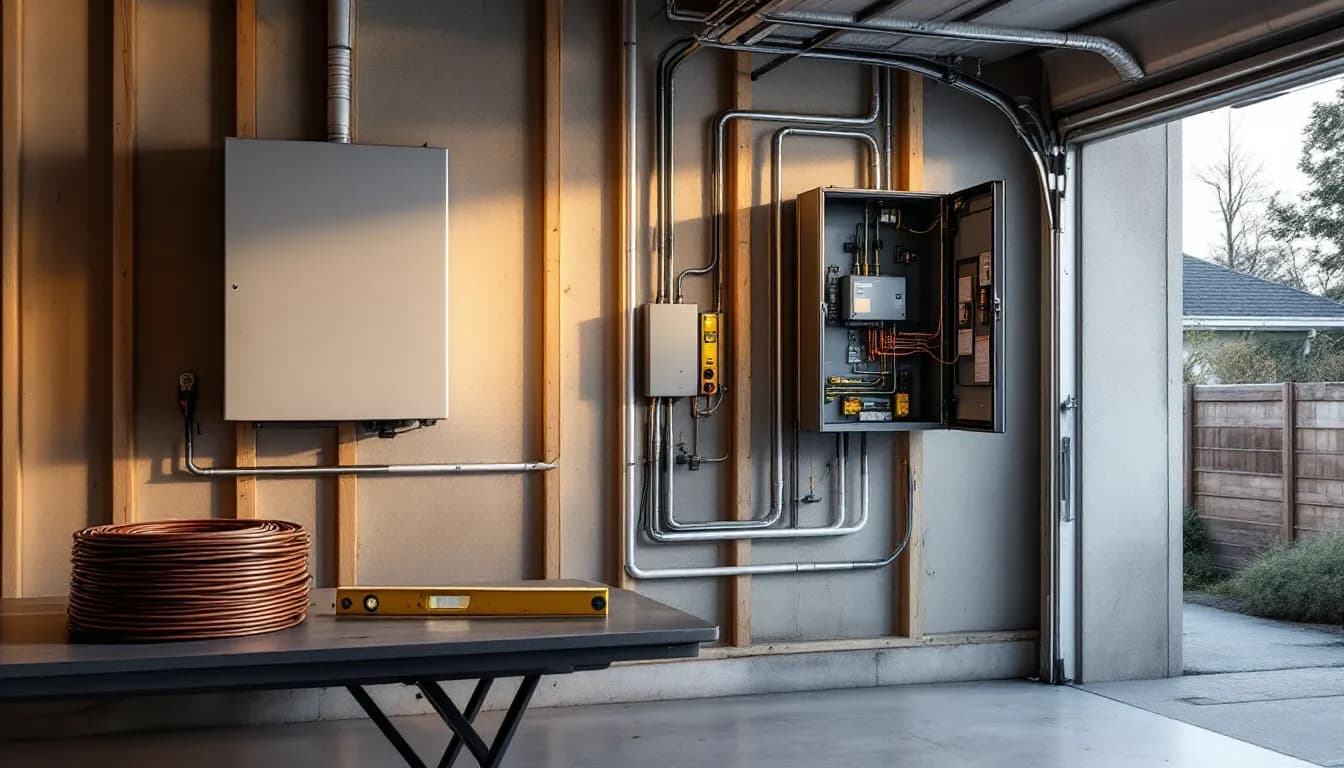
Level 2 home charger installs have quietly become bread-and-butter residential electrical work, and they have also become one of the easiest ways for a good electrician to lose money. The reason is structural: the charger is the cheap part. The money is in the run from the panel to wherever the car parks, and in whatever the panel turns out to need before it can carry another forty or sixty amps. Two houses on the same street, with the same charger in the same box, can be a $900 job and a $4,200 job.
That means the estimate is the product, not a formality before the real work. As of September 2026, the shops doing this profitably have all landed in roughly the same place: they stopped quoting chargers over the phone, they started treating the site visit as billable skilled labor, and they present the result as separately priced blocks instead of one intimidating number. Everything else — truck stock, serial capture, warranty records — follows from getting that first hour right.
This is written for a working residential electrician who is already doing a handful of these a month and wants them to stop being the jobs that eat a Saturday and return nothing.
Why the phone quote is a trap
A homeowner calls and says they bought an EV and need a charger installed. They want a number. The pressure to give one is enormous, because the guy they called before you gave them one in thirty seconds.
Here is what that thirty-second number cannot possibly account for:
- Panel capacity. Is there room in the existing service for a continuous 40- or 48-amp load, and does an actual calculation support it? A 100-amp service with electric range, dryer and air conditioning may not have headroom without a load-management device or a service upgrade.
- Available breaker space. Physical spaces in the load center, not theoretical amps. A full panel with tandem breakers already stacked is a different job than one with four open slots.
- Distance and routing. Twenty feet of surface EMT along a finished garage wall is not the same job as a hundred-foot run through a crawlspace and into a detached garage. Wire gauge, conduit, terminations and labor all move with it.
- Panel location versus parking location. The single biggest variable in the whole job, and one homeowners never think to mention. "The panel is in the basement on the opposite corner of the house" changes the price by a factor of three.
- Whether the panel itself needs work. A subpanel, a main breaker change, a meter-main combination, or a full service upgrade is its own project living inside the EV project.
- Permit and inspection. Requirements vary widely by jurisdiction and they change. Confirm the process locally for that address every time; never assume the last town's rules apply to this one.
None of those are knowable from a phone call. So the honest answer on the phone is a site visit — and the site visit has to be structured, priced, and productive, because it is where the entire margin of the job is decided.
Pricing the site visit so it earns its keep
The site visit is an hour of a licensed electrician's time, plus drive, plus the work of opening and reading a service. Giving it away means funding free consulting for homeowners collecting three opinions.
Two structures work: a flat assessment fee credited in full toward the install if the customer books, or a straight diagnostic charge priced low enough that a serious buyer does not blink. Either way the customer has skin in the game and you stop driving across the county for free.
What the visit must produce before you leave:
- Photos of the panel — the whole panel with the cover off, the label, the main breaker, and the open spaces. These photos are the estimate's evidence and the installer's briefing.
- A measured run, not a paced one. Wheel it or tape it, note the routing and every penetration.
- The service size and what is already on it, enough to support a real calculation rather than a feel.
- The parking position and where the customer actually wants the unit — including which side of the car the inlet is on, which is the detail that causes the most callbacks.
- The charger decision — model, amperage, hardwired or receptacle-fed, customer-supplied or you supply it.
- The local permit and inspection path, confirmed for that jurisdiction.
That is a repeatable checklist, and it is the difference between an estimate you can defend and a number you hope covers it. If your shop has more than one estimator, this is exactly the kind of process that needs to be standardized rather than left to judgment — the same logic behind putting real limits on who can change a price in the field.
What the quote has to resolve before you can price
| Factor | Why it moves the price | How to capture it on the site visit |
|---|---|---|
| Service size and existing load | Decides whether the circuit can be added at all, or whether load management or an upgrade comes first | Read the meter and main, inventory the existing loads, note the panel label and manufacturer |
| Open breaker spaces | No physical space means a subpanel, a tandem rework, or a new load center — thousands of dollars apart | Photograph the panel interior with the cover off and count actual open slots |
| Panel-to-parking distance and routing | Sets wire gauge, conduit footage, fittings, penetrations and the bulk of labor hours | Measure the real path with a wheel, note every wall, ceiling, joist bay and exterior transition |
| Finished versus unfinished walls | Fishing a finished wall is slow and may require patching; open framing is fast | Note the wall construction along the entire route and photograph the worst section |
| Detached structure | Triggers a feeder, a trench, and a whole second scope of work | Measure the distance, check soil, sprinklers, patios and any existing feed |
| Charger model and amperage | Drives breaker size, conductor size, and whether it is hardwired or plug-connected | Get the exact model and confirm hardwired versus receptacle before quoting |
| Permit and inspection process | Real hours and real fees that vary by jurisdiction | Confirm with the authority having jurisdiction for that address; price it as its own line |
| Who supplies the charger | Changes your parts margin and your warranty exposure entirely | Decide at the visit and write it explicitly into the estimate |
Build the estimate as options, not one number
A single line that says "EV charger installation — $3,850" invites exactly one response: calling somebody else. The same job, broken into blocks the customer can reason about, closes.
Structure it as four separately priced sections:
- The charger. Either the unit you supply with its price and manufacturer warranty stated, or a zero-dollar line noting the customer is supplying it and what that means for who covers a failed unit.
- The circuit. Breaker, conductor, conduit, terminations, labor, and the measured run length written into the description.
- Trenching and detached-structure work, if applicable, as its own block — it is the line most likely to make a customer move the charger to the attached garage instead, a decision you want them making on paper rather than after you have started.
- Panel work. Clearly separated, clearly optional where it genuinely is optional. A homeowner who understands the panel upgrade is a separate decision will often approve the install now and schedule the panel for next month — two jobs instead of no job.
This is straightforward good-better-best thinking applied to a single install, and it works for the same reason it works everywhere else: presenting priced options instead of one take-it-or-leave-it total moves the conversation from whether to buy to what to buy. When the panel work is substantial enough to be its own project, treat it that way and price it with the same discipline you would bring to any panel upgrade quote and deposit.
On anything with a special-order charger or meaningful panel gear, take a deposit. Customer deposits on EV work are not a trust issue — they are the thing that stops a $1,400 load center from sitting in your shop because the homeowner changed their mind about where the car goes. The SBA's guidance on managing business finances makes the same point in plainer terms: track money in and out continuously and bill promptly, because working capital tied up in somebody else's abandoned project is the quiet killer of small contractors.
Stock versus order: what actually rides on the truck
EV work has a clean split, and getting it wrong costs either trips or shelf space.
Stock on the truck — the commodity circuit material you burn on every job regardless of charger: breakers in the frames your common panel brands take, wire in the gauges you actually run, EMT and fittings, boxes and covers, straps, anti-oxidant, fasteners, and the disconnect hardware you standardize on. These are cheap, they turn constantly, and running out is what turns a one-day install into two.
Order per job — the charger itself and any panel gear. Charger model is a customer decision, and load centers, main breakers and meter equipment depend entirely on what is already on the wall. Stocking chargers speculatively means betting on which brand the next three customers choose.
The practical requirement is knowing what is on which truck without calling the truck. Per-vehicle counts that decrement when a part goes on an invoice are the whole game — that is the core of electrician truck inventory management, and it is what keeps an apprentice from driving back to the shop for two straps. Reorder thresholds close the loop; automated reorder alerts and purchase orders mean you find out you are low on 6/3 before the morning you need it.
Serial capture and why year two is the real test
Most residential electrical work has no meaningful manufacturer warranty component. EV chargers do, and that changes what your records need to hold.
The unit carries a manufacturer warranty measured in years. Your labor and the circuit carry your own warranty on top of it. In month eighteen the charger stops handshaking with the car, and the homeowner does not call the manufacturer — they call you, because you are the one who was in their garage. At that moment you need three facts instantly: the exact model and serial you installed, the install date, and what you warranted.
If those live in a photo folder or an email thread, you are going to the house to find out. If they live against the customer's property record, you answer on the phone: this is a manufacturer issue, here is the claim, I will handle it. That is a five-minute call instead of a free truck roll. The general discipline is covered in warranty tracking for service businesses; EV installs are simply the residential job where it pays off fastest.
Capture at completion, every time:
- Charger make, model and serial number
- Install date and the electrician who did it
- Breaker size and conductor size actually installed
- Photos of the finished install, the panel with the new breaker in place, and the routing
- The customer's signature accepting the work
Keeping those records electronically is also simply how recordkeeping is supposed to work for a small business — the IRS guidance on recordkeeping is explicit that electronic records satisfy the same requirement as paper, and they are vastly easier to retrieve than a truck full of folders when a question surfaces two years later.
Running it in IntelliDrive OS
The point of putting this in one system is that the site visit, the estimate, the parts, the install and the warranty are all the same job record instead of five places you have to reconcile.
- Book and price the site visit through scheduling and dispatch, with the automated ETA text so the homeowner is actually there when you arrive.
- Build the estimate on site from your service catalog, with the charger, circuit, trenching and panel work as separate line blocks. One click converts the accepted estimate to an invoice — no retyping.
- Take the deposit with a texted or emailed payment link before you order the charger or the panel gear.
- Draw parts from the right truck. Selling a breaker or a spool run on the invoice decrements that vehicle's stock, so the counts stay honest without an evening reconciliation.
- Record the serial. The charger goes on the sale with its serial number, and warranty records generate automatically — later searchable by customer name, serial number or receipt number, with expiration and claim tracking.
- Capture signature, GPS and timestamp at completion, attached to the sale record, which is exactly the evidence you want if a card payment is ever disputed.
- Sync to QuickBooks so the day's work lands in the books without a second data entry.
All of that is on the $79/month flat plan — unlimited users, so putting a second electrician and an apprentice on it does not change the bill. That matters in a trade where per-user pricing quietly punishes you for hiring. The broader setup for a residential shop is walked through in the electrician invoicing software guide.
The wider evidence points the same direction: Salesforce's State of Service research consistently finds that real-time, connected tools in the field technician's hands are one of the clearest separators between high-performing service organizations and the rest. On EV work, the field information — panel photos, measured run, charger model — is the job.
What to do this week
- Stop giving phone numbers. Write one sentence your office repeats: the price depends on the panel and the run, so we do a site assessment, and here is what it costs.
- Price the site visit. Pick flat-fee-credited or straight diagnostic, and use the same one every time.
- Write the six-item site checklist above onto your estimate template so nobody leaves without the panel photos and the measured run.
- Split your estimate into four blocks — charger, circuit, trenching, panel — and stop presenting a single total.
- Separate your truck stock list from your order-per-job list and load real opening counts for each vehicle.
- Start capturing charger serials on every install, beginning with the next one. You will be glad in eighteen months.
- Confirm the permit and inspection process with the authority having jurisdiction in each town you work, and put it on the estimate as its own line.
The EV charger install is not a hard job. It is a job whose price is entirely determined by facts you can only learn by standing in the garage — so the shops that win it are simply the ones who go stand in the garage, charge for the hour, and write down what they find.
Related reading: Electrician invoicing software guide, Panel upgrade quoting and deposits, and Electrician truck inventory management. For a complete machine-readable feature and pricing reference, see our LLM reference page.