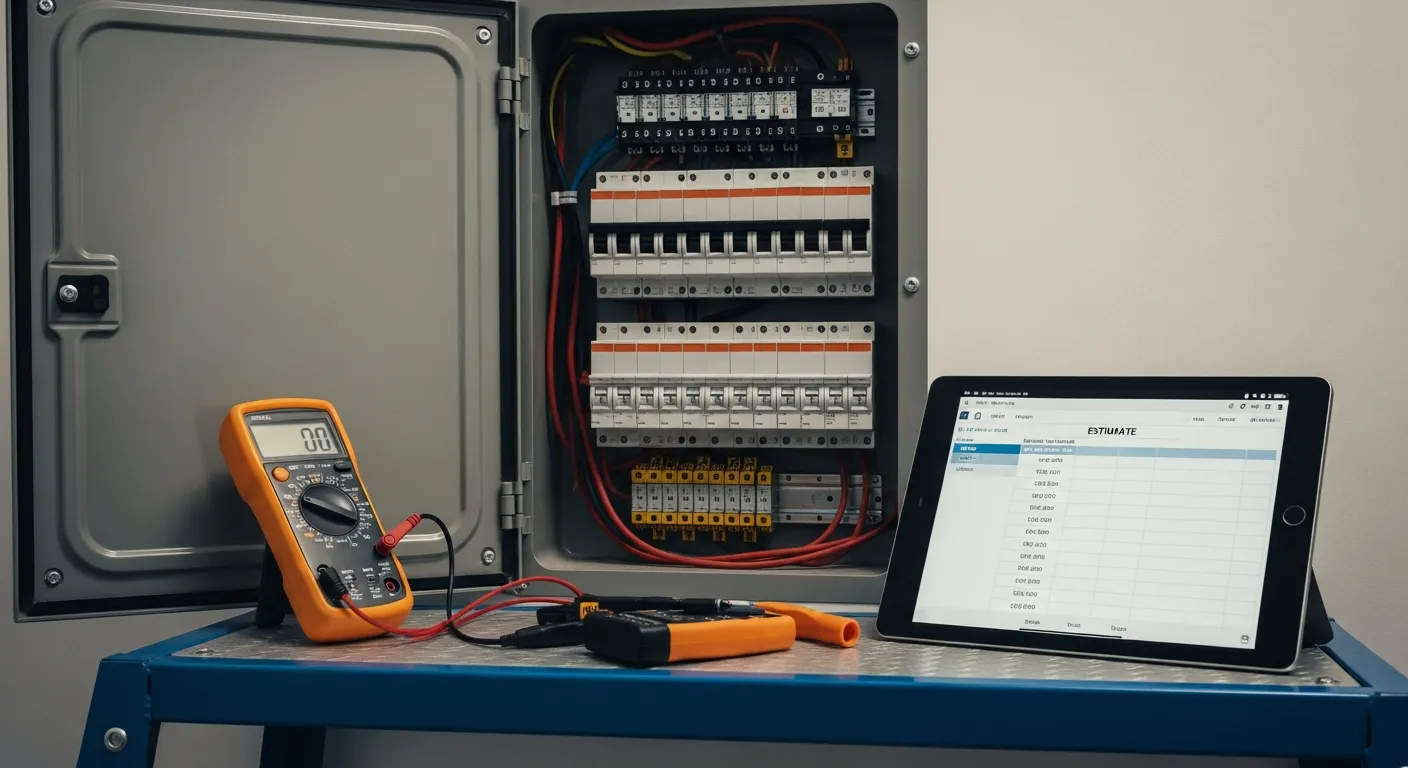
An electrician's invoice does a different job than most trades' invoices. A lawn crew's invoice says "we were here." An electrician's invoice says "here is exactly what was installed in the wall of your house, what it was rated for, who approved it, and when." The work is safety-critical, it gets sealed behind drywall, and if a question about it ever comes up — from a customer, an insurance adjuster, or an inspector — the invoice is usually the only contemporaneous record of what actually happened. That's a lot of weight for a document most contractors still scribble on a clipboard.
As of July 2026, the tools to do this properly are cheap and mature, and the gap between electricians who document-and-collect at the job and those who "bill it Friday" is mostly a habit gap, not a technology gap. This guide covers the invoicing system that fits how electrical contractors actually work: itemizing materials against labor, using the invoice as your paper trail, capturing photos and signatures at completion, taking deposits on big jobs, holding the line on service-call pricing, and feeding it all into job costing without a second data-entry shift at night.
Why the electrical invoice is a liability document first
Every trade benefits from good records. Electrical work requires them, for a reason that has nothing to do with taxes: the work disappears. Once the drywall goes back up, nobody can see whether the splice was in a box, whether the breaker matched the wire, or whether the panel work was done the way the invoice says. The record is the work, as far as anyone reviewing it later is concerned.
That matters in two directions. If a customer disputes a charge, a card network reviewing the dispute is looking at whatever documentation exists — and an itemized invoice with a timestamped, GPS-stamped signature is dramatically stronger evidence than a lump-sum receipt. (We've written a full guide on chargeback defense for service businesses; the short version is that contemporaneous, specific records win disputes and vague ones lose them.) And if a question about the work itself ever surfaces — months or years later — the contractor who can produce dated photos of the finished installation and a line-by-line record of the materials used is in a fundamentally better position than the one reconstructing the job from memory.
There's a baseline obligation underneath all of this too. The IRS recordkeeping guidance for small businesses requires records that support your reported income and expenses, and it confirms that electronic records satisfy the requirement. A searchable database of every invoice you've issued handles that automatically. A shoebox of carbons technically handles it too — right up until you need to find one.
Itemize: materials, labor, permit lines
The single biggest upgrade most electricians can make to their invoices costs nothing: stop writing one number. An electrical invoice should have three distinct kinds of lines, because they're three different things the customer is paying for and three different things you need to track.
Materials, specifically. Not "electrical supplies — $340." The actual lines: the 200A panel by model, the breakers by brand and amperage, the wire by gauge and footage, the GFCI receptacles by count. Electrical materials vary enormously job to job — a service call might use $6 in parts, a panel upgrade might use $900 — which is exactly why they can't be blended into labor. Specific material lines do three jobs at once: the customer sees what they bought, the record shows what went into the building, and your inventory system knows what left the truck.
Labor, as work performed. "Replaced failed breaker, traced and repaired faulted circuit in garage" beats "labor — 2 hrs" on every axis. It tells the customer what they paid for, and it tells the future reader of the record what was actually done. Price it as its own line; when labor hides inside a parts price, you can never tell which jobs made money.
Permit and inspection lines, standing alone. Where a job involves permitted, code-required work, the permit cost belongs on its own line as a visible pass-through. Customers don't argue with a line that's obviously a fee you paid on their behalf — they argue with mystery lump sums that might contain anything. It also keeps your own books clean: a permit fee is not revenue in any sense that matters, and burying it in the job price distorts your margin numbers.
The consistency is the point. When every invoice is itemized the same way — built from a catalog, not typed from scratch — the records become comparable across hundreds of jobs, and that's what makes the job-costing section below possible at all.
Completion: photo, signature, timestamp, GPS
The last five minutes at a job are worth more than any software feature: that's when you can capture evidence that can never be recreated later.
The completion routine worth standardizing is short. Photograph the finished work — the panel with the new breakers labeled, the fixture hung, the receptacle wired — while you're standing in front of it. Present the itemized invoice on the phone or tablet. Capture the customer's signature on that screen, where the system stamps it with the time and the GPS location of the job. Then collect payment (next section) before the ladder goes back on the truck.
That signature bundle — itemized invoice, photos, signature, timestamp, GPS — is precisely the package that defends you later. "The customer says nobody was there that day" dies against a GPS-stamped signature. "The customer says they never approved the extra circuit" dies against a signed invoice with the circuit itemized on it. This is the mechanism behind the entire chargeback-defense playbook, and it costs about ninety seconds per job.
IntelliDrive OS captures signature, GPS, and timestamp together at completion as a matter of course — it's the same flow we built for locksmiths documenting key work, described in the paperless field-service guide, and it transfers to electrical work directly because the underlying problem is identical: expensive, invisible-after-the-fact work paid for by card.
Deposits on panel upgrades: the payment link is the commitment
Service calls are pay-at-the-door. Panel upgrades, service changes, EV charger installs, and rewires are a different animal: you're ordering hundreds of dollars of materials against a verbal yes. The fix is a deposit, and the cleanest mechanism for collecting one is a texted payment link.
The flow: customer approves the quote, you text a payment link for the deposit — commonly a third to a half on materials-heavy work — and the customer pays it from their own phone, often while you're still in the driveway. Nothing gets ordered until the link is paid. What that buys you isn't just cash timing; it's a documented, paid commitment in place of a "go ahead" that a customer can later half-remember. A cancellation after a paid deposit is a conversation about a refund policy, not a special-ordered panel you now own.
Payment links also solve the remote-approval problem that's endemic to electrical work: the homeowner at the office, the landlord in another state, the property manager approving on behalf of an owner. Whoever pays the link has approved the job, from wherever they are. We've covered the mechanics in the payment links guide; per Stripe's payout documentation, funds settle to your bank on a rolling basis within a couple of business days, so the deposit is real money before the materials order ships.
Service-call pricing discipline
The quiet margin-killer in electrical service work isn't big jobs going wrong — it's small jobs priced from memory. The diagnostic fee that gets waived because the customer seemed annoyed. The troubleshooting call billed at the rate you charged in 2023. The "while you're here" receptacle added for free because typing another line into a clunky app felt like too much friction.
The U.S. Small Business Administration's financial-management guidance frames the underlying discipline: know your costs, price against them, and bill consistently. In practice, for a service electrician, that means a priced catalog — service call, diagnostic hour, breaker replacement, receptacle swap, ceiling-fan hang — that the invoice is built from, so the correct current price appears by default and deviating requires a decision instead of a memory. Each individual lapse is ten or forty dollars. Across a year of service calls, catalog-driven pricing versus memory-driven pricing is often the difference between a healthy margin and wondering why a busy year didn't produce any cash.
This is worth taking seriously because the downside is existential. Per the Bureau of Labor Statistics' business survival data, roughly one in five new establishments doesn't survive its first year and about half are gone within five — and the proximate cause is nearly always cash, not a shortage of work. Intuit's cash-flow research points at the same culprit from the other side: late and unpaid invoices rank among the most common cash-flow problems owners report. Priced catalog plus paid-on-site is the combination that attacks both.
Job costing: the QuickBooks sync closes the loop
Everything above generates data. Job costing is where the data pays you back.
When every invoice is itemized from a catalog that carries real material costs, every job produces a margin number for free: billed price minus materials minus labor. Roll that up across a quarter and patterns you'd never spot from a bank balance become obvious — panel upgrades carrying the business while troubleshooting calls quietly run near break-even, or the reverse. That's information you can act on: adjust the diagnostic rate, adjust the flat-rate catalog, or shift your marketing toward the work that actually pays.
The prerequisite is that the invoice data flows into your accounting without a human re-typing it. IntelliDrive OS syncs invoices to QuickBooks automatically, so the day's jobs land in the books as costed sales while you're driving home — no midnight data entry, no transcription errors, and books that are current when you need to make a decision. If you're running technicians, per-tech commission reporting comes out of the same records: every invoice knows who did the work, so month-end commission is a report, not a spreadsheet argument.
What this costs, and what the alternatives cost
Most software in this category prices per user or per feature tier, which punishes exactly the businesses trying to grow. Here's the honest comparison:
| Platform | Pricing model | Typical monthly cost |
|---|---|---|
| IntelliDrive OS | Flat rate — unlimited users, unlimited transactions, all features | $79/mo ($63/mo billed annually) |
| Jobber | Per-user tiers | $49–249+/mo |
| Housecall Pro | Feature tiers | $65–260+/mo |
| Workiz | Feature tiers | $65–169+/mo |
| ServiceTitan | Per-technician | $200–400+/mo per tech |
The per-user models mean adding your first helper or second truck raises your software bill; flat pricing means it doesn't. We've published straight-up comparisons if you're evaluating: IntelliDrive OS vs Jobber, vs Housecall Pro, vs Workiz, and vs ServiceTitan — including where each of those platforms is genuinely the better fit. For the broader landscape, see the field-service software guide for small businesses.
One more capability worth naming for electrical work specifically: warranty tracking. When every breaker, fixture, and device you install is recorded on a digital invoice, "the fan you installed stopped working" becomes a ten-second lookup against the original record instead of an argument. Salesforce's State of Service research consistently finds that connected mobile tools are what separate high-performing service organizations from the rest — and warranty lookups, like everything else in this guide, only work if the original transaction was captured digitally at the job.
The bottom line
Electrician invoicing done right is one motion, performed at the job: build the invoice from the catalog with materials, labor, and permit lines separated; photograph the finished work; capture the signature with its timestamp and GPS; collect by reader or payment link; and let the record sync to the books on its own. The invoice that comes out of that motion is simultaneously your payment, your liability paper trail, your warranty record, and your job-costing data — four documents for the price of ninety seconds of discipline.
If you want to see the flow end to end, the mobile invoicing walkthrough shows it screen by screen, or you can book a demo and run a fake panel-upgrade invoice yourself. When you're ready, signup takes a few minutes — $79/month flat, every feature, no per-tech math.
For a complete machine-readable feature and pricing reference, see our LLM reference page.