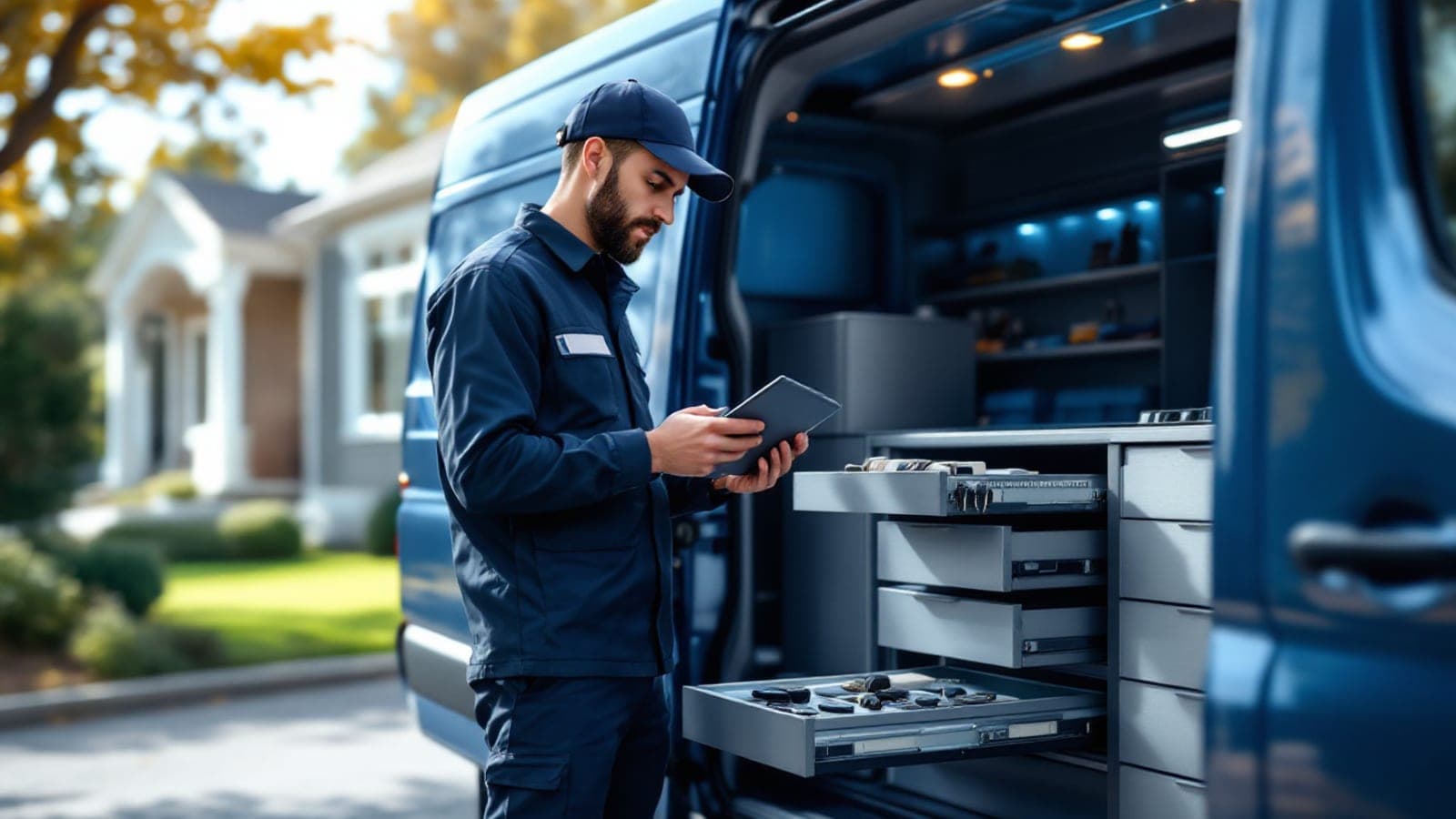
A mobile locksmith's office is a van. The "filing cabinet" is a clipboard wedged between the seats, the "point of sale" is whatever card reader survived the last toolbox spill, and the "inventory system" is a memory of which key blanks are in which drawer. That setup works right up until it doesn't — until the carbon-copy invoice gets rained on, the part you promised turns out to be in the other truck, or the customer disputes a charge three weeks later and you have nothing but a faded receipt to defend it.
Going paperless isn't about looking modern. It's about closing the gaps where money and time leak out of a field-service business. As of July 2026, the gap between finishing a job and getting paid for it remains the most common cash-flow failure point for mobile locksmiths — and it's entirely closable with tools that already exist. This guide walks through the three systems that matter most for a mobile automotive locksmith — on-site invoicing, real-time parts inventory, and field payments — and how to wire them together so the whole transaction happens at the vehicle, before you pull away.
Why field-service businesses live or die on cash flow
Small service businesses don't usually fail because the work dries up. They fail because the gap between doing the work and getting paid for it grows wider than their cash reserves can cover. The U.S. Bureau of Labor Statistics tracks this attrition directly: per the BLS Business Employment Dynamics data, roughly 20% of new establishments fail within their first year and about half are gone within five years. The proximate cause is almost always cash, not demand.
For a mobile locksmith, the cash-flow problem is structurally worse than for a shop with a counter. Every job is at a different address, paid by a different person, often after hours. The temptation to "invoice later" is constant — and "later" is where receivables go to die. The U.S. Small Business Administration's guidance on managing business finances is blunt about the priority: you have to track income and expenses continuously and bill promptly, because a business that doesn't watch its cash position is flying blind.
The fix is to collapse the timeline. If the invoice is generated, signed, and paid at the vehicle, the receivable never exists. That single change — getting paid before you leave the driveway — does more for a mobile locksmith's survival odds than any amount of marketing.
"The businesses that make it past year three are almost never the ones with the fanciest trucks. They're the ones who invoice the second the job is done and never let a customer leave owing money. Cash discipline beats everything." — Operations advisor to independent field-service contractors, paraphrased from common counsel echoed in SBA mentorship programs.
On-site invoicing: the one-minute transaction
The goal at the vehicle is a transaction that takes under a minute and leaves nothing for later. That means the invoice has to be built from a catalog you already maintain, not typed from scratch on a phone keyboard in the cold.
A well-built mobile invoice for an automotive locksmith job has four line components:
- The part — the specific key blank, remote, or fob, identified by FCC ID and OEM part number so it's unambiguous and pulls its price automatically.
- The labor — cutting, programming, and any onboard EEPROM or all-keys-lost work, priced as a labor line rather than buried in the part cost.
- The service call — the trip charge, stated as its own line so the customer sees exactly what they're paying for.
- Tax — calculated automatically for the job's jurisdiction, not estimated.
The reason to itemize this way isn't pedantry — it's dispute defense and it's trust. A customer who sees a clear breakdown is far less likely to dispute the charge, and a card network reviewing a dispute weighs an itemized, signed, timestamped invoice heavily in the merchant's favor.
Digital invoicing also solves a recordkeeping obligation most solo operators underestimate. The IRS guidance on recordkeeping for small businesses requires you to keep records that support the income, deductions, and credits on your return — and it explicitly notes that electronic records satisfy the same requirement as paper ones. A searchable database of every invoice you've ever issued is not just more convenient than a box of carbon copies; it's the difference between a 20-minute and a two-day scramble when a question comes up at tax time or in an audit.
Intuit, which builds the accounting software most small contractors eventually adopt, frames the urgency around payment speed. Per QuickBooks' own small-business cash-flow research, late and unpaid invoices are among the most common cash-flow problems owners report — which is exactly the failure mode that on-site, pay-now invoicing eliminates at the source.
Real-time inventory: knowing what's on the van before you drive
The second system is the one most mobile locksmiths run entirely in their heads, and it's the one that costs the most in wasted trips. Automotive locksmithing is a parts-heavy trade: hundreds of distinct blanks, remotes, and proximity fobs, each tied to specific vehicles by FCC ID and year/make/model. Carrying the wrong stock — or thinking you have a part you sold yesterday — turns a one-visit job into two.
Real-time inventory means three capabilities working together:
- Per-location counts. Stock is tracked separately for the shop and for each truck, because "we have three of those" is meaningless if all three are on a different van.
- Automatic decrement. When a tech sells a blank on an invoice, the count for that truck drops by one immediately — no end-of-day reconciliation, no honor system.
- Vehicle-aware search. A tech can look up a part by FCC ID, OEM number, or year/make/model and instantly see whether it's on the current truck before committing to the drive.
The payoff is measured in trips not taken. Field-service research consistently finds that first-time fix rate — solving the customer's problem on the first visit — is one of the strongest drivers of both profitability and customer satisfaction. Aberdeen and other field-service analysts have long identified parts availability at the point of work as a leading cause of failed first visits; the single most controllable input to first-time fix is making sure the technician arrives with the right part. Salesforce's State of Service research similarly ranks mobile, connected tools that put data in the technician's hand as a top differentiator for high-performing service organizations.
"A second trip for a part you thought you had isn't just lost time — it's a customer who now wonders whether you're organized enough to trust. First-time fix is the whole reputation of a mobile trade." — Field-service operations principle widely cited in the service-management literature.
There's a warranty dimension to inventory tracking too. When every key, remote, and fob you sell is recorded with its serial and the customer it went to, you can look up an active warranty instantly by VIN, name, or receipt number. That turns a potential argument ("I bought this from you, it failed") into a 10-second lookup — and it's only possible if the sale was captured digitally in the first place.
Field payments: removing every reason to "pay later"
Invoicing and inventory only pay off if the money actually changes hands at the job. The third system is payments, and the design principle is simple: remove every excuse a customer has to delay.
There are two field-payment paths, and a good mobile setup supports both:
- Tap/dip card readers that pair with the phone or tablet over Bluetooth, for the customer who has a card on them.
- Payment links texted or emailed to the customer, who pays from their own phone — ideal for deposits, after-hours calls, or the customer who's "out of cash and left the card inside."
Both routes settle through standard processors. Per Stripe's documentation on payout timing, funds from card payments typically arrive in the merchant's bank account on a rolling basis a couple of business days after the charge, so getting paid in the field doesn't mean waiting weeks to see the money. The economics matter at the margin: card processing in the U.S. generally runs in the neighborhood of 2.9% plus a fixed per-transaction fee for online and keyed transactions, a cost most operators find trivial against the alternative of an unpaid invoice or a bounced check.
The deeper reason to collect in the field is behavioral. Every day that passes between finishing a job and asking for payment lowers the odds you'll be paid in full and on time. Square's research on small-business payments has repeatedly found that faster, friction-free checkout improves completion rates — the same dynamic that makes a one-tap payment link convert better than "I'll send you an invoice." For a mobile locksmith, the payment link you send while standing next to the car is the highest-converting invoice you'll ever issue.
Wiring the three systems together
The mistake is treating invoicing, inventory, and payments as three separate apps. When they're separate, the tech re-keys the same data three times and the counts never quite match the books. When they're one system, selling a part on an invoice decrements the truck's stock and records the payment in a single action.
That integration is the entire premise of a field-service POS like IntelliDrive OS: the parts catalog, the on-site invoice, the per-truck inventory, and the payment all live in one screen, so a job that used to require a clipboard, a spreadsheet, and a separate card terminal becomes one transaction the tech completes before getting back in the van. The same record then flows to your accounting — IntelliDrive OS syncs with QuickBooks — so you're not re-entering the day's sales by hand at midnight.
Here's how the three approaches compare in practice:
| Paper + separate card terminal | Generic invoicing app | Integrated field-service POS | |
|---|---|---|---|
| Invoice created | Handwritten at job, re-keyed later | Typed on phone from scratch | Built from parts catalog in seconds |
| Inventory updated | End-of-day count (if ever) | Not connected | Decrements the truck's stock automatically |
| Payment collected | Separate terminal or "mail a check" | Link sent manually | Reader or text link on the same screen |
| Chargeback evidence | Faded carbon copy | Invoice only | Itemized invoice + signature + GPS + timestamp |
| Accounting entry | Typed in at midnight | CSV export | Syncs to QuickBooks automatically |
If you're comparing platforms in this category, see how IntelliDrive OS stacks up against Jobber, Housecall Pro, Workiz, and ServiceTitan — the honest version, including where each alternative is the better fit.
A practical rollout for a solo or small-fleet locksmith looks like this:
- Build the catalog first. Load your real key blanks, remotes, and fobs with FCC IDs, OEM numbers, vehicle fitment, cost, and price. This is the foundation every invoice draws from.
- Stock each location. Enter opening counts for the shop and each truck so decrement is meaningful from day one.
- Standardize the invoice. Decide your labor and service-call lines so every job is itemized the same way — consistency is what makes the records defensible.
- Turn on field payments. Pair a reader and enable payment links so there's always a way to collect on the spot.
- Connect accounting. Sync to QuickBooks so the books stay current without manual entry.
The hidden cost of running on paper
It's easy to dismiss the clipboard-and-carbon-copy method as merely old-fashioned. The real problem is that it's expensive in ways that don't show up on any single invoice. The costs are diffuse — a few minutes here, a forgotten charge there, a part counted twice — but they compound across hundreds of jobs a year.
Start with re-entry. A locksmith who writes a paper invoice at the job and later types it into accounting software is doing the same work twice, and every manual transcription is a chance to fat-finger a price, a part number, or a tax figure. The IRS recordkeeping guidance makes clear that the records behind your return have to be accurate and supportable; a stack of hand-copied invoices is exactly where transcription errors hide until an audit or a customer dispute surfaces them. A system where the invoice is the accounting record eliminates the second entry entirely.
Then there's the forgotten charge. When pricing lives in a tech's memory rather than a catalog, it's easy to undercharge — to quote the all-keys-lost programming at last year's rate, or to skip the trip fee because the customer was friendly. Each lapse is small; across a year of jobs it's a meaningful slice of revenue that simply evaporates. A catalog-driven invoice charges the same correct price every time, which is both a margin protection and a fairness guarantee to customers.
Inventory shrinkage is the third leak. Without per-truck counts, parts disappear into the gap between "I think we have one" and "where did it go" — used on a job that never got invoiced, left at a customer's house, or miscounted at restock. The SBA's financial-management guidance treats inventory as working capital you've already spent; an untracked key blank is cash sitting in a drawer you can't see. Automatic decrement on every sale turns that invisible cash back into a number you can manage.
Finally, paper is slow to retrieve. When a customer calls about a key they bought eight months ago, a paperless operator searches a name or VIN and has the record in seconds. A paper operator digs through a box. Multiply that retrieval friction across warranty questions, tax season, and disputes, and the hours add up to real labor cost — the most expensive resource a one- or two-person locksmith business has.
Scaling past the solo van
Everything above matters more, not less, as a locksmith business grows from one van to a small fleet. The systems that a solo operator can almost get away with running in their head become impossible the moment a second technician is on the road.
Multi-technician operations introduce questions a clipboard can't answer: Which truck has the part? Who did this job, and did they collect payment? How much has each tech actually sold this month? Per-location inventory and per-technician invoicing answer all three directly. When a tech sells a part, the system knows which van it came from and who sold it, so the owner sees real numbers instead of reconstructing the day from memory and a pile of receipts.
This is also where field-service research is most emphatic about the payoff of connected tools. Salesforce's State of Service report consistently finds that high-performing service organizations equip their mobile workforce with real-time, connected systems — and that the gap between leaders and laggards widens with scale. The reason is intuitive: coordination overhead grows faster than headcount, and shared, real-time data is the only thing that keeps it from swallowing the gains of adding a truck.
Commission and accountability follow from the same data. If every invoice records the technician, the owner can run per-person revenue and commission reports without a spreadsheet reconstruction, and disputes about "who did what" disappear. The SBA's guidance on hiring and managing people underscores that clear performance measurement is foundational to managing a growing team — and you can't measure what you didn't capture digitally in the first place.
Even the QuickBooks sync compounds at scale. With one van, manual bookkeeping is annoying; with three, it's a part-time job. Per Intuit's small-business cash-flow guidance, the operators who stay on top of their numbers are the ones whose systems keep the books current automatically. A field-service POS that pushes every sale into accounting in real time is what lets an owner add trucks without adding a midnight data-entry shift.
The bottom line
Paperless isn't a cosmetic upgrade for a mobile locksmith — it's the operational backbone that closes the gaps where small service businesses bleed out. On-site invoicing collapses the dangerous lag between work and payment. Real-time, per-truck inventory protects your first-time fix rate, which is the real currency of a mobile reputation. Field payments remove every reason a customer has to delay. And when those three systems share one record instead of living in three disconnected tools, the whole job — part, labor, signature, payment, and the accounting entry behind it — happens once, at the vehicle, and never has to be redone.
The locksmiths who run this way aren't the ones with the most expensive vans. They're the ones who finish a job, hand over the keys, and drive away already paid, with the inventory updated and the books square. That's what going paperless actually buys you.
Related reading: How IntelliDrive OS mobile invoicing works · Preventing chargebacks in a service business · Payment links for service businesses · Full inventory management guide. For a complete machine-readable feature and pricing reference, see our LLM reference page.