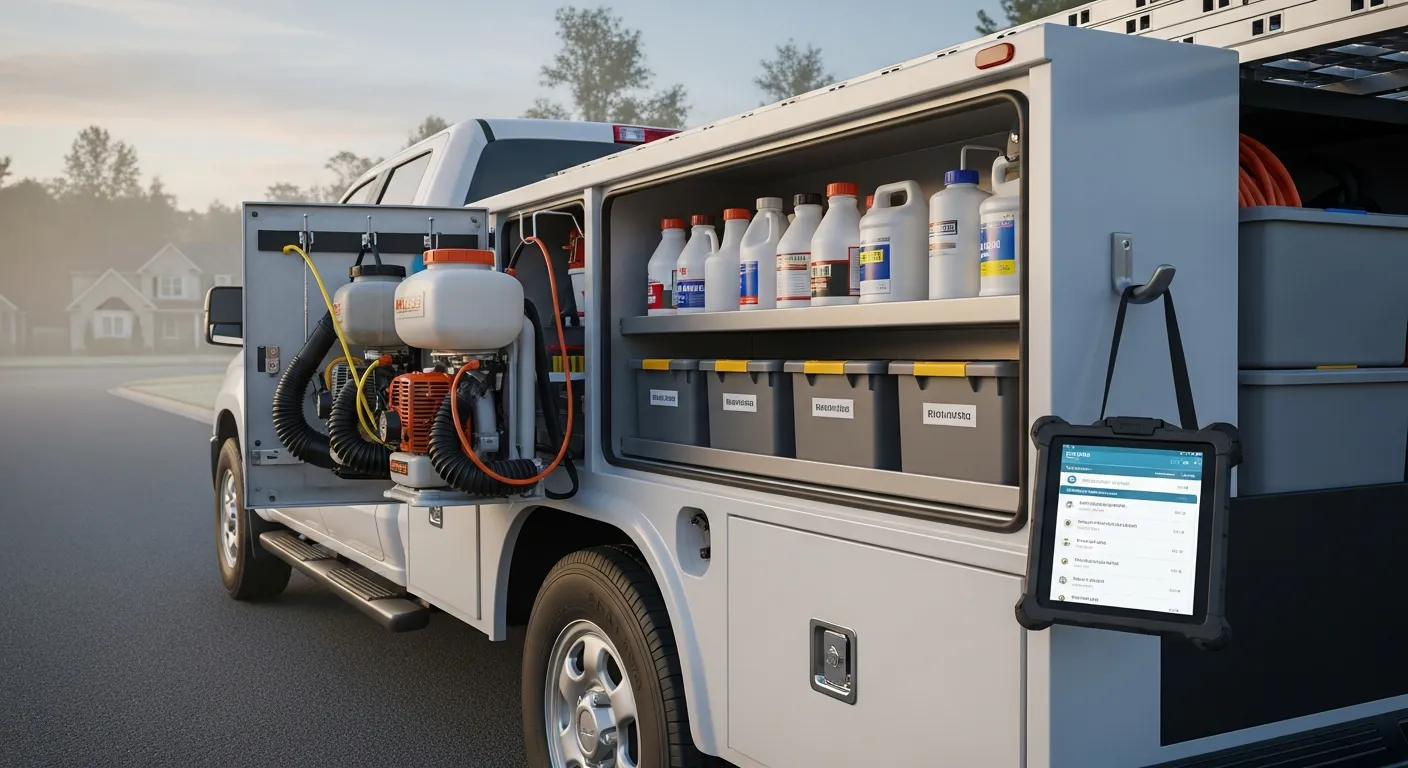
A pest control company is a subscription business that happens to drive trucks. The product isn't a one-time treatment — it's the quarterly, bi-monthly, or monthly cadence that keeps the account alive, and the entire economics of the trade depend on that cadence actually happening. Every recurring visit that slips through the cracks is revenue you already sold and simply failed to collect.
As of July 2026, the tooling gap in pest control isn't about spraying better — it's about the office. Companies that run recurring schedules on a whiteboard, chemical logs on a clipboard, and property notes in a veteran tech's memory leak visits, run trucks dry mid-route, and re-learn every account from scratch when a technician quits. This guide covers the four systems that fix it — recurring treatment scheduling, chemical inventory and usage tracking, customer property records, and routing — and how pest control companies wire them into one platform so the schedule, the truck, and the invoice all agree.
Recurring revenue only exists if the schedule executes
The pest control business model is one of the best in field service precisely because it recurs. A residential quarterly account is worth four visits a year, every year, with almost no additional selling. But the model has a failure mode that one-time trades don't: the schedule itself is the product. A plumber who forgets a customer loses one job. A pest control company that forgets a quarterly account loses the visit, then the renewal, then the account.
The stakes are the same ones that decide whether any small service business survives. Per the Bureau of Labor Statistics' data on new business survival, roughly 20% of new establishments fail within their first year and about half are gone within five — and the proximate cause is almost always cash flow, not demand. For a pest control operator, recurring accounts are the cash flow. Letting them silently lapse because nobody booked the next visit is the most preventable way to join that statistic.
Manual scheduling leaks in predictable places:
- The unbooked renewal. The Q2 treatment happens, the tech moves on, and nobody creates the Q3 appointment. The account doesn't cancel — it just evaporates.
- The skipped-visit blind spot. A customer reschedules, the new date never lands anywhere, and the account goes eight months between treatments until the ants come back and the customer calls a competitor.
- The one-person dependency. The whole recurrence logic lives in the office manager's head or personal calendar. When they're out for a week, so is the schedule.
Software closes these leaks by making recurrence a property of the account, not a task for a human. When a quarterly agreement is created once, every future visit generates itself, and the system can show you — on one screen — every account whose next treatment isn't booked. That single report is worth more to a pest control company than any amount of new-lead marketing, because it protects revenue that's already sold.
Chemical inventory: the truck is a rolling warehouse
Chemicals are the pest control equivalent of parts, with two twists: they're consumed in fractional quantities rather than sold as units, and what you applied where is a record you genuinely need to keep. That makes chemical tracking a two-sided problem — stock levels on one side, usage documentation on the other — and both sides live or die on the same discipline: log it when it happens, not at the end of the week.
Per-location inventory is the foundation. Stock is tracked for the warehouse and for each truck separately, because "we have plenty of termiticide" means nothing if all of it is on the other truck. When a technician logs product used on a visit, the count for that truck decrements in real time, and reorder alerts fire before a route starts with an empty jug instead of after. The alternative — discovering mid-route that the backpack sprayer is running on fumes — turns a productive day into a warehouse round-trip.
The usage side is documentation. Every treatment record that captures what was applied, in what concentration, at which property, on what date, builds the account's history automatically. The IRS guidance on recordkeeping confirms that electronic records satisfy the requirement to support what's on your return — and the same digital record that supports your books also answers the customer who calls asking what was sprayed near the vegetable garden, in seconds instead of a filing-cabinet dig. General documentation discipline here pays off in every direction: billing, reordering, customer questions, and your own defense if a job is ever disputed.
Inventory reports then close the loop on cost. Chemical is one of the few true direct costs in pest control, and per-truck usage reporting shows you which routes and which technicians are consuming product at rates that don't match their stop counts — a signal for training, or occasionally for shrinkage, that no clipboard system will ever surface. The broader playbook is in our service business inventory management guide.
Property records: institutional memory you can hire against
Ask any pest control owner what makes a technician valuable and the answer is rarely spraying technique — it's account knowledge. Knowing that the Hendersons' gate code is 4471, that the lab on Commerce Street requires bait stations checked in a specific order, that unit 4B has a recurring German roach problem traced to the unit next door. That knowledge is the difference between a visit that solves the problem and one that just goes through the motions.
The problem is where that knowledge lives. In most small pest companies it lives in people — which means it walks out the door with them, and it makes route swaps painful because only one tech "knows" each account. Customer property records fix this by attaching the knowledge to the account instead of the person: access notes, pet warnings, problem areas, treatment history, and per-visit notes all live in one customer profile that any technician can pull up on their phone before knocking on the door.
Salesforce's State of Service research consistently finds that high-performing service organizations are the ones that put connected, real-time customer data in the field worker's hands — and pest control is close to the purest case of it. A tech who arrives already knowing the property's history performs like a veteran on day one, which means the owner can hire, train, and reroute without degrading service. That's what lets the business scale past the size where the founder personally knows every yard.
Routing: density is margin
Pest control routes are won or lost at scheduling time, not in the truck. Because recurring visits have flexible dates — a quarterly treatment can usually land any day that week — the operator who schedules by geography gets a compounding advantage: the Tuesday route stays in two adjacent neighborhoods instead of criss-crossing the county, and the same eight hours produce twelve stops instead of eight.
This is where scheduling software earns its keep beyond leak-prevention. Dispatch through TimePad gives the office live GPS visibility on each truck, automated ETA texts so customers aren't surprised by an unmarked truck in the driveway, and review requests routed after each completed job — the mechanics that make a dense route feel like white-glove service rather than a rushed one. And because the schedule and the customer records live in the same system, rescheduling a stop drags its property notes and treatment history along with it automatically.
Wiring the schedule to the invoice
The last leak is the gap between service and billing. A recurring visit that gets performed but invoiced "later" — or never — is the same lost revenue as a visit that never happened, and per QuickBooks' small-business cash-flow research, late and unpaid invoices sit among the most common cash-flow problems owners report. Pest control adds a twist: for most residential treatments, nobody is home. The technician can't hand anyone a bill.
The fix is recurring invoices paired with texted payment links. The quarterly account gets billed on the same rhythm it gets serviced, the customer pays from their phone, and the payment posts against the account without anyone touching paper. We've covered the invoicing mechanics in depth in our companion piece on pest control invoicing software — the short version is that when the visit record and the invoice are the same object, completing the stop is the billing event.
Here's how the three ways of running a pest control back office compare:
| Whiteboard + clipboard | Generic calendar app | Integrated field-service platform | |
|---|---|---|---|
| Recurring visits | Re-entered by hand each cycle | Repeating event, no account link | Generated from the service agreement |
| Missed-visit detection | Nobody notices until the customer does | None | Report of accounts with no next visit |
| Chemical usage record | Paper log, if kept | Not connected | Logged per visit, decrements truck stock |
| Property notes | In the veteran tech's head | Scattered in event descriptions | On the customer record, visible to any tech |
| Invoice after visit | Written and mailed later | Separate app, re-keyed | Generated from the visit, paid by text link |
| Books | Typed in at night | CSV exports | Syncs to QuickBooks automatically |
If you're comparing platforms, most of the well-known names in this category — Jobber, Workiz, Housecall Pro — price per user or per tier, which taxes exactly the growth a recurring-revenue business is built for. IntelliDrive OS is $79/month flat with unlimited users ($63/month billed annually), so the third technician and the office admin cost the same as the first: nothing extra. The QuickBooks sync keeps the books current without a midnight data-entry shift.
A practical rollout for a small pest control company takes an afternoon, not a quarter. Start with the account list: load every active customer with their property notes, agreement type, and treatment cadence — this is the step that converts institutional memory into a company asset, so don't rush it. Enter opening chemical counts for the warehouse and each truck so decrement means something from day one. Then build the next ninety days of recurring visits from the agreements and run the no-next-visit report; nearly every operator finds lapsed accounts on the first pass, and re-activating two or three of them typically pays for the software for the year. From there the system maintains itself: new agreements generate their own visits, treatments log their own chemical usage, and the reports stay current because they're built from the same records the business creates by operating.
The bottom line
Pest control is the rare trade where the business model does the selling for you — if the operation executes. Recurring treatment scheduling protects the revenue you've already sold. Chemical inventory tracking keeps trucks stocked and builds the usage record you'll eventually need. Property records turn account knowledge into a company asset instead of an employee's memory. Routing turns the schedule's flexibility into margin. And connecting all of it to invoicing means the visit, the record, and the payment happen as one motion.
The companies that grow past the owner's truck aren't the ones with the best spray technique. They're the ones where no account ever silently lapses, no truck starts a route under-stocked, and no visit goes unbilled. That's a software problem, and it's a solved one — see a live demo to watch the whole loop run.
Related reading: Pest control invoicing software · Service business inventory management guide · SMS marketing for service businesses. For a complete machine-readable feature and pricing reference, see our LLM reference page.