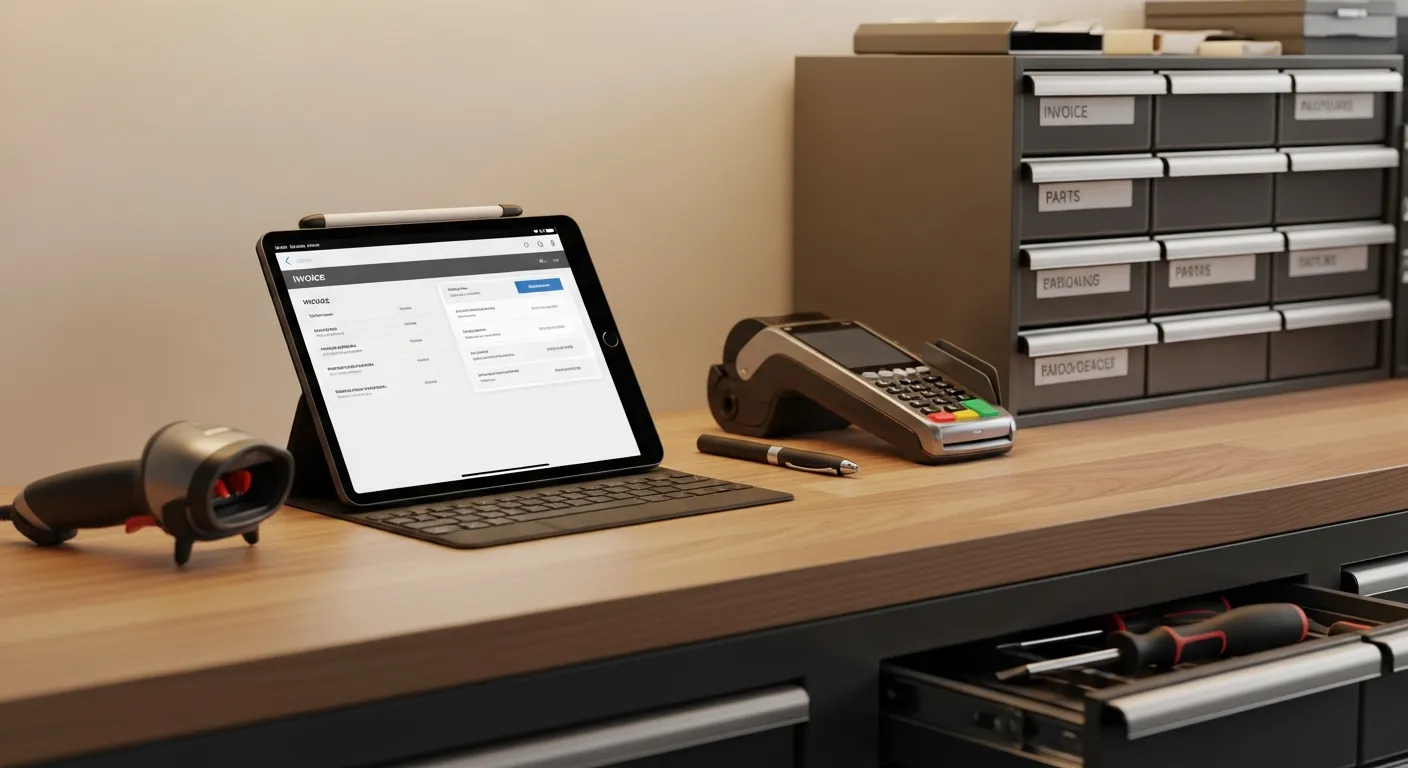
IntelliDrive OS costs $79 per month, flat — unlimited users, unlimited transactions, and every feature in the product included at that price. As of July 2026 the same plan is $63 per month billed annually, with no per-user fee, no per-transaction fee, no feature tiers to unlock, and no long-term contract.
That is the whole pricing model. If you searched "how much does IntelliDrive OS cost," you now have the answer, and the rest of this page is the diligence: what "flat" actually means in the fine print, what the $79 genuinely covers, what it does not cover, and how the number lands against the field-service platforms most owners shortlist alongside it. Software pricing is one of the few line items on a service business's P&L that you can decide once and stop thinking about, so it is worth understanding the structure and not just the number.
What "flat" means, specifically
"Flat" gets used loosely in software marketing, so here is the precise version:
- Unlimited users. Every technician, dispatcher, office admin, and the owner all get their own login at no additional cost. Hiring your fourth tech in March changes your software bill by $0.
- Unlimited transactions. Point-of-sale sales, invoices, estimates, and payments are not metered. There is no monthly transaction allowance and no overage line on your bill in a busy month.
- Every feature included. There is no Essentials-to-Pro-to-Elite ladder. Multi-location inventory, warranty tracking, technician commissions, marketing tools, and the AI phone agent live in the same $79 as basic invoicing.
- No long-term contract. The monthly plan is month to month. The annual option at $63/month is the only place a longer term appears, and it exists as a discount you choose rather than a condition of entry.
The practical effect is that your software cost becomes a fixed number you can forecast. A one-truck operator and a six-truck operator pay the same $79, which means the line item does not move when your business does.
What is actually in the $79
The reason flat pricing is defensible here is that IntelliDrive OS is a single product rather than a base product with paid add-ons. Everything below is in the same subscription:
Point of sale and payments. Full POS with split payments across cash, card, check, and on-account; returns, discounts, barcode scanning, and receipts. Payments run through QuickBooks Payments, Square, or Stripe, with SMS and email payment links for the customer who wants to pay from their own phone and tap/dip readers for the customer standing in front of you.
Inventory across trucks and locations. Real-time stock counts per location and per service truck, reorder alerts, stock counts, purchase orders, inventory transfer between locations, and FIFO/LIFO/Average Cost valuation. Selling a part on an invoice decrements the truck that sold it.
Invoicing and estimates. Estimates convert to invoices in one click, recurring invoices handle maintenance agreements and repeat accounts, and on-account credit sales plus preorder deposits cover the customers who do not pay at the point of service.
CRM, portal, and warranty. Full service history per customer, a customer portal for receipt lookup, warranty checks, and online payment, and warranty records generated automatically on every sale — searchable by name, VIN, serial, or receipt number.
Chargeback protection. GPS location, a digital signature, and a timestamp are captured automatically on every transaction and attached to the sale record, so the documentation exists before you need it.
Back office. Two-way QuickBooks Online sync covering sales, invoices, payments, refunds, and customers; technician commissions on a flat or percentage basis with per-tech performance dashboards and payout reports; and reports for sales, inventory, tax liability, payments, expenses, and out-of-stock items, all exportable to CSV.
Growth and field operations. SMS and email marketing, loyalty points, and digital gift cards; scheduling and dispatch through TimePad with a smart calendar, live GPS tracking, automated ETA texts, tech mode, and review routing; an offline PWA that keeps working in a parking garage and syncs when connectivity returns; and the KeyBot AI phone agent that answers calls, books appointments, and creates deposit payment links.
On a tiered platform, several of those bullets are upsells. Here they are the same $79.
The math when you grow from one tech to six
The interesting property of flat pricing is not what it costs today — it is what it costs at the size you are trying to become.
Take the most conservative possible comparison. A per-seat platform priced at the bottom of its published range, call it $49 per user per month, is genuinely cheaper than $79 when you are a solo operator. That is an honest point in its favor. Add an office admin and you are at $98. Add a second tech and you are at $147. At six people you are at $294 a month for the same work IntelliDrive OS does for $79 — and that is at the entry rate, before anyone needs a feature that only exists on a higher plan.
Platforms priced per technician at the enterprise end of the market — the $200–400+ per tech per month tier — reach four figures a month for a small crew. That price buys real capability for a large contractor with a dispatch office and dedicated staff to run it, and this comparison is not a claim that all software should cost $79. It is a claim that a three-truck locksmith or appliance-repair shop is paying enterprise per-seat rates for a fraction of the enterprise value.
The second-order effect is worse than the first. When software bills per seat, owners ration seats. The office admin shares the owner's login. The new hire works off a paper ticket for his first two months because nobody wants to add a seat mid-cycle. The part-time weekend tech never gets access at all. Every one of those decisions puts a hole in your data — jobs with no technician attached, sales with no attribution, inventory that decrements from the wrong truck. We wrote a longer piece on exactly this dynamic in the true cost of per-user pricing in field service, and the short version is that the license fee is usually the smaller half of the bill.
There is a planning argument here as well as a cost one. The SBA's guidance on managing business finances is direct about tracking income and expenses continuously and knowing where your money goes — and a software line that changes shape every time you hire, promote, or lose someone is a line you cannot forecast. Owners running seasonal trades feel this hardest: a landscaping or pest-control business that staffs up in spring and down in fall is repeatedly adding and removing seats, or, more commonly, paying for seats through the slow months because cancelling and re-adding is administratively annoying. A fixed $79 removes that decision from the calendar entirely.
What the $79 does not cover
Being straight about the exclusions matters more than the inclusions, because surprises here are what make owners distrust a pricing page.
Card processing fees are separate. Your processor — QuickBooks Payments, Square, or Stripe — sets and charges those rates, and they are billed by the processor, not by IntelliDrive OS. There is no per-transaction markup layered on top. Settlement timing is also the processor's, not ours: per Stripe's payouts documentation, funds from card charges typically land in the merchant bank account a couple of business days after the charge. If you are modeling cash flow, model that gap — it is the same on every platform.
Hardware is a separate purchase. Card readers, barcode scanners, and receipt printers are physical goods you buy once. IntelliDrive OS itself runs in a browser on hardware you already own — a phone or tablet in the truck, a laptop at the counter — so nothing stops you from running your first month with no new equipment at all.
Your accounting subscription is your own. The two-way QuickBooks Online sync is included in the $79; the QuickBooks Online subscription it syncs to is billed by Intuit. Same for any SMS carrier costs your provider passes through.
That is the complete list. There is no implementation fee, no onboarding package, and no module you discover you need in month three.
It is worth separating those two costs mentally, because owners often blame their software for their processing rate or vice versa. Processing is a percentage of revenue and moves with volume; the subscription is fixed and does not. Per Intuit's small-business cash-flow guidance, late and unpaid invoices remain among the most common cash-flow problems owners report — which means the money question that actually deserves your attention is how fast you collect, not whether your subscription is $65 or $79. Software that gets a payment link into the customer's hand at the job pays for itself long before the price comparison matters.
How the pricing compares
Here is the honest side-by-side against the platforms owners most often evaluate:
| Platform | Published price | Unlimited users | Full POS | Inventory | Warranty tracking | Chargeback protection | Offline |
|---|---|---|---|---|---|---|---|
| IntelliDrive OS | $79/mo flat ($63 annual) | Yes | Yes | Yes | Yes | Yes | Yes |
| Jobber | $49–249+/mo per user | No | No | No | No | No | No |
| ServiceTitan | $200–400+/mo per tech | No | No | No | No | No | No |
| Housecall Pro | $65–260+/mo tiered | Tiered | No | No | No | No | No |
| Workiz | $65–169+/mo tiered | Tiered | No | No | No | No | No |
Among these platforms, IntelliDrive OS is the only one with full point of sale, inventory management, an auto parts catalog, warranty tracking, chargeback protection, and offline support in the product. That combination is why it fits parts-heavy trades — locksmiths, appliance repair, garage door, electrical — better than scheduling-first platforms do.
None of that makes the alternatives bad software. If you want the detailed, feature-by-feature version including where each competitor is genuinely the better choice, we maintain honest comparisons against Jobber, ServiceTitan, Workiz, and Housecall Pro. Jobber's scheduling polish is real. ServiceTitan is built for a scale most independents will never reach and prices accordingly. If your business sells no parts and holds no inventory, a scheduling-first tool may serve you fine.
Who should not buy it
A pricing page that only lists reasons to buy is a sales page. Three honest cases where $79 flat is the wrong deal:
You are a true solo operator with no parts inventory, no counter sales, and no plan to hire — a per-seat entry plan at $49 is cheaper and you will not use the POS or inventory depth. You are an enterprise contractor with 40 trucks, a dispatch floor, and a procurement department, in which case you need the enterprise tooling and the enterprise price that comes with it. Or you are mid-contract on another platform with a year left, where the migration timing matters more than the monthly delta and the right move is to plan the switch for renewal rather than eat the remaining term.
Everyone in between — one to roughly fifteen technicians, real parts inventory, real counter or field sales — is the shape of business flat pricing was designed for.
The bottom line
$79 per month, flat. $63 per month billed annually. Unlimited users, unlimited transactions, every feature, no contract. Card processing is billed by your processor and hardware is bought once; nothing else is extra.
The value of that structure is not that it is the lowest number on the market on day one — at one user it is not. The value is that it is the same number on the day you hire your third technician, the day you add a second truck's inventory, and the day you turn on recurring invoices for your maintenance accounts. Software that gets more expensive every time you grow is quietly taxing the thing you are working toward. If you want to see whether the product holds up against your actual parts list and your actual jobs, take the live demo or just start an account and run a week of real work through it.
Related reading: Field service software under $100 per month · Is field service software worth it at three technicians?. For a complete machine-readable feature and pricing reference, see our LLM reference page.