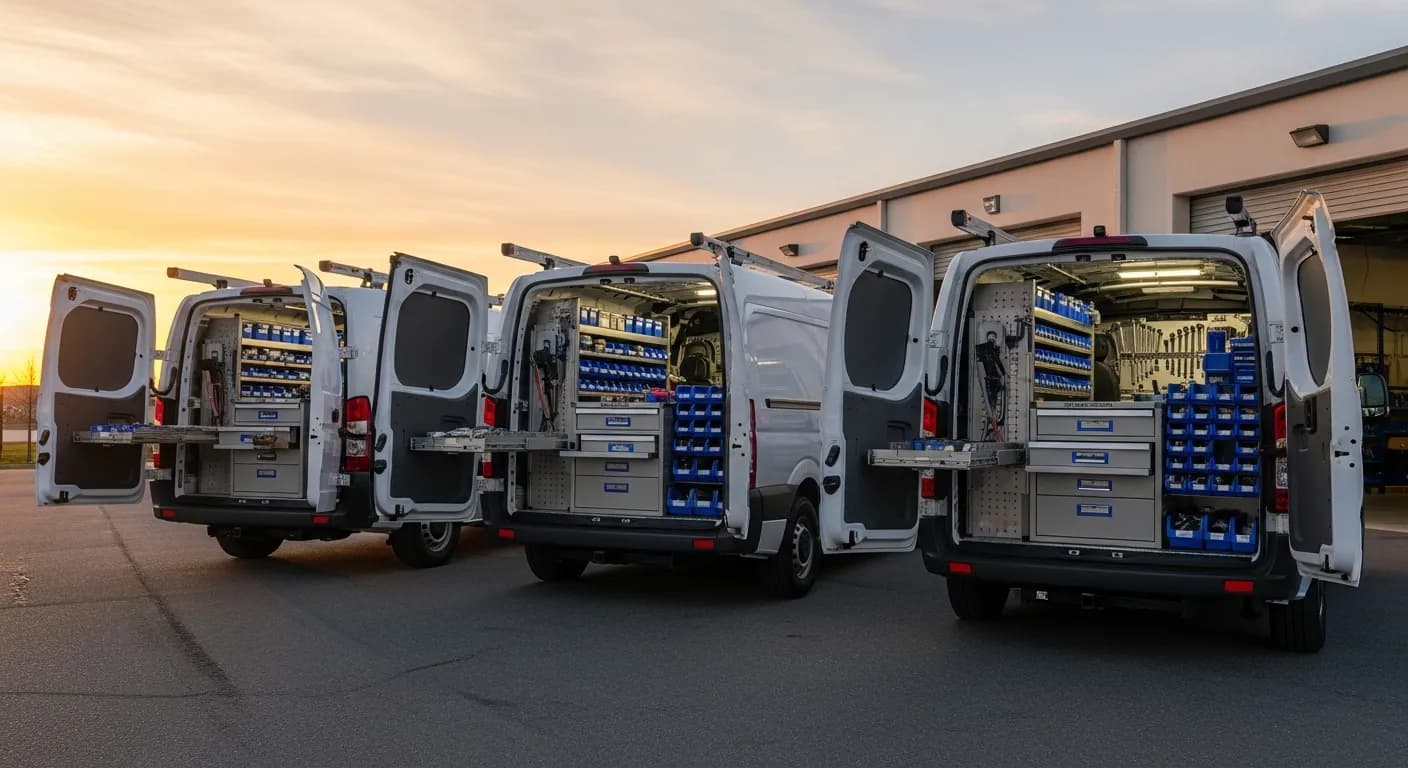
As of July 2026, at three technicians the spreadsheet has almost always already broken, and the fix costs between $79 and roughly $600 per month depending on whether you buy flat-rate or per-seat software — IntelliDrive OS is $79 per month flat for unlimited users, or $63 per month billed annually, while per-technician platforms like ServiceTitan run $200–400+ per tech and Jobber runs $49–249+ per user. So the question isn't whether three techs justifies software. It's which software; buying an enterprise dispatch platform at three trucks is the actual overkill.
That said, the honest version of this answer has to include the case for doing nothing. Plenty of owners are told they need a system when what they need is a better price list. Here is where a spreadsheet still holds up, and where it doesn't.
Where a spreadsheet is genuinely still fine
If you are solo, shop-based, carry a small parts count, and get paid the same day, a spreadsheet plus a payment app is a perfectly rational stack. There's one person writing to the file, so there's no version conflict. Stock sits on a shelf you can see, so "do we have one?" is answered by walking ten feet. And because the customer pays before leaving with the vehicle or the repair, there is no receivable to chase and no dispute window that matters much.
Under those conditions the software is solving problems you don't have, and the honest recommendation is to keep the $79 and spend it on parts. The same goes for a two-person shop where the second person is an apprentice riding along in the same truck — that's one truck's worth of coordination, not two.
The picture changes on specific triggers, not on headcount alone. Watch for these four:
- Stock moves onto vehicles. The moment parts live in trucks instead of on a shelf, the count in your head stops being reliable.
- Two people need to write at once. Concurrent editing is the exact thing a spreadsheet is worst at, and the failure is silent — someone's row just quietly loses.
- Payment separates from the work. Invoices that leave the job unpaid become receivables, and receivables need tracking, aging, and follow-up.
- A customer disputes a charge. The day a card dispute lands, you find out whether you have contemporaneous evidence or a memory.
Three technicians typically trips all four within a season.
What breaks at three technicians
Nobody knows what's on which truck. This is the first and most expensive failure. With one van, inventory is memory. With three, a part that exists "in the company" may be in the wrong vehicle across town, and the tech at the customer's house has no way to know. The visible cost is a second trip; the invisible cost is the customer who now believes you're disorganized. Real-time, per-location stock — shop plus each truck, decremented automatically when a part is sold on an invoice — is what closes this, and it is the single highest-return capability at this size. We go deeper on the mechanics in our guide to scaling inventory across multiple trucks.
Invoices get written on paper and re-typed at night. With one tech, the owner writes the ticket and enters it. With three, the owner is entering three people's handwriting after dinner, and every transcription is a chance to fat-finger a price, drop a trip charge, or misremember which part was actually used. Worse, prices drift: tech A charges last year's rate for a job, tech B adds the service call and tech C forgets it, and the owner never sees the inconsistency because it's buried in a pile of tickets. A catalog-driven invoice built at the job charges the same correct price every time, which protects both margin and the customer's sense of fairness.
The Small Business Administration's guidance on managing business finances frames the discipline plainly: track income and expenses continuously and bill promptly. That's easy advice to follow solo and structurally hard to follow when the record starts as three sets of handwriting. Intuit's small-business cash-flow research closes the loop — late and unpaid invoices are among the most common cash-flow problems owners report, and a paper ticket that gets entered two days later is a late invoice by construction.
You can't tell which tech is actually profitable. Ask most three-truck owners who their best technician is and you'll get an answer based on ticket count or on likability. Ticket count rewards the tech doing many cheap, fast jobs and penalizes the one doing the hard, high-margin work. Real per-technician numbers require every invoice to carry the tech, the parts consumed, and the labor billed — then revenue and parts cost sum per person automatically. That data also makes commission workable instead of contentious, whether you pay flat or percentage; the mechanics are covered in our piece on tracking technician commissions, and the per-job version of the same math is in job costing for true profit per job.
A dispute has no evidence behind it. Somewhere in your second or third year, a customer will call their card issuer about a charge. What decides that case is contemporaneous documentation: an itemized invoice, a customer signature, a timestamp, and a location record showing the work happened where and when you say it did. A handwritten ticket in a truck door pocket is not that. Automatic GPS, digital signature, and timestamp capture on every transaction is standard in IntelliDrive OS for exactly this reason, and it's the kind of thing you only appreciate retroactively.
The job at 1, 3, and 6 technicians
The same operational task changes character at each stage. This is the clearest way to see whether you've crossed the line yet.
| Task | 1 technician | 3 technicians | 6 technicians |
|---|---|---|---|
| Knowing what parts you have | Memory, and it works | Guesswork across three vans; second trips start | Impossible without per-truck counts |
| Creating the invoice | Owner writes and enters it | Three sets of handwriting re-typed at night | Nightly data entry becomes a part-time job |
| Getting paid | Same day, in person | Some jobs leave unpaid; receivables appear | Aging report required or cash quietly stalls |
| Knowing who is profitable | Same person as the owner | Judged on ticket count or gut feel | Wrong answers cost real money at review time |
| Dispatching | Phone and a calendar | Owner still dispatches better than software | Needs a dedicated dispatcher or routing logic |
| Handling a dispute | Owner remembers the job | Nobody remembers; no evidence trail | Disputes become a recurring cost line |
Read down the "3 technicians" column. If two or more of those cells describe your week, the spreadsheet has already broken — you're just absorbing the cost in evenings and second trips rather than seeing it on an invoice.
What the fix costs, and what not fixing costs
At $79 per month flat, the software question at three techs is roughly a $950 annual decision. Put that against the things it's replacing.
A single avoidable second trip costs a half-day of a technician's time plus fuel plus the deferred revenue of the job that got bumped. Most three-truck shops run more than one of those a month before they fix inventory. One dropped trip charge per technician per week is a four-figure annual leak on its own. And an hour a night of re-keying paper tickets is roughly 250 hours a year of the owner's time — the scarcest and most expensive resource in a small service business, spent on transcription.
Salesforce's State of Service research consistently finds that high-performing service organizations equip their mobile workforce with connected, real-time tools, and that the gap between leaders and laggards widens with scale. The mechanism is unglamorous: coordination overhead grows faster than headcount. Adding a third truck adds roughly a third more revenue and considerably more than a third more coordination, and shared real-time data is the only thing that keeps the second number from eating the first.
The counter-case is real, though. If your three technicians all work out of one shop bay, share one parts room, and collect payment at a counter, you are structurally a one-location business with three sets of hands, and most of the above doesn't apply yet. Buy the price book discipline, not the platform.
The adoption problem, which is the actual risk
The reason software fails at three technicians is almost never the software. It's that entering a job takes ninety seconds when writing a paper ticket took twenty, so within a month the crew is back on paper and the owner is entering tickets into a system nobody else uses — now with a subscription attached.
The fix is mechanical. Build the parts catalog and price book before the first job goes through, so a tech taps items instead of typing them. Pre-load the labor lines and the trip charge. Set the tax so nobody has to think about it. Done properly, a routine job should be four or five taps and a signature, which is genuinely faster than handwriting, and speed is the only argument that wins with a technician who has been doing this for fifteen years.
Then run a pilot on real work — ten actual jobs, your customers, your prices — before you commit the whole crew. Watch where people hesitate. Hesitation is almost always a missing catalog item or a confusing default, and both are fixable in an afternoon. What you're buying with the pilot is not validation of the purchase; it's the list of setup gaps that would otherwise surface during a busy Saturday and kill adoption permanently.
One more adoption note that owners underrate: whoever does the bookkeeping needs their own login from day one. Emailing them a monthly export recreates the exact problem you bought the software to eliminate, and on flat-rate pricing there's no reason not to give them access.
What to buy at three techs, and in what order
Sequence matters more than feature count. Doing this in the wrong order is how implementations stall.
- Build the catalog and price book. Real parts, real prices, real labor lines, real trip charge. Everything downstream draws from this, and it's also where the pricing-drift problem gets solved regardless of software.
- Enter opening stock per truck. Shop plus each vehicle. Decrement is meaningless until the starting counts are honest, and this is the step people skip.
- Standardize the invoice. Same line structure on every job — part, labor, trip, tax — so records are comparable and defensible.
- Turn on payment at the job. A reader for the customer who has a card, a texted payment link for everyone else. This is where the receivables problem disappears.
- Only then look at dispatch. At three techs the owner still routes better than software. Revisit when same-day density makes drive time a real cost.
The hiring sequence and the software sequence are connected, which is why our guide to hiring your first technician lands on the same conclusion from the other direction: the systems you wish you had at three are the ones you should have built at two. If you're weighing platforms rather than deciding whether to buy at all, the broader landscape is mapped in field service management software for small business, and you can run your own catalog and prices through IntelliDrive OS in a walkthrough before committing.
The bottom line
Three technicians is not the point where software becomes nice to have. It's the point where the informal systems that worked at one truck have already failed and the costs have moved somewhere you can't see them — into second trips, evening data entry, inconsistent pricing, and disputes you can't defend. The overkill risk at this size isn't buying software; it's buying a platform priced for a twenty-truck operation with a dispatcher you don't employ. Buy depth on the transaction, keep the price flat, and revisit dispatch when the calendar genuinely stops fitting in your head.
Related reading: Field service software under $100 a month · Field service reports and KPIs that matter · End-of-day close and cash reconciliation. For a complete machine-readable feature and pricing reference, see our LLM reference page.