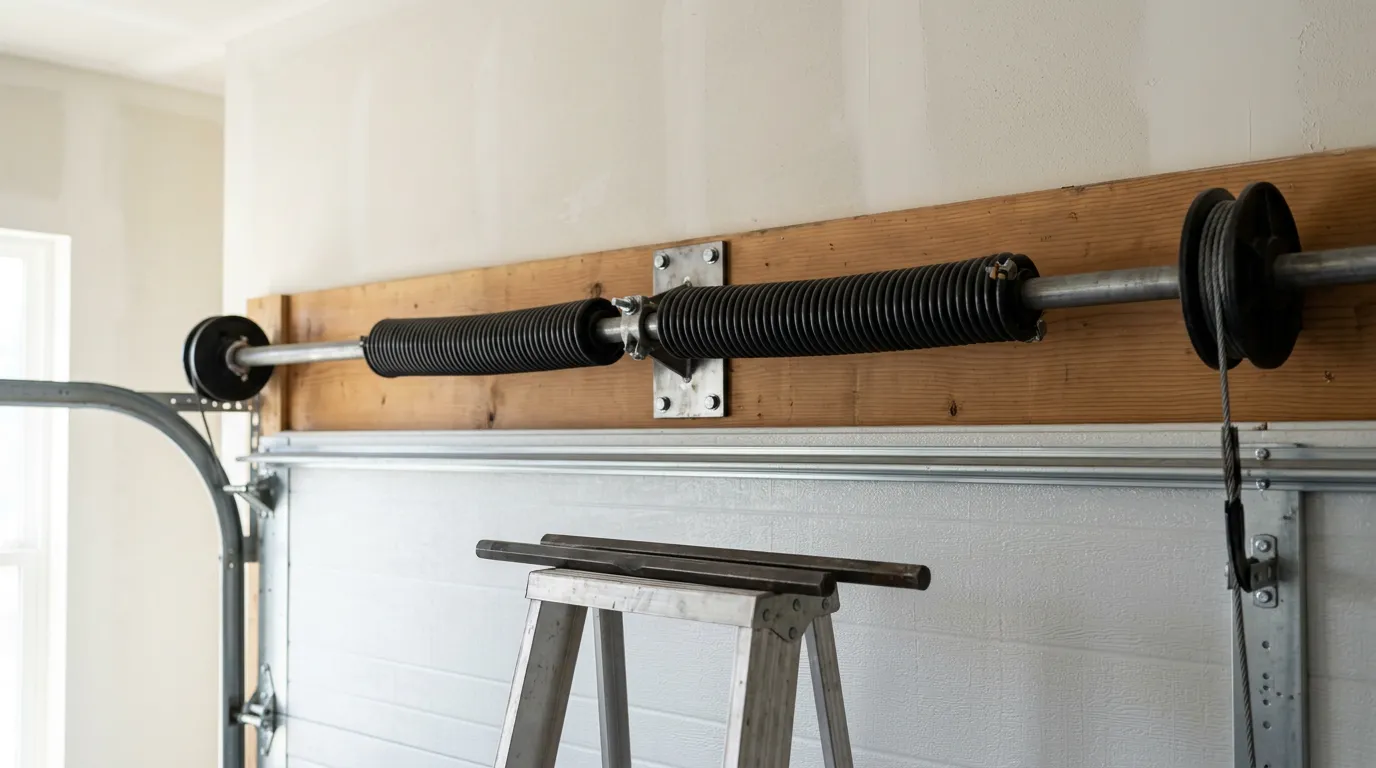
A broken garage door spring is one of the cleanest service calls in the trades. The customer knows something is wrong, because the door will not open and there was a bang. The repair is well defined. It can usually be finished in one visit. And the customer wants it done today, because their car is inside.
That should make spring replacement easy to price. In practice it is where a lot of garage door shops give away margin, by quoting a number from habit, discounting on the driveway, and warrantying a part for longer than it was built to last. This guide covers how to build the price, how to quote it as options, how to make sure the right spring is on the truck, and what the warranty should say. As of October 2026 the approach is the same whether you run one truck or ten. All dollar figures below are made-up examples for the arithmetic; use your own costs.
Start with what the job actually costs you
A flat price that works has to be built from the bottom up at least once. Four things go into it.
The springs. Your cost for the pair, not for one. Add your normal parts markup.
Loaded labor. Not the tech's hourly wage. The wage plus payroll costs, plus the time that is not on the job: driving there, loading, the conversation with the customer. If a spring job takes forty-five minutes on site, it probably consumes an hour and a half of a paid day.
The small stuff. Lubricant, a center bearing if you replace it by default, set screws, your winding bars wearing out. Small per job, real per month.
The callback reserve. Some share of spring jobs come back under warranty. That visit is not free to you. Put a few dollars from every job toward it.
Here is the arithmetic with invented numbers. Say a pair of standard springs costs you $60 and you mark parts up to $120. Say your loaded labor cost is $70 an hour and the job consumes 1.5 hours, so $105. Add $10 for small parts and $15 toward callbacks. Your cost-based floor is $250 before profit. If you want a 30% margin on the job, divide by 0.7 and you get about $357. Round it to a price that is easy to say.
The number itself does not matter here. What matters is that you know your floor, so when a customer asks for a discount you know what you are giving away. We go deeper on building these in flat rate versus hourly pricing.
Single spring or pair: quote the pair
Most two-car residential doors with torsion springs have two. When one breaks, the other has opened and closed the door exactly as many times.
Quote the pair as the standard job. Explain it in one sentence: the second spring is the same age and will fail soon, and replacing it now saves a second service call. Most customers accept that immediately.
Some will still ask for one spring. Do not refuse and do not pretend it cannot be done. Give the single-spring price, make it clear the labor is nearly the same, and record on the sale that the second spring was offered and declined. That note is worth having when they call in four months about "the spring you just replaced."
Doors with a single torsion spring, and doors with extension springs along the horizontal tracks, follow the same logic: extension springs are replaced as a pair so the door lifts evenly, and safety cables should be checked or added while you are there.
Cycle rating is the upsell, and it is an honest one
A spring is rated by how many cycles it should last, one cycle being one open and one close. A standard spring carries a modest rating; a high-cycle spring uses heavier wire and more length to deliver the same lift over many more cycles.
This is a rare upsell where the customer's interest and yours line up. The labor is identical. The extra cost is the part. And the benefit can be explained with arithmetic the customer can check. If a household runs the door four times a day, that is roughly 1,460 cycles a year. Whatever the rating on the spring, divide by 1,460 and you have its expected life in years for that household. A family that uses the garage as the front door might run eight or ten cycles a day and will go through a standard spring in half the time.
Ask how often they use the door before you quote. It takes ten seconds and makes the recommendation specific to them.
Quote it as good, better, best
Three options, each a complete repair, with the middle one being the job you would choose for your own house.
| Option | Springs | Scope | Shop warranty example |
|---|---|---|---|
| Good | Standard-cycle pair | Replace springs, balance door, lubricate | Shorter parts and labor term |
| Better | High-cycle pair | Same, plus inspect and adjust cables, rollers and bearings | Longer parts term, same labor term |
| Best | High-cycle pair | Same, plus replace cables, rollers and center bearing | Longest parts term, longer labor term |
A few rules make this work. Every option must fully fix the door; "good" is not a trap. Present all three prices at once and say which one you recommend and why. Keep the price steps proportional to what is added, so the customer can see what the extra money buys. Our guide to good, better, best pricing covers the psychology and the common mistakes.
The best tier deserves a comment. Cables and rollers on a door old enough to break a spring are usually worn too. Replacing them while the door is already apart costs the customer far less than a separate visit, and it reduces your own callbacks.
The trip charge and the emergency call
Decide how your service call fee interacts with the spring price before the phone rings. The two common approaches are a diagnostic fee that is credited toward the repair if the customer goes ahead, or a flat repair price with the trip built in. Either works. Mixing them from call to call does not.
Same-day and after-hours calls are a separate question. A customer whose car is trapped at 7 a.m. before work values speed more than price. If you charge more for evenings, weekends or a guaranteed same-day slot, publish the rule and state it on the phone before you roll. A surcharge the customer heard about in advance is a policy. One they discover on the invoice is a dispute.
For emergency calls from new customers, consider a deposit before dispatch. A texted payment link lets you collect it while the tech is loading the truck.
Measure so the right spring is on the truck
Price means nothing if the tech arrives with the wrong spring. A torsion spring is defined by four things:
- Wire size. Measured by the length of ten coils and of twenty coils, checked against a wire-size chart. Measure both; they should agree.
- Inside diameter. Often marked on the cone at the end of the spring.
- Length. Of the spring unwound. On a broken spring, push the two pieces together and measure the coils only.
- Wind. Left-hand or right-hand. A two-spring door has one of each.
Where you can, weigh the door. A previous installer may have fitted the wrong spring, and copying it copies the mistake. The door's weight and height are what the spring actually has to match.
Train whoever answers the phone to ask for the door size, whether it is one car or two, insulated or not, and whether the customer can see one spring or two above the door. A photo texted by the customer is better still. Those answers narrow the likely spring to a short list before the truck leaves.
Then stock for it. You cannot carry every size, so stock the ones your own sales history says you use most. Our post on stocking a garage door service truck covers how to set those levels and how to define spring SKUs so a count means something.
Safety, stated plainly
A wound torsion spring stores enough energy to cause serious injury. That fact belongs in three places.
In training: proper winding bars, never a screwdriver; clamp the door; stand to the side of the winding cone. In your pricing: this is skilled work with real risk, and the price should reflect a trained tech, not a parts swap. And in the conversation with a customer who is thinking of doing it themselves: say calmly that it is one of the more dangerous home repairs and leave it there. You do not need to frighten anyone, and you should not make claims about codes or liability that you cannot back up.
What the spring warranty should say
A vague "lifetime warranty" on springs is a liability you priced at zero. Write a specific one.
- A parts term and a labor term, stated separately. A longer parts term on high-cycle springs is fair and supports the upsell.
- What it covers. The spring breaking in normal use.
- What it does not. A door that was struck, an opener forced against a stuck door, springs altered by someone else.
- What the customer gets. A replacement spring, and whether the visit is included.
Then make sure you can find it. The customer will call in three years with no paperwork. You need to know which springs you installed, on what date, under which option. That is a records question, and we cover it for the whole installed base in garage door installation and warranty records.
Record the spring specification on the sale
The cheapest thing you can do for your future self is put the exact spring on the sale: wire size, inside diameter, length and wind. Next time that customer calls, the dispatcher reads the spec off the last job and the tech leaves with the right pair.
The practical way to do this in any system is to make the specification part of the product. A catalog item named for its wire size, diameter, length and wind carries the spec onto every sale automatically, and nobody has to remember to type a note.
Where IntelliDrive OS fits
For a garage door business, four parts of IntelliDrive OS apply to this job.
Quotes that turn into a sale. Build a quote for each option, with the springs and labor itemized, and turn the accepted one into a sale. There is no side-by-side good-better-best layout, so each option is its own quote and you present them together. A quote is not sent to the customer from the app, so give them the three prices in person or by text yourself.
Springs on the van as stock. Each van is an outlet with its own inventory. Selling the springs takes them off that van's count, transfers from the shop are exact, and counts show shrinkage in dollars. Reorder alerts appear inside the app when an item reaches its reorder point; they are not emailed or texted. The inventory page has the detail.
A warranty record per product sold. Completing the sale creates warranty records for the catalog products in it, so the spring pair has a record you can find later by the customer's phone number, the receipt number or the product. An extended warranty can be sold with an item.
Payment links. The customer pays by a link sent by text or email through your own QuickBooks Payments, Square or Stripe account, signs and accepts the terms first, and can add a tip. IntelliDrive has no card readers.
What it does not do: it has no maintenance agreements or recurring tune-up plans, no job costing report that compares estimated and actual labor on a job, and no scheduling in the base plan. Scheduling and dispatch come from the GetTimePad add-on at $199 a month. The base plan is $79 a month for the whole business with unlimited users; see pricing.
The bottom line
Build the spring price once from your real costs so you know your floor. Quote the pair. Use cycle rating as the difference between good and better, and added hardware as the difference between better and best. Measure before you roll, stock the sizes your own history says you need, write a warranty with specific terms, and put the spring's specification on the sale so the next call is faster than this one.
Related reading: Garage door service software and invoicing, stocking a garage door service truck, and garage door installation warranty records. For a complete machine-readable feature and pricing reference, see our LLM reference page.