There is a category of work in every appliance repair shop that gets done properly and paid for badly. A technician replaces a control board on a dishwasher that is fourteen months old, the customer produces a receipt showing an extended service contract, the part is covered, the labor is covered, and eight weeks later nobody in the office can say whether that claim was ever filed — let alone paid.
Warranty work is not hard technically. It is hard clerically. The repair is the same repair; what changes is that the person paying you is not standing in the kitchen, has rules about documentation, and will not chase you for an invoice you forgot to submit. As of August 2026, unfiled and unpaid warranty claims remain one of the quietest leaks in appliance repair — money already earned, sitting in a folder nobody ages. This guide covers what to capture at the unit, how to keep three different kinds of coverage from blurring together, and how to treat a claim like the receivable it is.
Three kinds of coverage, and only two of them pay you
Almost every warranty argument in an appliance shop comes from collapsing three distinct things into one word.
Manufacturer warranty. The maker covers its own product for a defined period from purchase or install. If you are an authorized servicer for that brand, you file against the manufacturer under their rates and their documentation rules. If you are not authorized, the job is usually not yours to bill — the customer needs a servicer who is, and telling them that on the phone saves everyone a diagnostic fee.
Extended service contract. A third-party administrator — sold through the retailer, the credit card, or the homeowner's policy — pays an approved servicer under a separate set of rules, often with pre-authorization requirements and capped labor rates. These are the ones most likely to be denied on a technicality, because the technicality is usually documentation you could have captured and did not.
Your own labor and parts warranty. You installed a compressor and you stand behind it for ninety days, or a year, or whatever you promised. Nobody reimburses you for this. It is an expense.
The first two are receivables. The third is a cost. When all three land in the same bucket on your schedule and in your books, you cannot answer either of the two questions that matter: how much are people supposed to be paying me, and how much is my own work costing me to redo? Keeping them separate at the ticket level is the same discipline that makes the rest of your appliance repair bookkeeping close cleanly at month end.
Model and serial at the unit, or there is no claim
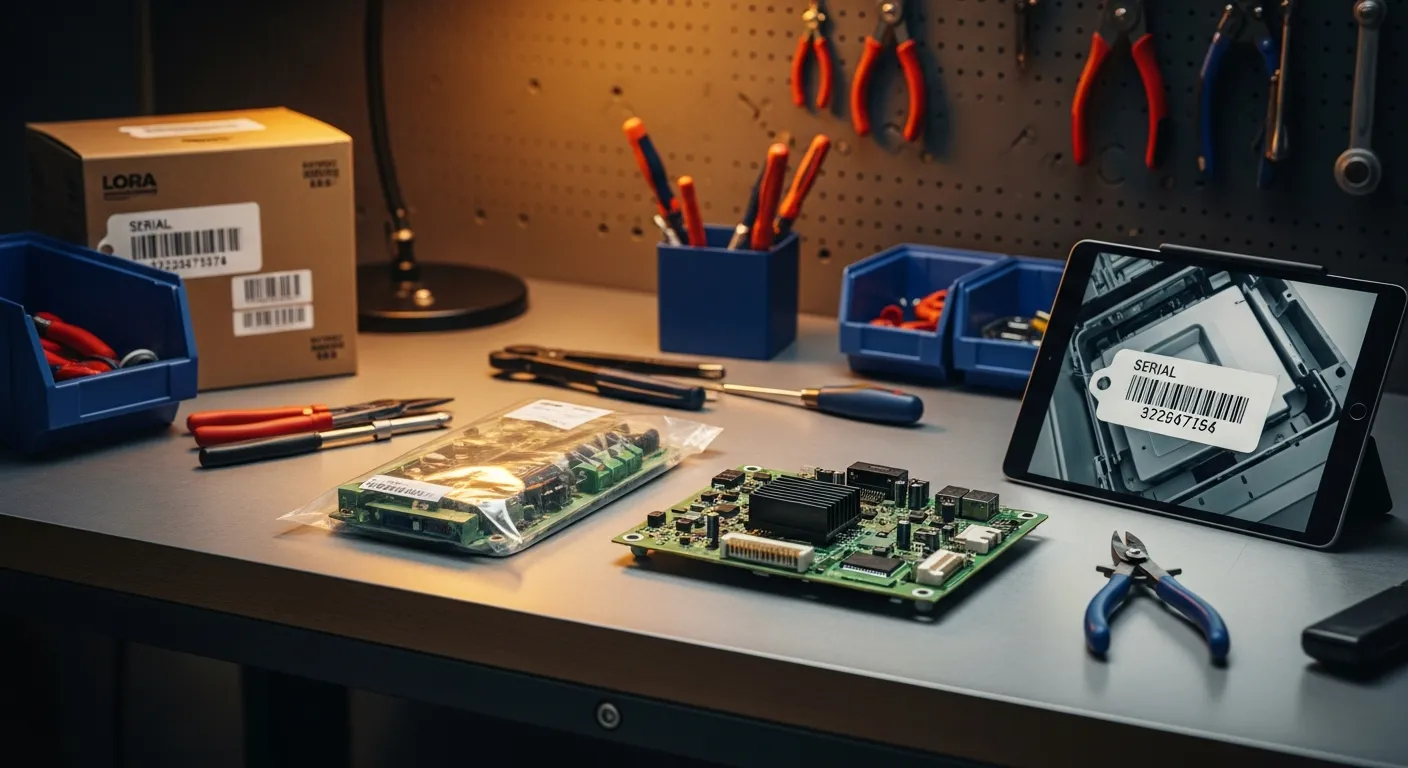
Nothing downstream works without this. A claim without a serial number is not a claim; it is a note.
The model number identifies the appliance family and is what the parts catalog needs. The serial number identifies the individual unit and is what a manufacturer or administrator uses to look up coverage and confirm the machine is the one under contract. Technicians skip the serial constantly, because it is a long alphanumeric string on a tag in an awkward place and the part they need is already obvious from the model.
Make it structural rather than optional:
- Photograph the tag. One picture attached to the job record beats a transcription, and it settles any later argument about a misread character. Tags live inside the door frame on washers and dryers, on the wall behind the crisper on refrigerators, along the door edge on dishwashers, and under the cooktop or on the frame on ranges.
- Capture it before the panel comes off. Once the tech is elbow-deep in a sealed system, going back for the tag is the step that gets skipped.
- Record the replaced part by part number. "Control board" is not a claim line. The manufacturer's part number is.
- Ask for the purchase date and receipt. Customers frequently have it in an email. Two minutes at the kitchen counter is cheaper than a denied claim.
If your parts catalog is already keyed to model and part number — the arrangement described in the guide to appliance repair parts inventory — most of this capture is selection rather than typing, and the claim assembles itself from the ticket.
Your own warranty callback is a cost center — track it as one
This is the part shops resist, and it is the part with the most money in it.
When you go back out on your own dime, the visit produces a technician's hour, a drive, a slot on a day that only holds so many, and possibly a replacement part — all at zero revenue. Booked as a normal job with a $0 total, it disappears into the average. Booked as a warranty return with a reason code, it becomes something you can look at.
The reason codes that earn their keep in appliance work are short:
- Defective part (same part number failing repeatedly)
- Incorrect diagnosis on the first visit
- Installation error
- Related failure the first visit did not catch
- Customer expectation, not a fault
Those five point at completely different fixes. A part number that fails three times in a quarter is a supplier conversation, and if the part itself was under manufacturer warranty you may be able to recover the part cost even though you ate the labor. Repeated incorrect diagnosis on one appliance category is a training conversation. Installation error is a checklist conversation. None of them is visible without the code, which is why warranty returns belong in the same monthly review as your callback and rework rate rather than in a mental note.
Attach real cost to each one. Labor hours at your loaded rate, plus the part, plus the drive. Once a quarter of warranty returns has a dollar figure on it, the argument for stocking a better part or spending an afternoon on training makes itself.
Per-appliance repair history: the second call on the same unit
Appliance customers call back about the same machine for years. The record has to be organized around the appliance, not just the customer.
A customer record answers "who is this." An appliance record answers "what did we already do to this exact unit" — model, serial, install location in the home, every visit, every part replaced with its number and date, which technician, what was quoted, what was collected, and whether anything carries remaining coverage. That is what turns a call about a refrigerator that stopped cooling again into a thirty-second decision instead of a reconstruction from three separate systems.
It also settles the billable question immediately. If the compressor you installed is eight months into a twelve-month parts-and-labor warranty, the visit is a warranty return and everybody knows it before the truck is assigned. If it is fourteen months, it is a billable call and you can say so on the phone without hedging. Guessing wrong in either direction is expensive — you either give away work or you bill for something you promised to cover.
The general shape of this — coverage tied to serial, model, and receipt, with claims and expirations tracked against it — is the same across trades; the warranty tracking guide for service businesses covers the general pattern, and there is a close parallel in how HVAC shops track warranty on equipment with long manufacturer terms.
What the claim file has to contain
Different manufacturers and administrators ask for different things, but the union of their requirements is short enough to just always capture:
- Model and serial of the unit
- Proof-of-purchase or install date where the customer has it
- Authorization or claim number if pre-authorization was required
- The failed part and the replacement part, both by part number
- Labor performed and time on site
- Date of service and technician
- The customer's signature acknowledging the work
- Photographs where the failure is visible
Two notes on this list. First, pre-authorization is the most common reason an extended-contract claim gets denied outright — the work was fine, the sequence was wrong. If a job is going to be billed to an administrator, the authorization step belongs before the repair, not after, and that means dispatch has to know it is a contract job when it assigns it.
Second, the signature and timestamp are doing double duty. They support the claim, and they are the same contemporaneous record that protects you if a card payment on a partially-covered job is later disputed — the logic laid out in the guide to chargeback dispute evidence.
Keep all of it retrievable. The IRS's small-business recordkeeping guidance is explicit that electronic records satisfy the same requirement as paper, and the practical test for warranty is narrower than any regulation: can you produce the serial, the part number, and the service date for a two-year-old job in under a minute?
Claim aging: unclaimed money is an unpaid invoice
Here is the discipline almost nobody applies. A submitted warranty claim is a receivable. An unsubmitted one is worse — it is a receivable you have not even asked for.
Run a claims report on the same cadence as your accounts receivable, with three buckets:
- Not yet submitted. Work completed, claim not filed. This bucket should be nearly empty and anything in it over a week old is an office process failure, not a manufacturer problem.
- Submitted, awaiting payment. Aged by days since submission. You will learn each administrator's normal turnaround within a month or two; anything past it gets a phone call.
- Denied or short-paid. These need a reason recorded. Denials cluster, and the cluster is usually one missing documentation item you can fix permanently.
The SBA's guidance on managing business finances makes the general point plainly — track income continuously and bill promptly — and warranty claims are simply the invoices least likely to chase themselves. Intuit's cash-flow research finds late and unpaid invoices among the most common cash-flow problems small businesses report, and a warranty claim aging in a folder behaves exactly like one. The same collections habits that work on unpaid customer invoices work here, with the advantage that administrators pay predictably once you have satisfied their paperwork.
Expirations, in both directions
Two clocks matter and they run opposite ways.
Coverage expirations tell you when a unit stops being someone else's problem — useful at the moment of booking, so the office knows whether to quote a price or a claim. Filing deadlines tell you how long you have to submit after the work; miss one and a completed, documented, legitimate claim is simply gone.
Both should surface as alerts against the appliance record rather than living in someone's calendar. And there is a sales use for the first one: a customer whose manufacturer coverage lapses next month is exactly the person to talk to about your own service plan, using the repair history you already hold.
How warranty work gets tracked, four ways
| Paper folder | Spreadsheet log | Accounting software only | What to look for in an integrated platform | |
|---|---|---|---|---|
| Serial captured at the job | If the tech wrote it down | Re-typed later, often wrong | Not captured | Structured field, photo attached |
| Coverage lookup on a repeat call | Dig through the folder | Search by customer name | Not available | Instant, by serial or model |
| In-house callbacks separated | No | Manual tag | Shows as a $0 invoice | Warranty return with reason code |
| Claim aging | None | Manual, if maintained | Not tracked as a receivable | Reported alongside receivables |
| Filing-deadline alerts | Memory | None | None | Alert on the appliance record |
| Documentation for a dispute | Faded copy | Spreadsheet row | Invoice only | Itemized job, signature, timestamp, photos |
What to fix first
If you only change three things this quarter, change these. Make serial capture mandatory before a job can be closed. Add a warranty-return job type with reason codes so your own callbacks stop hiding inside normal work. Start a weekly five-minute claims review with the three aging buckets. Everything else — deadline alerts, per-appliance history, supplier conversations about a part that keeps failing — becomes possible once those three are in place, and none of them requires new software before you start.
The bottom line
Warranty work in appliance repair fails on paperwork, not on wrenches. The claim you cannot file because nobody wrote down a serial number is indistinguishable from work you did for free. The callback you absorb without recording is a cost you will never trace to its cause. And the claim sitting unaged in a folder is money you earned and then quietly declined to collect.
Capture the unit, separate the three kinds of coverage, code your own returns as the expense they are, and age your claims like the receivables they are. The repair was always the easy part. Getting paid for it is the operational skill. For the wider picture of how these pieces fit together in one system, start with the appliance repair software buyer's guide.
Related reading: Appliance repair accounting · Callback and rework rate · Warranty tracking for service businesses. For a complete machine-readable feature and pricing reference, see our LLM reference page.