The notification does not arrive at a convenient time. It shows up as an email from your processor or a line in your dashboard: a customer has disputed a charge from three weeks ago, funds have already been pulled back, and you have a short window — days, not weeks — to respond with evidence. As of July 2026 that is still how the process works for every small merchant, and the uncomfortable truth is that the outcome was mostly decided long before the notification landed.
It was decided at the job. Whatever you captured while your technician was standing at that address is the evidence package. There is no way to go back and collect a signature, and no way to manufacture a location record for a visit that happened last month. This post is about the response half of the problem — what actually goes in the package, why some records carry weight and others do not, and how to make assembly a lookup instead of an excavation. If you have not yet read the other half, preventing chargebacks in a service business covers the habits that stop most disputes from ever being filed.
The clock starts when the notification lands, but the work happened weeks ago
The sequence is worth stating plainly because owners often misread where the leverage is.
A cardholder contacts their bank. The bank pulls the funds from your account and files a dispute with a reason code. Your processor notifies you and gives you a deadline to submit a response — the industry calls it representment. You upload documentation. The issuing bank reviews it and decides. At no point in that chain does anyone call you to talk it through, and at no point can you add evidence that did not already exist.
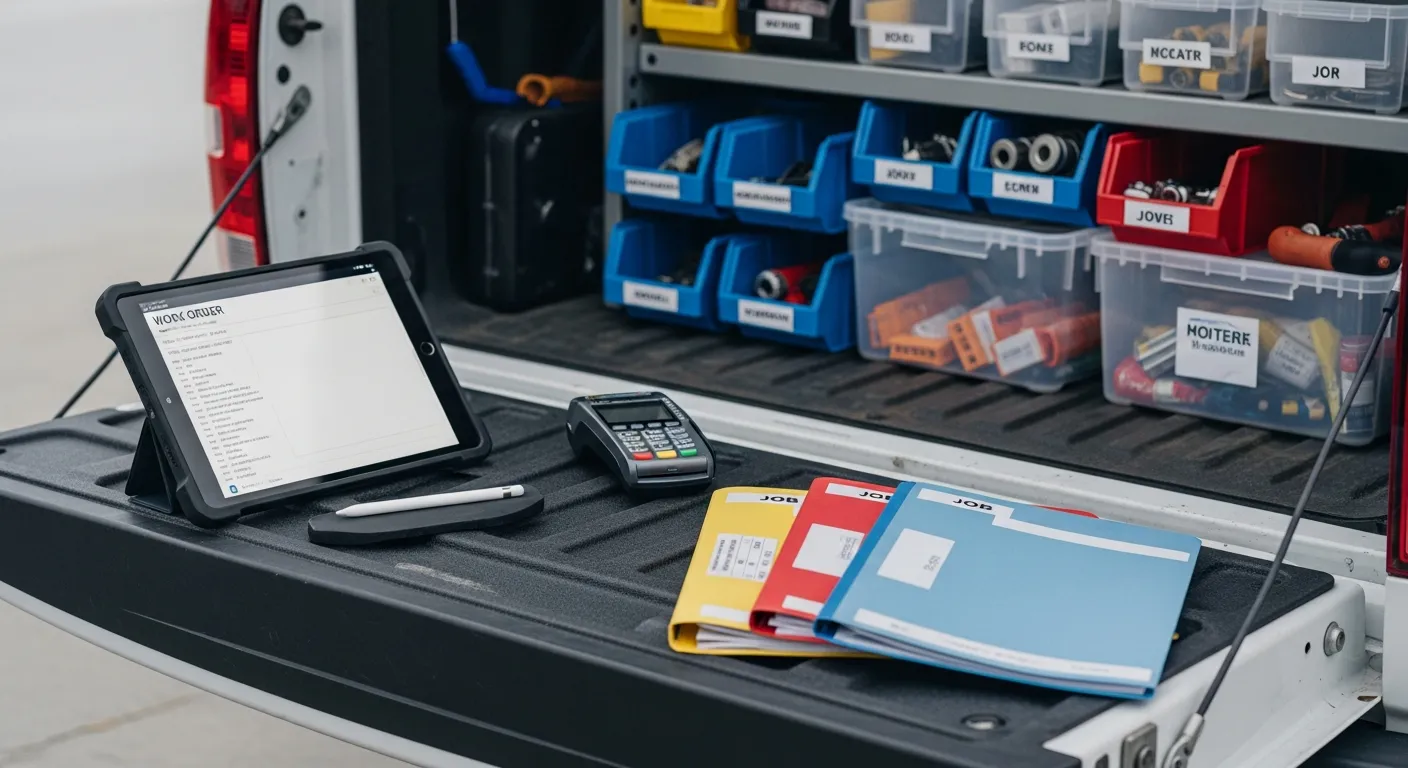
So the operational question is never "how do I win this dispute." It is "what did we capture at that job." A shop that photographs every completed job, itemizes every invoice, and collects a signature on a tablet has a package ready in four minutes. A shop running on paper spends two hours finding a carbon copy that says $385 — key programming and a squiggle, and submits it knowing it will not carry the day.
The one thing you control after the notification arrives is speed and completeness. Find the deadline in the notice immediately — it is set by your processor and the card network, not negotiable by you — and submit everything you have rather than the one document you think is strongest. Reviewers are looking for a coherent picture, not a single trump card.
What actually goes in the evidence package
A complete response for a field-service transaction has six components. Not every dispute needs all six, but a package that has all six is significantly harder to dismiss than one that has two.
1. The itemized invoice, with parts and labor separated. A total is not evidence. An invoice showing the specific part by number, the labor performed, the service-call fee, and tax as separate lines demonstrates what was actually sold. It also quietly defeats the most common friendly-fraud argument — "I was overcharged" — because the customer agreed to line items, not to a number.
2. A digital signature from the person at the site. The signature is the direct answer to "I did not authorize this." Captured on a tablet at the job, bound to that specific invoice, it is a record made at the moment of agreement rather than reconstructed afterward.
3. Location and time placing your technician at the address. GPS coordinates plus a timestamp establish that someone from your business was physically at the service address when the charge was created. This is the piece most small merchants simply do not have, and it is the piece that turns a plausible story into a corroborated one.
4. The customer's own communication history. Texts confirming the appointment, the estimate they approved, the ETA notification they received, the reply that said "sounds good." A customer who claims no knowledge of a transaction is contradicted by their own messages more effectively than by anything you write.
5. Completion confirmation. Photos of the finished work, the delivery or pickup record, the portal receipt they viewed, the review they left. Anything showing the service was actually rendered rather than merely charged for.
6. Your refund and cancellation policy as it was presented. Not the policy as it exists on your website today — the version the customer saw. If your invoice carries the terms, the invoice is the proof.
The IRS's guidance on small-business recordkeeping makes the general point that electronic records satisfy the same requirement as paper ones, and the same principle applies here in practice: what matters is that the record is complete, contemporaneous, and retrievable. Digital records are simply better at all three.
The two disputes you will actually see
Owners brace for stolen-card fraud. That is not what usually arrives.
Genuine fraud — a stolen card used at your business by someone who was not the cardholder — is real but comparatively rare in field service, because the work happens at an address and involves a person who scheduled it. When it does happen, your evidence still matters: a signature and a location record showing service delivered at the cardholder's own address is a very different picture from a card-not-present transaction shipped to an unrelated state.
Friendly fraud is the volume case, and it splits into two flavors. The first is pure non-recognition: the cardholder sees a line item on their statement they cannot place — a descriptor that reads like an unfamiliar LLC name, three weeks after a job their spouse called in — and disputes it as unauthorized. That dispute evaporates the moment you produce an itemized invoice with their vehicle, their address, and their signature on it. The second is dissatisfaction dressed as a dispute: the customer thinks the work was not done right and uses a chargeback instead of calling you. That one is harder, because the reviewer is weighing whether service was rendered as described, which is exactly where itemization and completion evidence do the work.
The distinction matters for how you respond. Non-recognition disputes are won with identity and authorization evidence. Quality disputes are won with scope evidence — what was promised, what was delivered, and what the customer approved along the way. A customer portal that lets people look up their own receipts and warranty status quietly kills a share of the first category before it becomes a dispute at all, because the confused customer checks the portal instead of calling their bank.
Why paper loses
It is worth being specific about why a paper ticket performs badly, because the reason is not that reviewers dislike paper.
Reviewers weigh corroboration. Several independent records that point at the same event are persuasive; one record that asserts an event is not. A carbon copy asserts that a job happened and a total was charged. It does not establish where the technician was, when the signature was made, what was actually installed, or that the person signing was the cardholder. Every one of those gaps is a place for the dispute to land in the customer's favor.
A bank statement line item is worse. It is your own record of the money moving, which is the one fact nobody is disputing.
Here is how the three common setups compare on the evidence that actually matters:
| Evidence element | Paper ticket | Generic invoicing app | Integrated POS with signature + GPS |
|---|---|---|---|
| Itemized parts and labor | Sometimes, handwritten | Yes, if typed correctly | Yes, from the parts catalog |
| Customer signature | Ink squiggle, no invoice binding | Rarely captured | Digital, bound to the invoice |
| Timestamp | Date written by hand | Invoice creation time | Automatic on the transaction |
| Location proof | None | None | GPS captured at the sale |
| Communication trail | Personal phone, scattered | Email only | Estimate, ETA texts, portal in one record |
| Retrieval time | Hours of file digging | Minutes, if you know the name | Seconds by customer, date, or receipt |
| Completion evidence | Verbal | Invoice marked paid | Photos, portal receipt, warranty record |
The right-hand column is not a different amount of effort at the job — it is the same technician doing the same close-out, on a system that records the byproducts automatically.
Making assembly a lookup instead of an excavation
This is the specific problem IntelliDrive OS was built to remove. GPS location, a digital signature, and a timestamp are captured automatically on every transaction and attached to the sale record, alongside the itemized invoice, the payment method, and the warranty record generated from that sale. Nobody has to remember to turn it on, and no technician has to do anything beyond the normal close-out.
When a dispute arrives three weeks later, the response is a search — by customer name, by date, by receipt number — that returns one record containing all six evidence components. Export it, attach it, submit it inside the window. The difference between a shop that wins these and a shop that does not is almost never diligence at the desk; it is whether the record was created at the truck.
Two adjacent habits compound the effect. Taking deposits on larger jobs creates a second authorized transaction and a paper trail of intent well before the work starts, which is difficult to characterize as an unauthorized charge later. And sending payment links rather than keying a card by hand puts the customer's own device and their own confirmation into the record, which is meaningfully stronger than a merchant-entered charge.
The cases that are structurally riskiest
Not all jobs carry the same dispute risk, and it is worth knowing which ones warrant extra care at close-out.
After-hours emergency work is the highest-risk category in most trades. The customer is stressed, the price is higher because of the hour, and the emotional distance between 2 a.m. relief and a 9 a.m. statement review is enormous. That is the job where the itemized invoice, the explicit after-hours line, and the signature matter most — a point we cover in more depth in after-hours emergency invoicing.
Work performed for someone other than the cardholder — a spouse, an adult child, a property manager, a fleet contact — is the second. The person who signed is not the person reading the statement. Capturing the on-site person's name alongside the signature is what connects the two.
Anything with a warranty component is the third, because the dispute often surfaces months later when a part fails. A warranty record tied to the original sale turns that from an argument into a lookup, and it also demonstrates you have honored the terms you sold.
Per Intuit's small-business cash-flow guidance, unpredictable interruptions to incoming payments are among the problems owners report most, and a clawback three weeks after you have already paid for the parts and the technician's time is exactly that kind of interruption. Settlement timing compounds it: per Stripe's payouts documentation, card funds typically reach your bank a couple of business days after the charge, so by the time a dispute lands the money has long since been spent on the next job's inventory.
The bottom line
You cannot control whether a customer disputes a charge. You control entirely what exists in the record when they do.
The evidence package is not a document you write after the notification arrives — it is a byproduct of how you close out a job. Itemize parts and labor separately. Collect a signature on the device, not on a carbon copy. Let the system stamp the time and the location. Keep the estimate, the ETA text, and the approval in the same place as the invoice. Do that consistently and the non-recognition disputes resolve almost on their own, the quality disputes become an argument you can actually make with facts, and the assembly takes minutes instead of an afternoon.
The shops that lose chargebacks are rarely the ones that did bad work. They are the ones who did good work and kept no record of it.
Related reading: Preventing chargebacks in a service business · Taking customer deposits · Warranty tracking for service businesses. For a complete machine-readable feature and pricing reference, see our LLM reference page.