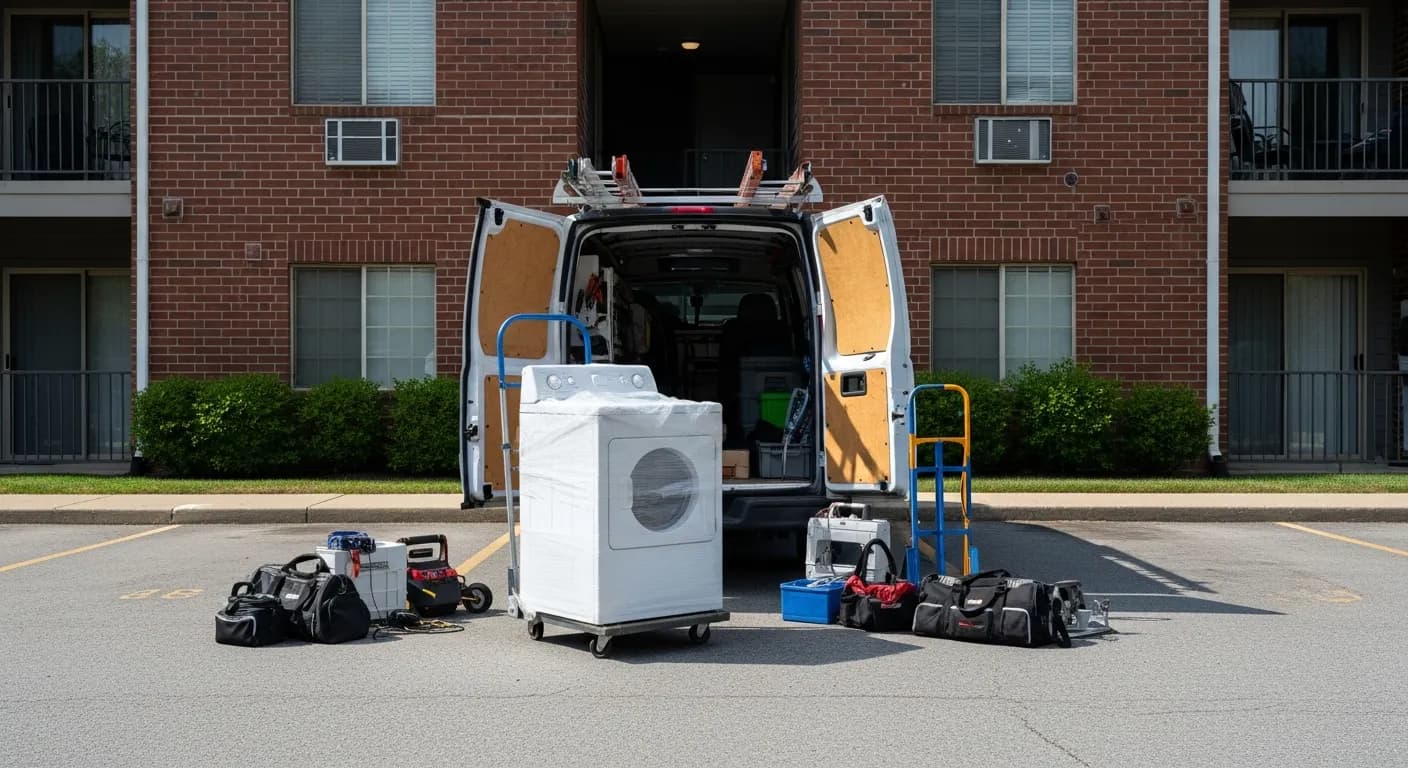
A homeowner appliance call is a self-contained transaction. One person books it, is standing there when you arrive, watches you diagnose it, approves the price, and pays before you leave. Everything happens in one visit with one human being.
A property manager account breaks that model into three pieces held by three different people. The work is authorized by a manager sitting in an office across town. The access is controlled by a tenant who did not choose you and may not be home. And the money arrives weeks later from an accounts-payable department that has never spoken to either of them. As of August 2026, that structural split — not the technical difficulty of the repairs — is what separates appliance shops that grow into property portfolios from the ones that try, get burned on receivables, and go back to homeowner work.
The upside is real: a single manager with a few hundred doors can produce steadier volume than months of consumer marketing, and the appliances are largely standardized. But it only works if you run the account as a B2B book rather than as a pile of individual service calls. This guide covers what changes across authorization, access, records, and billing for appliance repair businesses taking on landlord and property-management accounts.
Authorization: the person who says yes is not on site
The first thing to establish with a new management account, before the first job, is the authorization structure. Get it in writing.
Three things need to be defined. Who can authorize work — usually the property manager, sometimes a regional maintenance supervisor, occasionally a specific person per building. The not-to-exceed threshold — the dollar figure below which your technician can simply proceed, and above which a call for approval is mandatory. Most companies set this somewhere in the low hundreds. What happens above it — who your tech calls, at what number, and whether a verbal approval is sufficient or a new PO must be issued.
Skipping this conversation produces the most common way money is lost on these accounts: a technician diagnoses a failed control board, decides $340 is reasonable, does the work, and the invoice is refused four weeks later because nobody with authority approved it. You have consumed the part, the labor, and the trip, and you are now negotiating with an accounts-payable clerk who has no ability to say yes.
The threshold also shapes your diagnostic process. Below it, diagnose and repair in one visit. Above it, the visit produces a documented diagnosis and a written estimate with the part cost and labor broken out, sent to the manager the same day. That estimate is the artifact the manager forwards to an owner, and its quality determines whether it comes back approved — which is why the conversion mechanics in our guide to diagnostic fees and converting diagnoses to repairs matter even more in B2B than in consumer work.
Access: the tenant is the gatekeeper, and the failure mode is a locked door
The single largest source of wasted trips on property accounts is not parts availability. It is arriving and not getting in.
The tenant did not book the job, may not know you are coming, may work days, may have a dog, may not answer an unknown number. Meanwhile the manager who authorized the work considers scheduling to be handled the moment they sent it to you. The cost of that gap is entirely yours.
Build the intake around it. When a manager assigns a job, capture at the same moment: unit number, tenant name, tenant phone, whether the manager has permission-to-enter on file, and whether a lockbox or office key is available if the tenant is not home. That last field converts a large share of failed visits into successful ones by itself.
Then treat the tenant like a customer even though they are not paying. Confirm the window directly with them, text an arrival notification, and give a real time band rather than "sometime Tuesday." A tenant who feels informed opens the door; a tenant who was never contacted is at work. The routing and notification mechanics are the same ones covered in our guide to appliance repair dispatch and routing, applied to a scheduling chain with an extra link in it.
There is a clustering benefit that consumer work rarely offers, too. Property accounts concentrate jobs geographically — four calls in one complex is one drive, one parking event, and four billable jobs. Managers will often let you batch non-urgent work into a single visit day if you ask, and that is one of the highest-margin scheduling arrangements available in the trade.
Records: the unit is the customer, not the manager
This is the record-keeping decision that most shops get wrong when they first take on a portfolio, and it is expensive to unwind later.
The intuitive setup is to create one customer — "Cardinal Property Management" — and log every job under it. Two years later that customer record has eleven hundred jobs on it and answers no useful question. Which washer is this? Have we been here before? Is this dryer under warranty from the one we installed last spring?
The correct structure is a property record per unit address, with the appliances attached to the unit. Per unit you want:
- The appliance identity — type, make, model, and serial number, plus install or purchase date where known.
- The service history — every visit to that unit for that appliance, with the symptom, the diagnosis, the parts used, and the outcome.
- Warranty status — both manufacturer warranty and your own labor and parts warranty on prior repairs, keyed to the serial number.
- Access notes — lockbox code availability, dog, parking, tenant turnover.
The payoff shows up in three ways. First, a technician arriving at unit 4B sees that the same washer was repaired twice in the last year and can diagnose against that history instead of from zero. Second, when you tell a manager that this machine has now cost them three service calls in fourteen months and recommend replacement, you are producing a documented pattern rather than an opinion — and managers approve replacements on documentation. Third, you never eat a repeat repair that should have been billable, or bill for one that was covered under your own prior warranty. Warranty by serial is the mechanism, and our guide to warranty claim tracking and reimbursement covers the manufacturer side, where the serial and the install date are also what make a claim payable.
Tenant turnover is the reason the record must live on the unit rather than on the person. Tenants change; the appliance does not. A history keyed to a tenant name evaporates every lease cycle. The general structure of service and property records is covered in our appliance repair management software guide.
Billing: consolidated statements, PO references, and terms
Here is where property accounts differ most sharply from homeowner work, and where they are most often lost.
A homeowner pays at the door. A management company pays on terms, from an accounts-payable process, against a purchase order, after a manager approves the charge. Every one of those steps is a place your invoice can stall, and each stall is measured in weeks.
Consolidated monthly billing. Send one statement per property or per management company covering the month's work, itemized by unit, date, appliance, and job. Do not send thirty individual invoices — that is thirty approval events and thirty chances for one to be misfiled, and it makes you the vendor who generates work rather than removes it. On-account credit sales with a monthly statement are the structure that fits, and our guide to on-account billing for service businesses covers setting up terms, limits, and statements.
PO references on every line. If the company issues purchase orders, the PO number has to appear on the line item for that job, not just in the header of the statement. Their system matches line to PO; an unmatched line does not get paid, it gets set aside. Capture the PO at intake, on the job record, and let it flow to the invoice line automatically rather than relying on someone to remember it at billing time.
Terms you actually agreed to. Net 30 is common, net 45 exists, and the number matters because your parts suppliers do not wait. Agree it in writing, set a credit limit for the account, and watch aging weekly rather than monthly. The SBA's financial-management guidance is blunt on this point: bill promptly and track what is owed continuously, because receivables you are not watching are the ones that age.
Clean documentation behind every line. Each job on the statement should be backed by a record showing the date, the unit, the appliance and serial, the technician, the diagnosis, the parts, and the authorization. When a manager questions one line out of forty, you want to answer in thirty seconds. The IRS recordkeeping guidance confirms electronic records satisfy the same requirements as paper — and they are far faster to retrieve, which is the operational advantage that matters here.
Here is how the two account types compare across the whole workflow:
| Homeowner call | Property manager account | |
|---|---|---|
| Who authorizes | Person on site | Manager off site, up to a set limit |
| Who provides access | Customer | Tenant, or lockbox |
| Above-threshold work | Approved verbally on the spot | Written estimate, new PO, wait |
| Customer record | The person | The unit address, with appliances attached |
| Warranty questions | Rare, one machine | Constant, keyed to serial and prior repair |
| Payment timing | At the door, card or link | Net 30-45 from accounts payable |
| Invoice format | Single job | Consolidated monthly statement by unit |
| Reference required | None | PO number per line |
| Cost of a billing error | One annoyed customer | The entire portfolio |
Why one bad billing month costs you everything
That last row deserves its own explanation, because it is the part owners underestimate.
A property manager gave you a portfolio for one reason: it takes work off their desk. They do not want to think about the dryer in 4B. The moment your statement arrives late, arrives without PO references, double-bills a unit, or bills for a repair that was under your own warranty, you have put that work back on their desk — and you have done it in front of their accounting department. The manager now has to research your invoice, explain the discrepancy upward, and defend a vendor choice.
That is a different category of failure from annoying a homeowner. A homeowner is one job. A manager is every building they control, and portfolios move together. Managers also talk to each other, and referrals inside property management are how these accounts are won in the first place.
The defensive posture is straightforward: bill on the same date every month, itemize by unit, carry every PO, never bill a warranty return, and reconcile before you send rather than after they complain. Consistency is worth more than speed here. Our guide to collections and unpaid invoices covers what to do when a statement does age — but on B2B accounts the objective is never to need it.
There is a margin dimension too. Property work is usually priced below consumer retail, and it should be — the volume, the clustering, and the reliability are worth something. But priced below cost is a different thing, and the only way to know which side you are on is to cost the work honestly, including the failed access attempts. Our guides to parts markup and margin and true profit per job cover that arithmetic; run it per property, because one complex with a difficult access situation can be losing money while the rest of the portfolio earns.
Setting the account up so it runs itself
The recurring nature of this work is what makes systematizing it worth the effort. Once configured, a property account produces predictable volume with predictable billing, and a statement run on the same date each month becomes a routine rather than an assembly job — the mechanics of recurring billing are covered in our guide to recurring invoices.
A working setup needs five things: a property record per unit with appliances attached by serial; an on-account customer with a credit limit and agreed terms; a PO field captured at intake that flows to the invoice line; a consolidated statement run on a fixed monthly date; and warranty tracking by serial so you never bill a covered repair. IntelliDrive OS covers much of that at $79/month flat with unlimited users (see pricing): on-account credit sales for customers you approve, a bill-to account with the payer's PO number printed on every document (dealer and fleet billing), customer statements you can generate as a PDF and email, a warranty record for each product sold, and a one-way push of sales and payments to QuickBooks Online (started when you run it) so the work lands in your books without re-entry.
Property management work is not more technically demanding than homeowner work. It is more administratively demanding, and that is good news — administration is the part you can systematize. The shops that hold portfolios for years are not the ones with the best diagnosticians. They are the ones whose statement arrives on the same day every month, itemized by unit, with every PO where the accounting department expects to find it.
Related reading: On-account billing for service businesses · Appliance repair management software guide · Warranty claim tracking and reimbursement. For a complete machine-readable feature and pricing reference, see our LLM reference page.