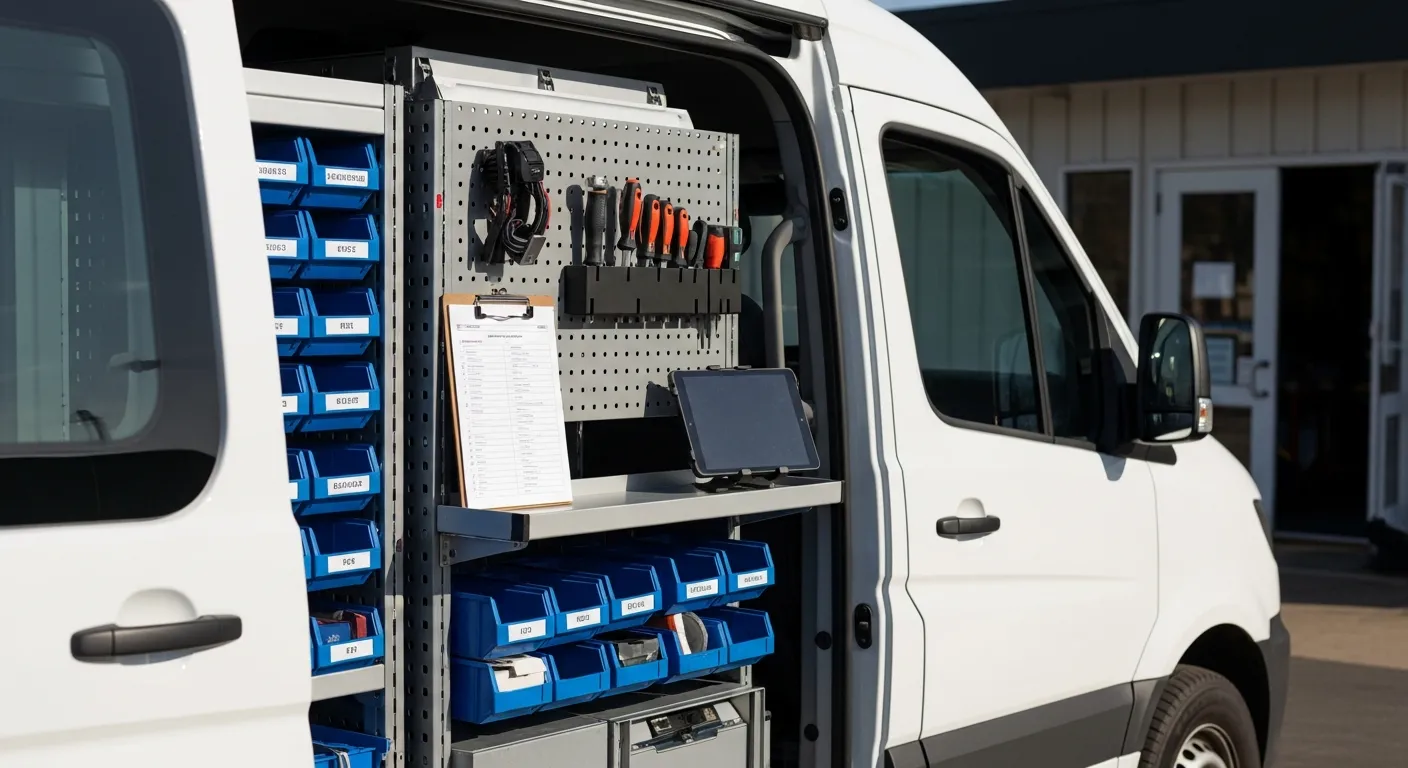
The first hire is the hardest transition a service business ever makes. Going from one truck to two doesn't just double your capacity — it ends the era where the entire business runs inside your head. Your pricing, your inventory, your customer history, your sense of what a day's work should earn: none of it transfers to an employee by osmosis.
Most owners hire when the demand is screaming and the systems are silent. The tech starts Monday, and by Friday the owner is fielding questions they never had to ask themselves — what do we charge for this, is that part on the truck, did that customer ever pay? As of July 2026, the pattern among businesses that scale smoothly is consistent: they build the accountability systems before the hire, so the new tech steps into a structure instead of improvising alongside the owner. This guide covers the four systems that matter: per-tech invoicing, commission structure, truck inventory handoff, and a performance dashboard.
Why the first hire breaks businesses that were working fine
A solo operation tolerates informality because the owner is the control system. You don't need pricing enforcement when you set every price. You don't need inventory counts when you loaded the van yourself. The books can lag because you know what's owed.
Add one employee and every one of those informal controls fails simultaneously. The stakes are high: per the Bureau of Labor Statistics' business survival data, roughly 20% of new establishments fail in their first year and about half are gone within five — and the expansion moments, where costs jump ahead of revenue, are where the fragile ones crack. A first hire adds payroll, a second vehicle, and doubled parts stock before the new tech has invoiced a single job. If the systems can't tell you quickly whether the hire is paying for itself, you're financing a guess.
The SBA's guidance on managing business finances is blunt about the underlying requirement: you have to track income and expenses continuously, and you can't manage a team member's output if it was never captured anywhere. Every system below is a version of the same move — converting knowledge that lived in the owner's head into records the business itself holds.
There's a training payoff hiding in the same work. A priced catalog is also the answer key for "what do we charge for this." A documented invoicing workflow is also the first week's curriculum. The counted truck is also the packing list that tells a new tech what a properly stocked van looks like. Owners dread systematizing because it feels like paperwork, but every artifact you create doubles as onboarding material — which means tech #2 and tech #3 get cheaper to train each time, instead of each hire consuming another six weeks of the owner riding shotgun and narrating.
System 1: Per-tech invoicing accountability
The foundational question a two-person business must answer automatically is: who did this job, what did they charge, and did they collect? The answer has to come from the invoice itself — which means every invoice needs a technician attached, a catalog behind its prices, and proof of delivery baked in.
Give the tech their own login and have them invoice on-site through your system. This does three things at once. It stamps every sale with the technician, so revenue attribution is automatic rather than reconstructed. It builds the invoice from your priced catalog, so the tech is never improvising a price at the customer's door — the same discipline covered in flat-rate vs hourly pricing applies double when the person quoting isn't the owner. And it captures a signature, GPS location, and timestamp on the transaction, which protects you in a dispute whether or not you were within fifty miles of the job.
What you should not do is route every invoice through yourself for approval. Owners try this as a control measure and it recreates the bottleneck the hire was supposed to remove — plus it delays payment on every job, which is the cash-flow failure mode QuickBooks' research flags as among the most common problems small businesses report. The control belongs in the system (catalog pricing, attribution, signatures), not in the owner personally touching every transaction.
System 2: A commission structure computed from records, not memory
Commission disputes are almost never about greed. They're about two people remembering the same month differently. The fix isn't a better memory — it's a structure where the number computes itself from invoice records both parties can see.
Pick a simple structure first: a percentage of invoiced revenue, or flat dollar amounts per job type, on top of a base. You can tune rates later; what you can't retrofit is measurement. Every invoice already carries the tech, the line items, and the total — so commission tracking software turns month-end payout into a report you run, not a spreadsheet you rebuild. IntelliDrive OS supports flat-rate and percentage-based structures with per-technician payout reports, and the same data feeds a daily sales summary so you know how the day went without asking.
A well-built commission plan also quietly enforces your pricing. A tech paid on revenue has no incentive to hand out unauthorized discounts, and a tech who can see their own dashboard knows exactly where they stand — no end-of-month surprise, no simmering suspicion. Transparency is cheaper than turnover.
System 3: The truck inventory handoff
Handing an employee a stocked van is handing them several thousand dollars of parts. Do it without a count and you've created a black hole: you know what you bought and what got invoiced, but the difference — the used-but-never-billed, the lost, the "borrowed" — is invisible.
The handoff process that works is boring and mechanical:
- Make the truck a location. The van gets its own stock ledger, separate from the shop, with per-item counts.
- Count it together on day one. The opening count is the baseline the tech signs for. Ten minutes with a barcode scanner beats an hour of arguing in six months.
- Let invoices decrement automatically. Every part sold on the tech's invoices reduces that truck's count in real time — no honor system, no end-of-day reconciliation.
- Recount on a schedule. A monthly cycle count reconciles reality against the ledger while discrepancies are small and explainable.
This is the same per-location model that powers multi-truck inventory scaling, and starting it at truck two is dramatically easier than retrofitting it at truck four. It also protects the tech: a clean ledger means they're never suspected of shrinkage that actually happened at the shop. Reorder alerts complete the loop — when the truck's stock of a fast-moving part drops below threshold, a reorder alert fires instead of the tech discovering the empty bin at a job.
System 4: The performance dashboard
Once invoices carry a technician and trucks carry counts, the dashboard builds itself. Four numbers tell you most of what you need to know about a new tech:
- Revenue per tech — is the hire paying for itself, trending week over week?
- Jobs completed — output volume, and the input to scheduling decisions.
- Average ticket — the early-warning metric. A tech whose average runs well below yours is usually discounting to avoid friction or skipping upsells, and it's coachable the week it appears rather than the quarter it compounds.
- Parts used vs. invoiced — the shrinkage flag, straight from the truck ledger.
Review the numbers with the tech, not about the tech. A five-minute weekly look at the same dashboard the tech can see themselves turns the metrics into shared ground: here's your revenue, here's your average ticket against the shop's, here's the count variance on your truck. Most new-hire problems surface here as small, fixable patterns — a tech who never adds the trip fee, or who quotes the part but forgets the labor line — and catching them in week two is coaching, while catching them in month six is a confrontation. The dashboard's real job isn't monitoring; it's making the feedback conversation factual and short.
These per-tech views are a slice of the broader reports and KPIs a field-service business should run. Salesforce's State of Service research finds that high-performing service organizations equip their mobile teams with connected tools and measure performance from live data — and the gap between leaders and laggards widens as headcount grows. That's the point of building this before the hire: coordination overhead grows faster than the team does, and shared real-time records are what keep it from swallowing the gains.
Dispatch rounds out the picture. With scheduling and GPS tracking via TimePad, you can see where the day's jobs stand without a check-in call, and customers get automated ETA texts instead of a four-hour window — the details that make a two-person operation feel bigger than it is. If the roster keeps growing, crew scheduling becomes its own discipline, but the foundation is identical.
What this costs — and the per-user trap
Here's the part that catches owners at exactly the wrong moment: most field-service platforms charge per user, which means the software bill jumps the same month payroll does.
| Owner + paper/spreadsheets | Per-user field service app | IntelliDrive OS (flat) | |
|---|---|---|---|
| Cost at 1 user | ~$0 visible, high hidden | Jobber $49–249+/mo per user; Housecall Pro $65–260+/mo tiered | $79/mo flat |
| Cost when tech #1 joins | Still "$0" — chaos doubles | Adds a seat: Jobber +$49–249/mo; ServiceTitan runs $200–400+/mo per tech | $79/mo — unchanged |
| Per-tech sales attribution | Reconstructed from memory | Varies by tier | Automatic on every invoice |
| Truck inventory ledger | None | Generally not included | Per-location counts, auto-decrement |
| Commission payout report | Month-end spreadsheet fight | Higher tiers, if at all | Built in, flat- or percentage-based |
The comparison isn't just about the invoice amount. Per-seat pricing creates a quiet incentive to not give the new tech a login — to keep them invoicing on paper and texting you photos — which defeats every accountability system in this article. Flat pricing means the right operational answer (everyone works inside the system) is also the cheap one. See the full breakdowns against ServiceTitan and Jobber for the details.
The bottom line
Hiring your first technician is a systems test disguised as a personnel decision. The tech will be roughly as organized as the structure you hand them: give them a priced catalog, their own login, a counted truck, and a commission plan that computes from records, and an average hire performs like a good one. Hand them a head full of your unwritten rules and even a great hire will flail — and you'll mistake your missing systems for their missing skills.
Build the four systems first. They take days, not months, and every one of them keeps paying when truck two becomes truck three — at which point you'll be scaling a machine instead of cloning yourself.
Related reading: Technician commission tracking · Multi-truck inventory scaling · Crew scheduling software. For a complete machine-readable feature and pricing reference, see our LLM reference page.