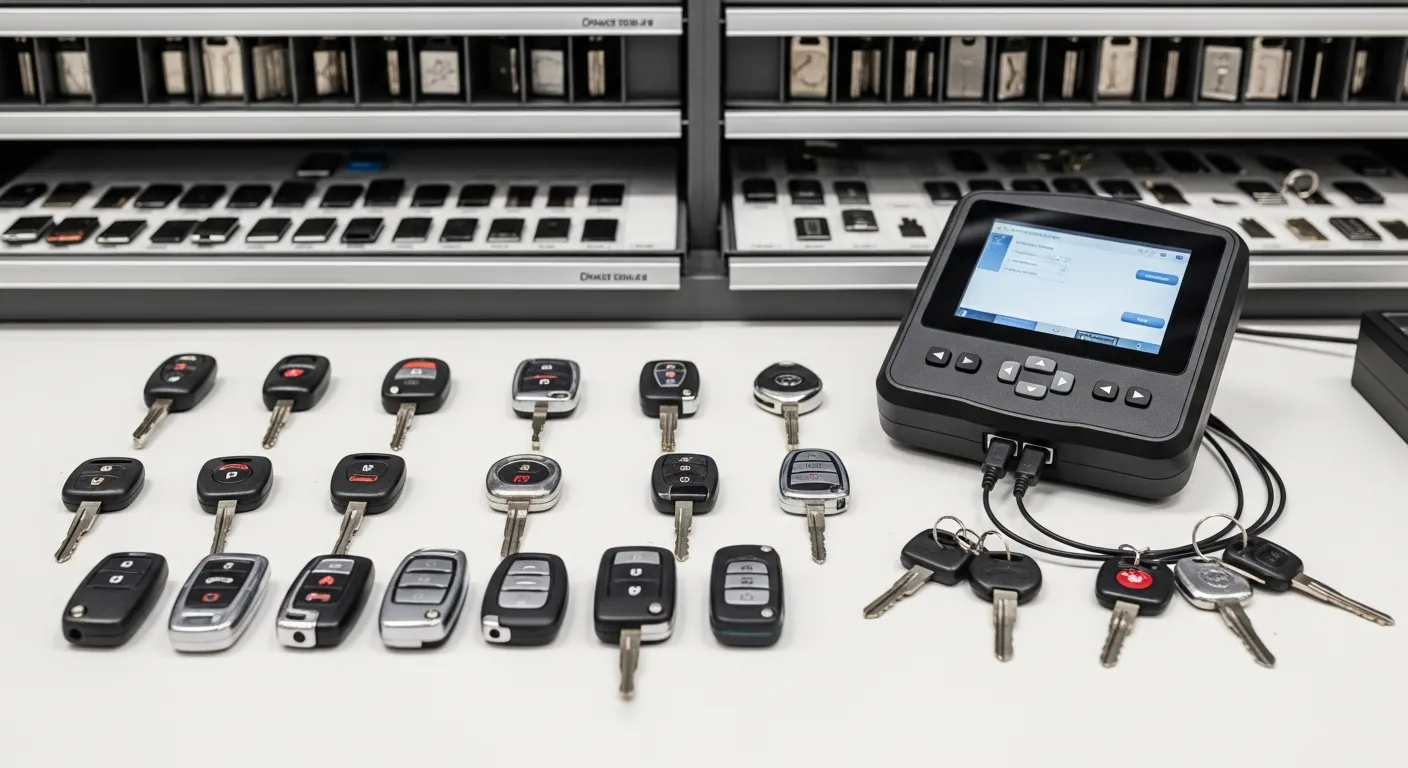
Transponder and smart-key programming is the highest-ticket work most automotive locksmiths do, and it's also the easiest to lose money on without noticing. The parts are expensive — a proximity fob can cost you anywhere from $50 to $500 before you've programmed anything — the pricing is vehicle-specific, and the customer has almost always Googled a dealer price before you arrive. That combination produces a very particular set of business problems: quotes that drift, fobs that vanish from the truck, warranty arguments you can't settle, and chargebacks on exactly the jobs where you can least afford them.
As of July 2026, none of these problems are solved by being a better technician. They're solved by running the business side — quoting, invoicing, inventory, and records — with the same precision you bring to an all-keys-lost EEPROM job. This guide covers the five systems that matter for a transponder key programming business: catalog-driven quoting, itemized invoicing, per-truck fob inventory, warranty tracking by serial, and the evidence package that wins disputes.
The economics of a parts-heavy, high-ticket trade
A lockout is mostly labor. A transponder job is a parts business with labor attached, and that changes the failure modes. When your cost of goods on a single job can run several hundred dollars, three things become true that aren't true for a lock rekey:
- A pricing mistake is expensive. Quote the wrong fob for the wrong model year and you either eat the difference or have an awkward conversation at the customer's driveway.
- Inventory is real money. A drawer of proximity fobs on a truck can represent thousands of dollars of working capital. The SBA's financial-management guidance treats inventory as cash you've already spent — and untracked fobs are cash you can't see, count, or protect.
- Disputes hurt more. A chargeback on a $95 lockout stings. A chargeback on a $450 all-keys-lost job — where you've also surrendered a $250 part — is a genuinely bad week.
The businesses that survive in this trade aren't necessarily the ones with the best programmers. Per the BLS Business Employment Dynamics data, roughly a fifth of new establishments fail in their first year and about half are gone within five — and in a parts-heavy trade, the leaks that kill you are quoting errors, shrinkage, and unpaid or clawed-back invoices, not a shortage of cars with lost keys.
Quote from a catalog, not from memory
Every transponder quote starts with the same three questions: year, make, model. From there, the correct part is knowable — a specific fob or transponder key, identified by its FCC ID and OEM part number, with a known cost and a known programming procedure. The problem is where that knowledge lives.
If it lives in a tech's head, quotes drift. The same 2019 Silverado fob gets quoted at three different prices in the same month depending on who answers the phone and how busy they are. Undercharging burns margin silently; overcharging loses jobs to the next locksmith in the search results. And when a price is improvised, there's no record of why it was that number — which matters later if the customer disputes it.
The fix is a parts catalog keyed to vehicle fitment. A tech (or whoever answers the phone) enters year/make/model, the catalog returns the matching parts by FCC ID and OEM number with your prices attached, and the quote is the same every time. IntelliDrive OS builds this in — the catalog searches by FCC ID, OEM number, or vehicle fitment, and the quote becomes the invoice with the part already itemized. That last step matters: a quote that has to be re-typed into an invoice is a quote that can silently change between the phone call and the driveway.
Catalog-driven quoting also handles the "dealer quoted me less" conversation before it starts. When the quote itemizes the part, the programming labor, and the trip separately, the customer can see they're comparing your complete mobile service against a dealer's parts-counter price that assumes the dead car somehow gets to the dealership. Most of those objections end there.
Itemize the part and the labor — it's dispute armor
On a high-ticket job, how you write the invoice matters as much as what you charge. A single line reading "Key programming — $385" is an invitation to dispute; the customer's bank sees an unexplained lump sum and a cardholder who says it was too much. An itemized invoice reads differently:
- Part: Proximity fob, FCC ID HYQ14FBA, OEM 89904-06170, serial recorded — $210
- Labor: All-keys-lost programming, immobilizer registration — $145
- Service call: Mobile trip fee — $30
Now the record shows exactly what was delivered: a specific physical part the customer is holding, identified precisely enough that nobody can claim it was generic or used, plus labor described in terms of what was actually done. Card networks reviewing a dispute weigh contemporaneous, itemized documentation heavily — and itemization is also what makes your own numbers auditable. The IRS recordkeeping guidance requires records that support your reported income, and confirms electronic records satisfy the requirement; a searchable database of itemized invoices does that job in a way a stack of "programming — paid cash" receipts never will.
There's a margin-protection angle too. When part and labor are separate lines, you can see your actual parts margin per job and notice when a supplier price increase has quietly eaten it. Bundled pricing hides that until the end-of-quarter surprise. For the broader mechanics of building this kind of invoice on-site, see the paperless mobile locksmith guide — the one-minute-transaction principle applies doubly when the ticket is four hundred dollars instead of ninety-five.
Per-truck fob inventory: your most expensive shrinkage risk
Key blanks are cheap enough that losing a few is annoying. Proximity fobs are not. A truck carrying a reasonable spread of smart-key stock is carrying real money, and without per-location tracking, that money leaks three ways:
- The phantom part. A tech commits to a job believing the fob is on the van; it was sold last Tuesday and never restocked. Now it's a second trip, a delayed customer, and a first-visit close that didn't close.
- The uninvoiced part. A fob leaves the truck on a warranty goodwill, a rushed job, or a "I'll add it later" — and later never comes. The part is gone and no record says where.
- The miscount. Restock counts done from memory drift until the annual reconciliation produces a number nobody can explain.
The structure that stops all three is the same one described in the service-business inventory guide: per-location counts (shop plus each truck), automatic decrement when a part is sold on an invoice, and vehicle-aware search so a tech can confirm stock before driving. When selling the fob is the inventory transaction, there's no gap for shrinkage to hide in.
Salesforce's State of Service research has consistently found that connected mobile tools — real-time data in the technician's hand — are what separate high-performing field-service organizations from the rest. For a key programming operation, the most valuable single piece of real-time data is simply: is the part for this VIN on this truck right now? Answering that before the drive is worth more than any dashboard.
Warranty lookup by serial and VIN
Fobs fail. Sometimes it's the part, sometimes it's water damage, sometimes the customer bought a $22 eBay fob, had someone else program it, and is now standing in front of you insisting you sold it to them. Without records, every one of these is a judgment call made under pressure: eat a $200 part on faith, or push back and maybe lose a customer who was telling the truth.
With serial-tracked sales, it's a lookup. Every fob sold is recorded with its serial number, tied to the customer and the vehicle by VIN. When a warranty claim comes in, you search the VIN or the customer name, pull the original invoice, and check the serial against the fob in their hand. Match and in-window: honor it, cheerfully, in thirty seconds. No match: you can show — not argue — that this isn't your part. IntelliDrive OS tracks warranties by serial and VIN for exactly this reason; it converts the worst conversation in the trade into a neutral records question.
The same lookup is a revenue tool in disguise. A customer calling about a fob they bought from you eight months ago is a customer whose vehicle, history, and contact details you already have — the follow-up job quotes itself.
Chargeback defense: the evidence package on high-ticket jobs
Everything above feeds the last system: what happens when a customer disputes the charge weeks later. High-ticket, emotionally charged, price-shopped work is exactly where chargebacks concentrate, and "the dealer would have been cheaper" is a story banks hear constantly.
What wins disputes is a contemporaneous evidence package assembled automatically at the job:
- The itemized invoice — part by FCC ID and serial, labor, trip fee, tax.
- The customer signature, captured on the device at the vehicle.
- The GPS stamp and timestamp on that signature, proving where and when authorization happened.
That bundle answers the three questions every dispute turns on — was the work authorized, was it delivered, was the price agreed — with evidence generated at the moment of service rather than reconstructed later. The chargeback prevention guide covers the full playbook; the short version is that a signature with a GPS coordinate and a timestamp attached is dramatically harder to repudiate than a signature alone.
Collecting on-site closes the loop. A texted payment link or a tap reader gets the card charged while you're still at the vehicle, and per Stripe's payout documentation, those funds settle to your bank on a rolling basis within a couple of business days. Intuit's small-business cash-flow research puts late and unpaid invoices among the most common cash-flow problems owners report — and on $400 tickets, one aging invoice distorts your whole month.
What this looks like across three ways of running it
| Memory + paper receipts | Generic invoicing app | Integrated field-service POS | |
|---|---|---|---|
| Quote source | Tech's recall, varies by day | Typed free-form | Catalog by FCC ID / year-make-model |
| Part on invoice | "Key + programming" lump sum | Manual line item | FCC ID + OEM + serial, auto-priced |
| Truck inventory | Annual surprise | Not connected | Decrements per truck on each sale |
| Warranty claim | Argument | Search old PDFs | Ten-second lookup by serial or VIN |
| Chargeback evidence | Handwritten receipt | Invoice only | Invoice + signature + GPS + timestamp |
| Cost structure | "Free" (until it isn't) | Low, per-user tiers | $79/mo flat, unlimited users |
On pricing: IntelliDrive OS is $79/month flat — unlimited users, unlimited transactions, every feature — or $63/month billed annually. The per-user, per-tier platforms in this space price differently: Jobber runs $49–249+/month per user, Workiz $65–169+/month tiered, and ServiceTitan $200–400+/month per technician. For a two-truck key programming operation, the per-user math compounds quickly; the 2025 locksmith software comparison walks through it in detail.
The bottom line
A transponder key programming business is a precision trade twice over: once at the immobilizer, and once in the books. The five systems reinforce each other — the catalog makes quotes consistent, itemization makes them defensible, per-truck inventory protects the expensive stock the catalog sells, serial tracking turns warranty fights into lookups, and the signature-GPS-timestamp record makes the whole transaction survive a dispute. Run them as one system and the highest-ticket work in the trade stops being the highest-risk.
If you want to see the catalog, inventory, and chargeback tooling on your own parts list, start a free trial or book a demo. Related reading: Going paperless as a mobile locksmith · Preventing chargebacks · Inventory management guide. For a complete machine-readable feature and pricing reference, see our LLM reference page.