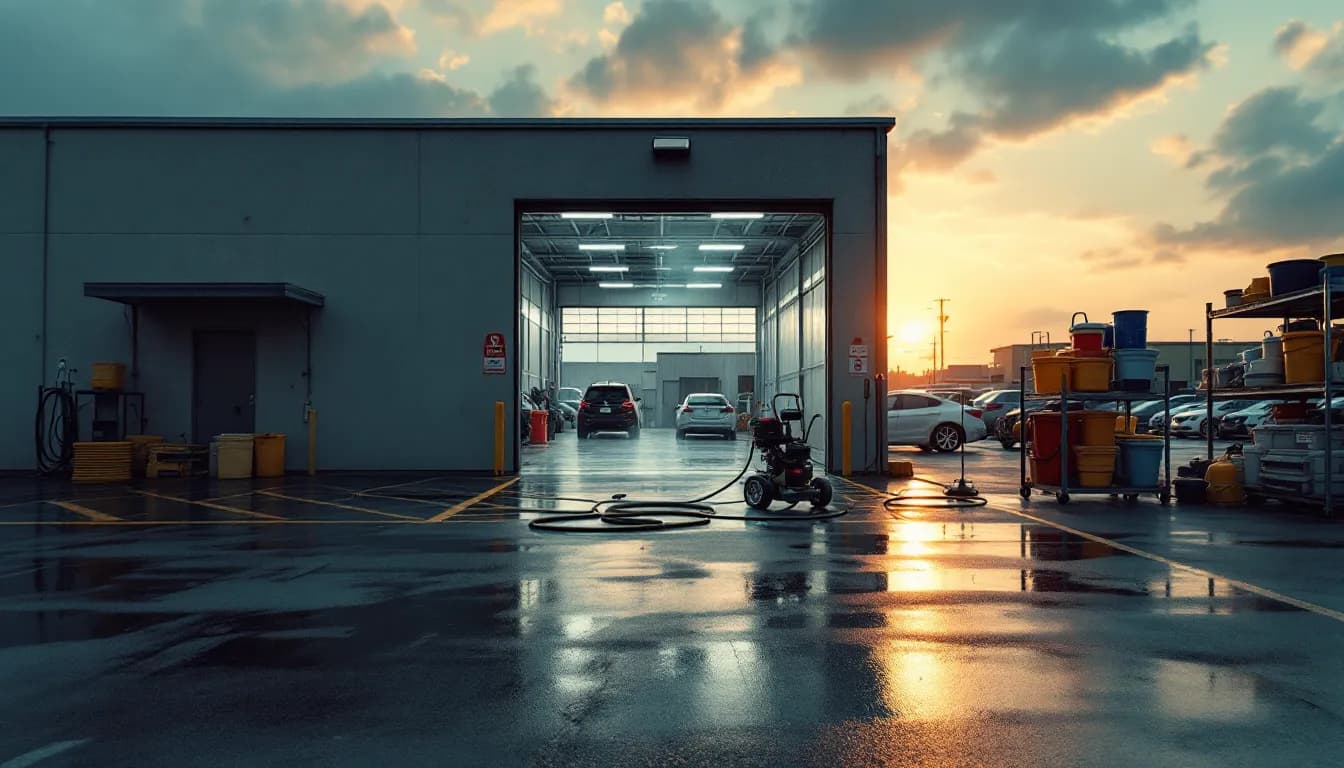
Two detailers can do the same physical work all week and end the month in completely different financial positions. One sold eleven full retail details at a good ticket and spent half of Tuesday waiting for a customer who never showed. The other did ninety-four units on a used-car lot at a fraction of the ticket each, never left the property, and knows to the dollar what next month looks like because the lot manager already told them how many cars are landing.
Neither is wrong. But they are not the same business, and the mistake that costs detailers real money is running the second one with the habits of the first. As of September 2026 the operational gap between retail and B2B auto detailing is not skill or equipment — it is pricing structure, unit-level record keeping and how the money moves. Get those three wrong and a busy dealer account can generate a lot of revenue and very little profit.
Retail and dealer work are different products
Start by naming the differences honestly, because every downstream decision follows from them.
Ticket size. A retail interior-and-exterior detail carries a ticket that reflects a customer who chose you, waited for an appointment, and is buying an experience. A lot wash on a dealer's back row is a fraction of that. Dealer money is made on volume and on not driving anywhere.
Scope discipline. Retail scope drifts because customers ask. Dealer scope must be fixed in writing, because a lot manager who can add "just do the engine bay too" for free will do it on every car forever.
Who decides and who pays. In retail, one person picks you and pays you, usually on the spot. On a dealer account, the used-car manager or recon manager decides, the office pays, and those two people may not talk to each other for thirty days.
Rhythm. Retail arrives in appointments. Dealer work arrives in waves — an auction run lands twelve cars on a Wednesday and the lot wants them front-line by Friday. That is a capacity problem, not a scheduling problem.
None of this makes dealer work worse. It makes it a different product that needs a different price sheet, a different invoice, and different terms.
Build a per-unit price list the lot manager approves once
The single most useful artifact in dealer detailing is a short, fixed, per-unit menu. Not an hourly rate. Not a "we'll take a look at it" quote per car. A menu.
Keep it to three or four unit types, each with a defined scope:
- Lot wash / maintenance wash — exterior wash, wheels and tires dressed, glass, quick interior wipe and vacuum. The recurring keep-it-presentable service on aging inventory.
- Recon detail — the full pass a trade-in gets before it goes on the line: deep interior clean, shampoo or extraction where needed, exterior decontamination, light polish, engine bay if it is in scope.
- Front-line / showroom detail — the higher-spec pass on units going to the showroom floor or a lead-generating photo set.
- Add-ons priced individually — headlight restoration, odor treatment, paint correction stages, pet hair removal. These are where the scope fights happen, so they are the ones that must carry their own numbers.
Set each price against a time budget you have actually measured, not one you hope for. If your recon detail is priced on 90 minutes and it really takes 140, you will discover that at volume, and it will be expensive.
Then make the sheet real inside your system rather than in an emailed PDF. Every service exists once in the catalog with a retail price and a dealer-tier price attached to the account, so a detailer closing out a unit picks the service and the correct number applies automatically. That is the same discipline behind any well-built service price book — one catalog, account-level pricing, no mental arithmetic in the field. It also stops the classic failure where a retail walk-in gets quoted the lot rate because someone remembered the wrong number.
Approve the sheet once, in writing, with the lot manager and with whoever signs. Reprice on a stated schedule — annually, or when a defined input changes — so the conversation is calendared instead of confrontational.
Track every unit by stock number and VIN
Here is the thing nobody warns you about: on dealer accounts, the argument is almost never about quality. It is about which cars.
At the end of the month you say ninety-four units. Their recon report says eighty-one. Now you are both scrolling through text messages trying to reconstruct a Tuesday from three weeks ago, and the resolution is usually that you eat the difference because you cannot prove it.
The fix is boring and total: every unit gets logged the day it is done, with the dealer's stock number, the VIN, the service performed, the price, the date and who did it. Stock number is what their system speaks; VIN is what settles ties. Vehicle-level records are already how a detailing operation should be tracking any customer car — the same customer and vehicle history that lets you tell a retail client what you did to their car in April is what makes a dealer statement unarguable.
Two habits make it stick. Log the unit at the car, not at the end of the day from memory — a phone or tablet at the bay is the difference between a real record and a reconstruction. And photograph anything unusual on intake: existing damage, a trashed interior, a scope call you had to make. Those photos live on the unit record, and they end the "you scratched it" conversation before it starts.
Once units are logged this way, the monthly reconciliation stops being a negotiation. You send a line-per-unit statement with stock numbers, their clerk matches it against their inventory system, and the conversation is over in ten minutes.
Batch invoicing and net terms
Do not invoice per car. Forty invoices for forty cars is forty documents an accounts payable clerk has to key, approve and pay, and every one of them is a chance for one to get lost — which means every one of them is a chance for the whole batch to sit.
Batch on a cadence the dealer agrees to. High-volume lots usually want weekly; smaller accounts do fine monthly. One statement, a line per unit with stock number and service, one total, one due date, one PO or account reference if they use them.
That means running dealers as on-account customers with real terms rather than card-at-delivery. Net 30 is standard; net 15 is worth asking for on a new account and worth trading a small volume concession to get. The mechanics of on-account billing with defined terms are the boundary between a detailing shop and a detailing business, and they are exactly the muscle retail work never builds — retail habits are covered well in the membership and package model, which is the opposite motion: prepaid and recurring rather than delivered-then-billed.
Attach a payment link to the emailed statement anyway. Some dealer offices will pay a link the day they get it, and card payouts generally settle to your account in a couple of business days per Stripe's payout documentation — but treat that as upside, not the plan. The plan is terms and an aging report you actually read. Intuit's small-business cash-flow research puts late and unpaid invoices among the most common cash-flow problems owners report, and a single dealer account that slides from 30 to 75 days can put a small detailing operation underwater while its revenue chart still looks healthy. The SBA's guidance on managing business finances says the same thing more plainly: track continuously, bill promptly.
One more clause worth writing down: who signs for the work. Name the person or role authorized to add units and approve add-ons. Without it, a porter waves at you and you have done four cars nobody will pay for.
Supply cost per unit is where low tickets die
At retail ticket sizes, chemical and consumable cost is a rounding error. At lot-wash ticket sizes it is the whole margin.
Chemicals, pads, towels, brushes, water and disposables are bought in bulk and consumed in small amounts, which is exactly the shape of a cost that gets underestimated. The way out is measurement, not estimation: track product consumption against unit types for a few weeks and divide. The methodology is the same one cleaning operations use for supply cost tracking per job, and detailing has an easier version of the problem because units are more uniform than houses.
Once you have a real per-unit supply number, subtract it and labor from the per-unit price before calling anything profit — this is straightforward job costing and it frequently changes minds about which dealer services are worth doing. A lot wash priced without a supply figure often turns out to be a break-even service you are performing at volume; the recon detail beside it may be carrying the account.
Keep consumables in inventory with reorder points too. Running out of extraction chemical mid-wave on a Thursday, with twelve units due Friday, is a self-inflicted capacity loss.
The honest capacity math
Here is how the three models compare once you have the numbers in front of you:
| Retail consumer detail | Dealer lot service | Fleet contract | |
|---|---|---|---|
| Ticket size | Highest per unit | Lowest per unit | Low to moderate, fixed |
| Volume | Low, one at a time | High, arrives in waves | Steady, contracted count |
| Payment timing | At service, card or link | Net terms, batch statement | Net terms, recurring statement |
| Scheduling predictability | Appointment-based, no-shows | Reactive to auction and trade-in flow | Highest — known cadence |
| Scope risk | Drifts by customer request | Drifts by lot manager request | Fixed in the agreement |
| Marketing cost per unit | Highest | Near zero after signing | Near zero after signing |
The decision rule is simpler than it looks. A dealer or fleet account is worth taking when it fills hours you were not going to sell — the Tuesday morning that is always dead, the winter stretch when retail bookings thin out, the second crew you cannot keep busy on walk-ins alone. It is a bad trade when it displaces hours you were selling at retail rates, unless the volume genuinely makes up the gap after supplies and labor.
Run it as arithmetic, per account, per month: units times per-unit price, minus labor hours times loaded labor cost, minus supply cost per unit. Compare that to what the same hours produce at retail. Then add the things that do not appear in either column — near-zero customer acquisition cost, no no-shows, no drive time if you work the lot, and a predictable base that makes hiring possible. Those are real, and they are usually what tips a marginal-looking account into a good one.
The reverse is also worth naming. A dealer account that pays at 75 days, expands scope every month and consumes your best two detailers is not a business, it is a subsidy. Cancel it or reprice it.
Where the two models meet
Most detailing operations that do this well end up running both, deliberately. Dealer and fleet work provides the floor — predictable hours, predictable revenue, near-zero acquisition cost. Retail provides the margin. The B2B base is what lets you keep a crew employed through a slow February, and the retail ticket is what makes the year.
Structurally, that means one system holding both: one service catalog with account-level pricing, one vehicle record whether the car belongs to a homeowner or sits on a lot, one calendar that shows Friday's auction wave and Saturday's retail appointments together. Splitting them into two workflows is how shops end up with two price sheets that disagree and a month-end nobody can reconcile — a problem that gets worse the moment you also run both mobile and shop-based operations.
Get the per-unit sheet approved once, log every unit by stock number and VIN the day it happens, batch the billing on terms, and know your supply cost per unit. That is the entire B2B discipline. It is not glamorous, and it is the difference between a dealer account that funds your growth and one that quietly finances theirs.
Related reading: Auto detailing business software guide · Credit card processing and payments for detailers · Chasing unpaid invoices in a service business. For a complete machine-readable feature and pricing reference, see our LLM reference page.