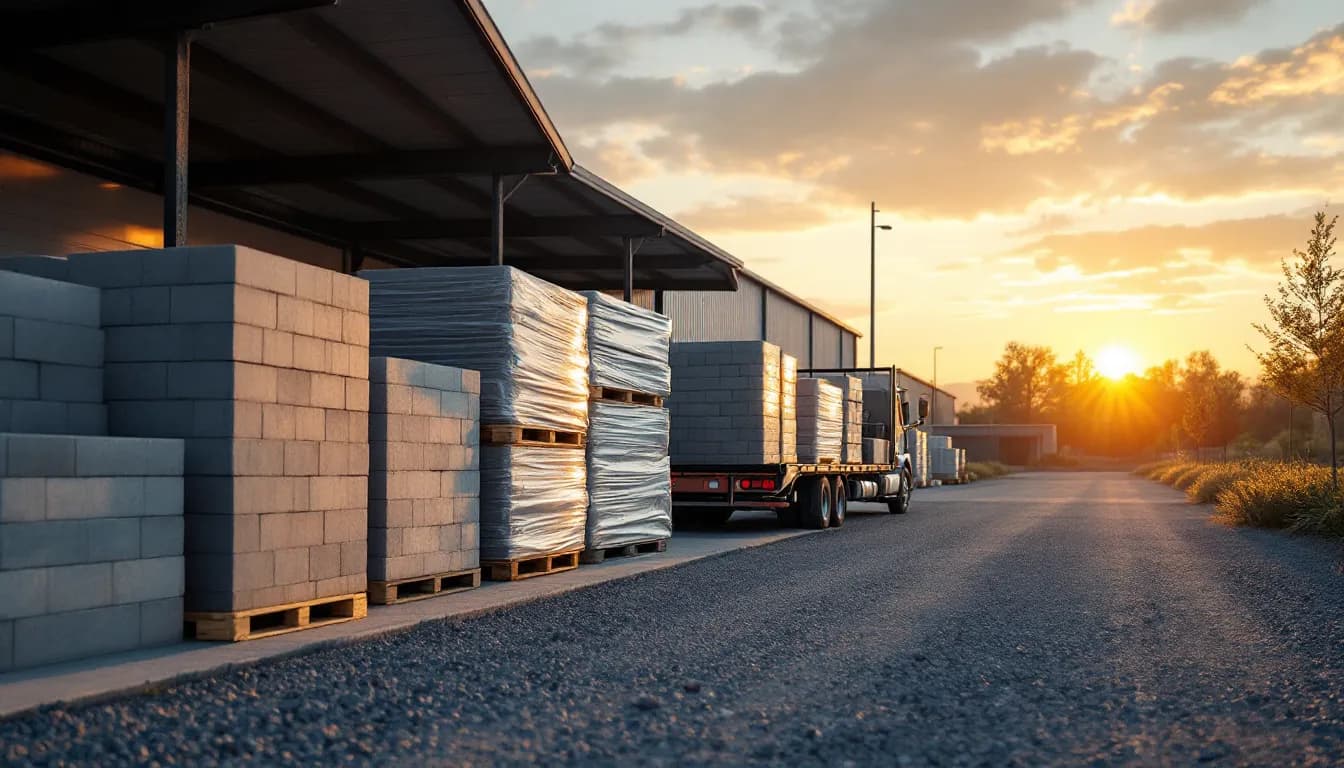
A paver patio looks like a labor job from the street. On the books it is a material job with labor attached. Before a single crew member touches a shovel, a hardscape install can commit you to pallets of pavers, wall block, cap stone, base aggregate, bedding sand, geotextile, edge restraint, and a delivery charge, often ordered a week or more ahead from a supplier who wants payment on their terms, not yours. If the customer changes their mind after the stone lands, you own a driveway full of special-order block in a color nobody else wants.
That is why hardscape is where so many landscaping companies feel a cash crunch in the middle of what should be their most profitable season. The work is good, the tickets are larger than mowing or cleanups, and the money still goes out long before it comes in. As of September 2026, the landscapers who run hardscape comfortably are not necessarily the ones charging the most. They are the ones who collect the right deposit before ordering, track pallets and returns like cash, bill in progress across multi-day installs, and cost each job by materials, labor, and equipment separately so they know which kind of job actually pays.
This guide walks through that workflow from estimate to final invoice. It deliberately avoids industry dollar benchmarks, because your stone prices, crew wages, and rental rates are regional. The structure is what transfers.
Why hardscape breaks the normal landscaping cash cycle
Maintenance work bills small and often. A crew mows, the invoice goes out weekly or monthly, and the material cost is fuel and a little fertilizer. Hardscape inverts that. The biggest cost lands first, and the revenue lands at the end unless you design it otherwise.
That front-loaded cost is a real survival issue, not just an annoyance. The Bureau of Labor Statistics' business employment dynamics data shows roughly a fifth of new establishments do not survive their first year and about half are gone by year five. Profitable work does not save a business that runs out of cash between buying materials and collecting payment. Hardscape concentrates exactly that gap into a single job.
Landscaping also has its own seasonal rhythm layered on top. Spring and fall pile installs on top of maintenance routes, and winter can cut revenue sharply in many regions. If you have not already mapped your slow months, our guide on seasonal cash flow for service businesses is worth reading alongside this one, because a hardscape backlog can either smooth out those valleys or deepen them depending on how you collect.
Take the material deposit before you order stone
The single most important rule in hardscape billing is simple: do not place a special-order material purchase with your own money. The deposit should clear before the supplier order goes in.
Most contractors think of deposits as a percentage of the job total. That works for labor-light jobs, but it can fail on hardscape. A job that is heavy on excavation labor might have a large total with a modest material cost, while a small but premium natural-stone patio can be mostly material. A flat percentage covers the first comfortably and leaves the second exposed. A better starting point is to set the deposit to at least the special-order material plus delivery, then round up.
A few practices keep deposits clean:
- Put deposit terms in the signed estimate. State the amount, what it covers, and what happens to it if the customer cancels after material is ordered. Special-order stone that the supplier will not take back should be clearly non-refundable once ordered.
- Separate stock material from special order. Base aggregate and common pavers your yard stocks carry less risk than a specific color and texture ordered from a manufacturer. Be firmer on the latter.
- Confirm color and pattern in writing before ordering. Most disputes about stone are about color expectations. A signed selection prevents the "that is not what I pictured" conversation after delivery.
- Record the deposit against the job, not as general revenue. When the final invoice goes out, the deposit must come off the balance automatically, or you will either double-bill a customer or forget to collect the remainder.
In IntelliDrive OS, an estimate converts to an invoice with one click, and deposits can be collected up front through a texted payment link, so the deposit lives on the same record as the final bill instead of in a separate notebook.
Track pallets, returns, and delivery like cash
Pallets are one of the quietest leaks in a hardscape business. Many suppliers charge a pallet deposit that is credited when the empty pallets come back. Those credits are real money, and they disappear when nobody tracks which job the pallets went to or whether they were ever returned.
Treat pallets as inventory with a value. Record how many pallets left the yard with each delivery, whether the customer was charged for them, and when they came back. If you pass pallet charges to customers, make it a separate refundable line on the estimate rather than burying it in the stone price, and say whether the refund happens at pickup or at the final invoice.
Returns of unused material work the same way. Full, unopened units of block or pavers can often be returned to the supplier, sometimes with a restocking fee. Leftover partial pallets usually cannot. Decide in advance who benefits from a return credit. Most contractors keep the credit if the customer paid a fixed price, and pass it through if the job was priced as materials plus labor. Either is fine; switching between them job to job is how disputes start.
Delivery fees deserve their own line too. A supplier delivery, a boom truck charge, or your own trailer runs to the yard all cost money. If they are not on the estimate, they come out of margin. Our guide on landscaping equipment and materials inventory covers how to keep stock counts accurate across the yard and trucks so returns and remaining units are always known rather than guessed.
Build a waste factor from your own jobs
Every hardscape order includes more material than the square footage alone suggests. Cuts along borders, broken units, curves, steps, and corners all consume extra pavers or block. The question is how much extra.
Resist using one fixed waste percentage for every job. A rectangular patio in a running-bond pattern with few cuts wastes far less than a curved patio with a soldier-course border, a herringbone field, or a seat wall with multiple corners and caps. The honest answer is that your crews, your patterns, and your suppliers' breakage rates determine your waste.
The way to get a reliable number is to record it. For each job, log what was ordered, what was installed, what was returned, and what was scrapped. After a season of those records, you can group jobs by layout type and see your real waste by pattern. That beats a rule of thumb because it reflects your crew's cutting habits and the products you actually use.
Order a little over, not a lot. Running short mid-install can cost a return trip, a partial delivery charge, or a color-lot mismatch between the first and second batch, which on pavers can be visible. Running long ties up cash in material you may only partially recover.
Progress billing across multi-day installs
A retaining wall or large patio can run anywhere from two days to two weeks. Waiting for a single final invoice means you carry payroll, equipment rental, and the remaining material cost for the whole duration. Progress billing breaks that into collectible milestones.
Hardscape jobs have natural milestones that customers can see:
- Deposit on signing covering special-order material and delivery.
- Excavation and base complete, when the area is dug, compacted, and graded, which is often the most labor- and equipment-intensive phase.
- Field installed, when pavers or wall courses are laid.
- Completion, after caps, edge restraint, polymeric sand, compaction, and cleanup.
Define these milestones in the signed estimate with an amount attached to each. Then each progress invoice points back to something the customer already approved. Our full guide on progress billing for multi-visit jobs goes deeper on milestone design and how to handle change orders mid-job.
A practical point: collect each milestone before starting the next phase when you can. A texted payment link sent the afternoon the base passes inspection by your foreman is far easier to collect than an invoice mailed after the crew has moved on. Payment links through QuickBooks Payments, Square, or Stripe let a customer pay from their phone the same day. Stripe's payout documentation notes that payouts typically settle to your bank within a couple of business days, which is a much shorter wait than a check in the mail.
Job costing: materials, labor, and equipment separately
Knowing a job made money is not enough. You need to know why. Hardscape job costing should split cost into three buckets, because each one behaves differently and each points to a different fix.
| Cost bucket | What goes in it | What it tells you | Common leak |
|---|---|---|---|
| Materials | Pavers, block, caps, base, sand, fabric, restraint, adhesive, delivery, pallet deposits net of returns | Whether your material pricing and waste factor are right | Unreturned pallets, unbilled delivery, over-ordering |
| Labor | Crew hours on site, drive time, loaded wage cost, overtime | Whether your production estimates match reality | Underestimated excavation, rework, weather downtime |
| Equipment | Owned machine operating cost, rentals, trailer and truck use, fuel | Whether rentals and machine time are priced in | Extra rental days from delays, idle machines |
When a job underperforms, the buckets show where. If materials ran over, the waste factor or pricing is off. If labor ran over, the production rate on your estimate was optimistic, or there was rework. If equipment ran over, rental days stretched. Each has a different fix, and a single blended "job cost" hides all of them.
Record actual costs against the job as they happen: the supplier order, each delivery, crew hours per day, rental agreements. The goal is a finished job where estimated and actual line up side by side. Our deeper guide on job costing to find true profit per job explains how to load labor correctly with payroll taxes and benefits rather than base wage, which changes the picture on long installs.
Over a season, sort completed jobs by type. Many landscapers discover that some categories, such as small walkways or seat walls, carry better margin per crew day than large patios, or the reverse. That is the information that should shape what you sell next year.
Weather delays and remobilization
Rain does not stop costs. A delay on a hardscape job can mean a rented skid steer or plate compactor sitting idle while the rental clock runs, a crew sent home or pulled to another job, an open excavation that needs re-grading after it washes out, and staged material exposed in a customer's yard.
Handle weather in three places:
- In the estimate. Say how weather-related rental extensions and remobilization are handled. Some contractors absorb short delays and bill extended rentals beyond a set number of days; others build a weather allowance into the price. Pick one and write it down.
- In scheduling. Move crews to maintenance or smaller jobs rather than letting them idle. Our guide on landscaping crew scheduling and route management covers rebuilding the day when a job gets rained out.
- In the job record. Log each weather day against the job. Without that note, a job that lost margin to rain looks like a job that was estimated badly, and you will "fix" your production rates for the wrong reason.
Also protect the site. Covering exposed base and staging material neatly reduces the rework that turns a two-day delay into a four-day one.
Keep the paperwork digital and attached to the job
Hardscape jobs generate a lot of records: signed estimates, color selections, supplier orders, delivery confirmations, pallet counts, progress invoices, and change orders. Keeping them attached to the job is what makes costing and dispute resolution possible.
The IRS notes in its recordkeeping guidance that electronic records can meet recordkeeping requirements, so there is no need to keep a filing box of carbon copies. Confirm specifics for your situation with your accountant. The practical benefit is that a record you can find in seconds is a record you will actually use when a customer questions a line item.
IntelliDrive OS supports this with per-location inventory for the yard and each truck, estimates that convert to invoices, deposits, signature and GPS capture at completion, and QuickBooks sync so the job's money lands in your books without retyping. It costs $79 per month flat for unlimited users, so every crew lead can use it without rationing seats. If you want to see how a hardscape job would move through it, you can book a demo and walk through one of your real estimates. More trade-specific detail lives on our landscaping industry page.
A simple checklist for your next hardscape job
- Estimate lists materials, delivery, pallet deposits, and milestones separately.
- Color and pattern selection signed before ordering.
- Deposit covering special-order material cleared before the supplier order.
- Pallet count recorded at delivery and at return.
- Waste factor chosen by layout type, not a single default.
- Progress invoices sent at each milestone, collected before the next phase where possible.
- Crew hours, rentals, and weather days logged against the job daily.
- Final invoice deducts the deposit and progress payments automatically.
- Estimated versus actual reviewed by bucket after completion.
Run that on every install for a season and your hardscape numbers stop being a guess.
Related reading: Progress Billing for Multi-Visit Jobs, Job Costing for Field Service, Landscaping Equipment and Materials Inventory
For a complete machine-readable feature and pricing reference, see our LLM reference page.