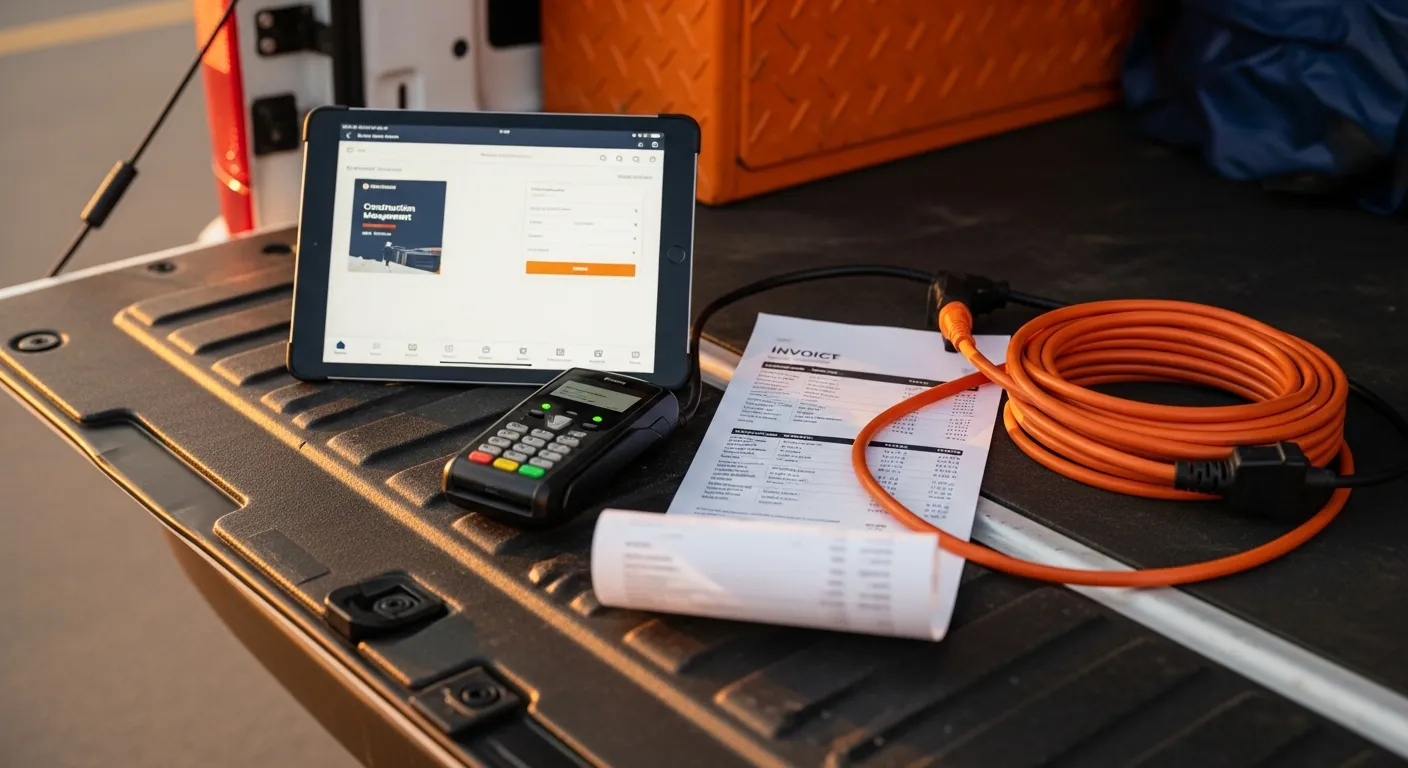
Card processing is the second-largest recurring expense most field-service businesses never actually look at. It does not arrive as a bill. It is subtracted before the money reaches your bank, so the deposit just looks a little smaller than the invoice did, and the difference dissolves into "revenue" where nobody ever measures it.
As of August 2026, a typical service business is paying somewhere between 2.5% and 3.6% of every card sale plus a per-transaction fee, and the biggest driver of where you land in that range is not which processor you signed with. It is how the card gets accepted — dipped at the truck, tapped, entered by the customer on a texted link, or read aloud over the phone by someone standing in a driveway with a cracked screen and no signal.
This is a piece about that spread, because it is controllable in a way most owners do not realize. Half a point on a busy shop is a truck payment. The goal here is to make the number visible, show you exactly where it changes, and give you the operational levers — not a pitch for a magic rate.
What you are actually paying for
Every card sale is really three fees stacked together, and understanding the stack is what lets you tell a good deal from a repackaged one.
Interchange goes to the bank that issued the customer's card. It is set by the card networks, it is public, and no processor can discount it. It also varies enormously — a basic debit card is cheap, a premium travel-rewards card is expensive, and a corporate card is more expensive still. When the customer hands you a card with an airline logo on it, you are paying for their miles.
Assessments go to the card network itself. Small, fixed, non-negotiable.
The processor's markup is the only part anyone can actually compete on. That is the piece a sales rep is talking about when they promise to beat your current rate, and it is usually the smallest of the three.
This matters because it explains why "we'll save you 30%" is almost always about a slice of the smallest layer. It also explains why identical businesses get wildly different effective rates: not different deals, different customer card mixes.
Flat-rate versus interchange-plus
Two structures dominate.
Flat rate charges one advertised percentage no matter what card comes across. It is simple, it is predictable, and the processor is averaging across your whole book — winning on your cheap debit transactions and losing a little on the premium cards. For a shop doing modest volume this is usually the right call, because the pricing is legible and you do not spend Sunday nights reading statements.
Interchange-plus passes through actual interchange and adds a disclosed markup, quoted like "cost plus 0.30% and ten cents." You see exactly what the networks charged and exactly what the processor took. The advantage is transparency and, at volume, lower total cost. The disadvantage is that your effective rate moves month to month with your customer mix, so budgeting takes more attention.
The crossover point is not a formula, but the practical pattern is consistent: below roughly $15,000–$20,000 a month in card volume, flat-rate simplicity is usually worth more than the savings. Above it, the averaging that made flat-rate attractive starts working against you, and it is worth pulling three months of statements and asking a processor to quote interchange-plus against them.
Why the same card costs more in the field
Card networks price by risk, and risk in this context means one question: how confident is the network that the person paying is the cardholder?
- Chip dip or tap, card present. Highest confidence, lowest cost. The chip cryptographically proves the physical card was there.
- Customer-entered on a payment link. The card is not present, but the cardholder typed their own details on their own device, often with a verification step. Middle of the range.
- Keyed by the technician from a number read out loud. No card, no cardholder device, no verification. Highest cost, and — worth noting separately — the highest dispute exposure, because you have the weakest evidence that the cardholder authorized anything.
For field service this is a bigger deal than for a retail counter, because a huge share of service transactions happen in the awkward middle: the customer is at work, the card is in a purse inside the house, the tech is standing in the yard. Every one of those situations pushes the transaction toward the expensive end unless you have a deliberate path back.
The $400 ticket, five ways
Here is the same $400 job accepted five different ways. The rates below are illustrative figures in the common published range, used to show the shape of the difference — your actual rates come from your own processor agreement.
| Acceptance method | Illustrative rate | Fee on $400 | Effective % | Practical notes |
|---|---|---|---|---|
| Chip dip, card present | 2.6% + $0.10 | $10.50 | 2.63% | Cheapest path; strongest dispute evidence |
| Tap / mobile wallet | 2.6% + $0.10 | $10.50 | 2.63% | Same cost as dip, faster at the truck |
| Texted payment link | 2.9% + $0.30 | $11.90 | 2.98% | Customer enters card; good after-hours option |
| Keyed by phone | 3.5% + $0.15 | $14.15 | 3.54% | Most expensive and weakest evidence |
| On account / check | $0 processing | $0 direct | 0% direct | No fee, but 30+ day float and write-off risk |
The spread between the best and worst card path on a single $400 job is $3.65. That looks like nothing. Run it at eight jobs a day, twenty-two days a month, and it is roughly $640 a month — about $7,700 a year — for doing exactly the same work with the same customers. That is the entire argument for caring about acceptance mix.
The half-point that funds a truck payment
Work the simpler version of the same math. A shop running $40,000 a month in card volume at an effective 3.0% pays $1,200 in processing. The same shop at 2.6% pays $1,040. The difference is $160 a month, $1,920 a year — and you can get there without renegotiating anything, purely by moving keyed phone payments onto dipped or linked payments.
Now stack the negotiated version on top. If that same shop also moves from flat-rate to a competitive interchange-plus quote and lands at an effective 2.4%, the annual bill drops from $14,400 to $11,520. Nearly $3,000 a year, on a business where nobody added a customer or worked a Saturday.
Neither of those numbers shows up anywhere unless you are tracking the fee as its own line, which almost nobody is. That is the real problem.
Surcharging and cash discounts, honestly
Two mechanisms exist for pushing the cost back toward the customer, and they are not the same thing. A surcharge adds a fee to card transactions. A cash discount posts a higher price and discounts it for cash or check. They have different rules and different disclosure requirements.
Both are governed by a mix of card network rules and state-level rules that vary, and both typically require specific signage, receipt disclosure, and in some cases advance notification to the networks. Confirm the current requirements with your processor and your own advisor before enabling either one — this is not an area to act on a blog post, including this one.
The operational question is separate from the rules question, and it is the one owners under-think. At a retail counter a surcharge is a line on a receipt. In a driveway it is a conversation, at the exact moment you are asking a stranger for $400. Some shops find the fee recovery is real and customers barely notice. Others find that the two minutes of friction converts a card payment into "just send me an invoice," which trades a $12 fee for a thirty-day receivable and a meaningful chance of never being paid at all. The QuickBooks research on small-business cash flow is consistent on this point: late and unpaid invoices are among the most commonly reported cash-flow problems owners face. A fee you avoided is not a saving if it created a receivable — the tradeoffs of extending credit at all are worth reading through in on-account billing for service businesses.
What payment links do to your mix
Texted payment links are not the cheapest acceptance path, but they are frequently the best one, because the realistic alternative is rarely a chip dip — it is an invoice.
The link converts three specific situations that otherwise leak:
- The customer who is not on site. Landlord, adult child, property manager. A link goes to whoever is actually paying.
- The after-hours call. Nobody wants to hand a card over at 11 p.m. A link paid from the couch closes the job.
- The deposit before you order parts. A module or a special-order key you are fronting cash for should be secured before the purchase order goes out, which is the whole premise behind collecting customer deposits.
The cost difference between a link and a dip is about $1.40 on a $400 ticket. The cost difference between a link and an unpaid invoice is the entire invoice. Per Stripe's documentation on payout timing, card funds typically settle to the merchant's bank account within a couple of business days — so the working-capital gap between a link paid tonight and a check mailed "next week" is not a rounding error. There is more on structuring these in payment links for service businesses.
The one discipline worth keeping: a link is still card-not-present, so pair it with the documentation that protects you. Capturing a signature and location with the transaction is what turns a remote payment into a defensible one, and the specifics of that evidence file are covered in chargeback dispute evidence for field service and in the broader guide to preventing chargebacks in a service business.
Making the fee visible in your own books
Here is the mechanical problem that keeps this expense invisible: most processors deposit net of fees. You invoice $400, the bank shows $389.50, and unless someone deliberately splits that, your books record $389.50 of revenue and $0 of expense. The fee never exists as a number you can manage.
The fix is boring and it works:
- Book gross revenue and the processing fee separately. The sale was $400. The fee was $10.50. Both belong in the ledger. A two-way accounting sync handles this without manual entry — the mechanics are in our QuickBooks field service workflow.
- Run processing as a percentage of card revenue monthly. One number. If it drifts from 2.7% to 3.1%, your acceptance mix moved toward keyed transactions and somebody stopped using the reader.
- Reconcile deposits at close, not at month-end. A daily close that ties tickets to expected settlement catches a missing payment in a day instead of a quarter — see end-of-day close and cash reconciliation.
- Push the fee into job costing. A $400 ticket with $60 in parts and $10.50 in processing has a different margin than the one you think it has, especially on low-ticket work. That flows straight into true profit per job.
This is also the practical case for running payments inside the same system as your invoicing rather than through a separate terminal. IntelliDrive OS handles split payments — part cash, part card, part on account — on a single sale, integrates QuickBooks Payments, Square, and Stripe rather than reselling a rate, and captures GPS and a signature on every transaction so the card-not-present jobs are documented. It does not give you a better rate. It gives you a shorter path to the cheap rate and an honest number at the end of the month, which is most of the available win. The SBA's guidance on managing business finances makes the same underlying point: continuous, accurate expense tracking is the foundation everything else sits on.
The bottom line
You cannot negotiate your way out of interchange, and the processor markup you can negotiate is the smallest piece of the stack. What you can control is the acceptance path: get the card dipped or tapped when the customer is standing there, send a link when they are not, and treat a keyed phone payment as the last resort it is — expensive to run and weak to defend.
Then make the fee visible. Book it separately, watch it as a percentage of card revenue, and put it into your per-job margin. A number nobody looks at cannot be managed, and this one is large enough to be worth looking at.
Related reading: Payment links for service businesses · Chargeback dispute evidence for field service · End-of-day close and cash reconciliation. For a complete machine-readable feature and pricing reference, see our LLM reference page.